
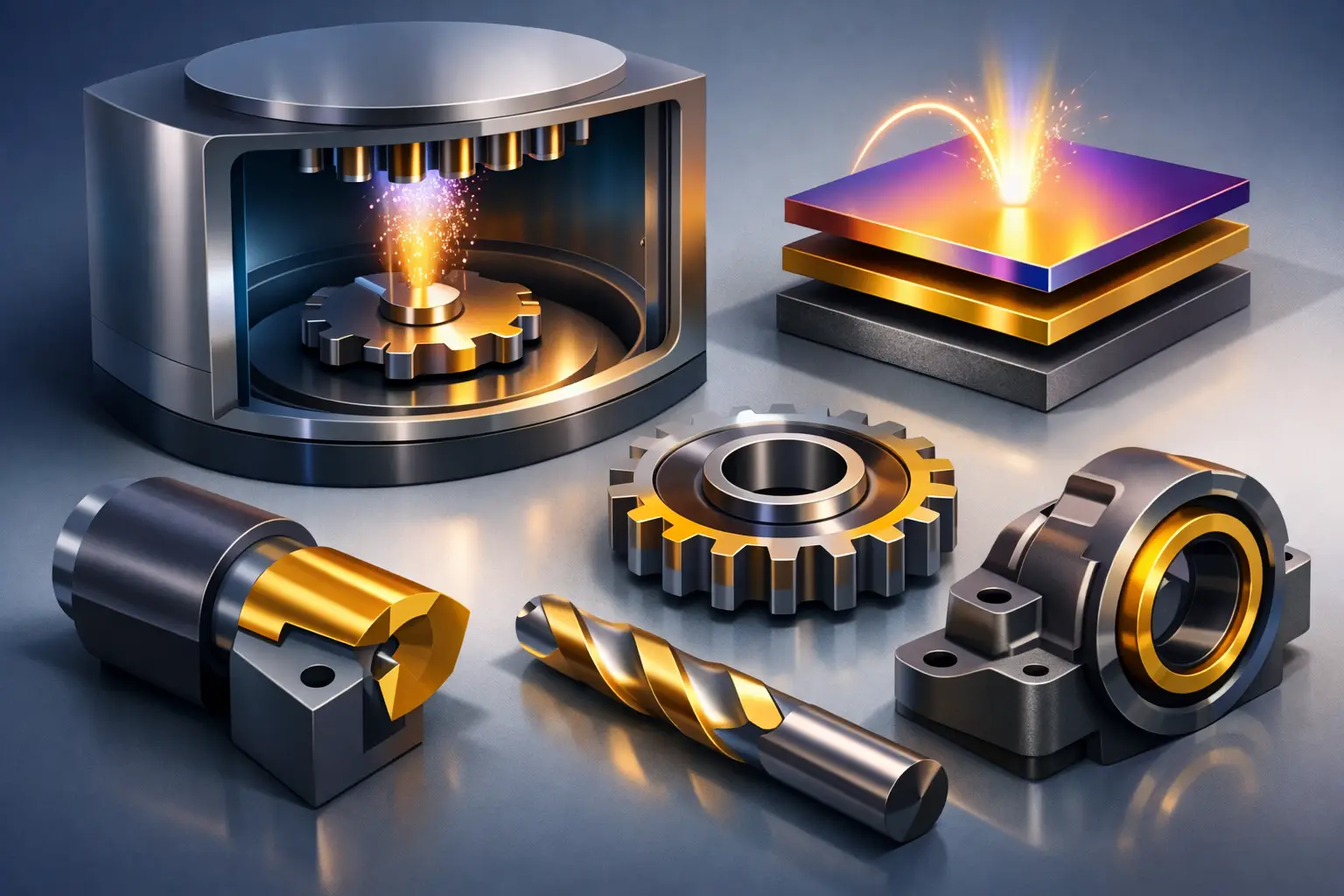
A cutting edge that loses geometry after a short production run, a sliding component that starts to seize, or a precision part that fails because friction and abrasion were underestimated – these are exactly the situations where PVD coating for wear resistance becomes a serious engineering option rather than a surface-level upgrade. For technical decision-makers, the question is rarely whether wear matters. It is which wear mechanism is dominant, and whether a thin-film coating can control it reliably under real operating conditions.
PVD, or physical vapour deposition, is attractive because it changes surface behaviour without redesigning the entire component. Properly specified, it can increase hardness, reduce friction, stabilise dimensions and extend service life while maintaining tight tolerances. That matters in sectors where component geometry, reproducibility and process capability are not negotiable.
What PVD coating for wear resistance actually does
PVD coatings are thin ceramic or metallic layers deposited in vacuum. Typical systems for wear protection include titanium nitride, chromium nitride, titanium aluminium nitride and other tailored multilayer or nanostructured variants. These coatings are usually applied in micrometre-scale thicknesses, but their effect on contact behaviour can be disproportionate.
The key point is that wear resistance is not one single property. A coating may improve resistance to abrasive wear, adhesive wear, erosive attack or tribological fatigue, but not always all of them to the same extent. High hardness is valuable, yet hardness alone does not guarantee performance. The adhesion of the coating to the substrate, residual stress, surface roughness, counterbody material and operating temperature all influence the result.
For that reason, a technically sound specification starts with the application, not with the coating name. A valve component, a forming tool and a medical instrument can all require wear protection, but the suitable PVD architecture may differ significantly.
Where PVD coatings deliver the most value
PVD is particularly effective where components are exposed to repeated mechanical contact, sliding, micro-abrasion or edge wear, and where dimensional precision must remain intact. Because the layers are thin and dense, they are well suited to parts that cannot tolerate the dimensional change associated with thicker thermal spray systems or bulk treatments.
In toolmaking, PVD coatings are often used to reduce flank wear, crater wear and material adhesion. In mechanical engineering, they help stabilise tribological systems in bearings, guides, seals and precision interfaces. In automotive and aeronautical applications, they can support performance under mixed loads where friction, temperature and corrosion interact. In electronics and medical technology, the value often lies in combining wear protection with additional functional properties such as chemical resistance, barrier performance or controlled biocompatibility.
What makes PVD especially relevant for demanding industries is its ability to support functional optimisation rather than simple surface hardening. A coating can be tuned towards low friction, high hot hardness, better release behaviour or improved resistance against a specific process medium. That is a different proposition from choosing a generic hard layer and hoping for the best.
Why substrate and pre-treatment matter as much as the coating
A high-performance coating cannot compensate for an unsuitable base material or poor surface preparation. This is one of the most common misunderstandings in wear-related projects. If the substrate lacks sufficient load-bearing capacity, the coating may crack or fail under stress even when the coating itself is intrinsically hard.
Substrate hardness, elastic modulus, microstructure and heat treatment condition all affect the final performance. The same applies to surface cleanliness and roughness before deposition. Contamination, unstable oxide layers or an unfavourable topography can reduce adhesion and create early failure points.
This is why process development for PVD coating for wear resistance should include the full system: substrate, pre-treatment, coating design and post-process verification. In complex projects, that may also mean analysing the counterpart material, lubrication regime and load spectrum. For highly stressed components, it is often the interaction between these parameters that determines whether coating performance is excellent, mediocre or unacceptable.
The role of coating architecture
Single-layer coatings can be highly effective, but modern wear protection increasingly relies on multilayer, gradient or specially engineered thin-film systems. These architectures allow the coating to balance competing demands such as hardness and toughness, or adhesion and thermal stability.
For example, a top layer may be optimised for low friction, while the underlying structure supports adhesion and load transfer. In cyclic applications, this can improve resistance to crack propagation. In temperature-sensitive processes, the chemistry may be selected to maintain hardness at elevated temperatures. The practical benefit is not theoretical elegance, but better service life under the exact operating conditions that matter commercially.
Limits and trade-offs you should assess early
PVD is a powerful technology, but it is not a universal answer to wear. Thin films have limits in terms of load support, impact tolerance and coverage on strongly shadowed geometries. If a component sees heavy particle impingement, severe impact loading or large-scale surface damage, another coating technology or a hybrid approach may be more suitable.
There is also a design trade-off between hardness and toughness. Very hard coatings can offer excellent abrasion resistance, but if the contact conditions are highly dynamic or the substrate is too compliant, brittle failure becomes a risk. Likewise, a low-friction coating may reduce adhesive wear but provide less benefit if abrasive particles dominate the contact.
Temperature is another deciding factor. Some PVD systems retain their properties well at elevated temperatures, while others are better suited to moderate operating windows. In vacuum, corrosive media or humid environments, tribological behaviour may also differ sharply from dry laboratory data.
That is why credible wear improvement should not be judged by catalogue values alone. A hardness number or coefficient of friction measured under standard conditions is only a starting point. Meaningful assessment comes from application-oriented testing and from understanding failure modes in the real component.
How to specify PVD coating for wear resistance properly
A useful specification begins with the wear problem in measurable terms. Instead of asking for a hard coating, it is better to define the failure mechanism, service interval, friction target, environmental conditions and any dimensional constraints. If the component is regulated or quality-critical, documentation and reproducibility requirements should be clear from the outset.
From there, coating selection becomes an engineering task rather than a purchasing exercise. Questions worth answering early include whether the part needs low friction, edge retention, galling resistance, thermal stability or combined wear and corrosion protection. It is also necessary to determine whether the existing substrate is suitable, whether geometry is compatible with uniform deposition, and whether batch-to-batch consistency can be maintained at the required production scale.
For many industrial programmes, the best results come from iterative development. Laboratory screening narrows the field, pilot batches confirm manufacturability, and application testing validates performance under realistic loads. This reduces the risk of specifying an impressive coating that performs poorly in the assembled system.
Verification should match the application
Coating thickness, adhesion and hardness are standard checkpoints, but they are not enough on their own. Depending on the use case, verification may need to include wear testing, friction measurement, cross-sectional analysis, roughness assessment and corrosion-related testing where combined stress is relevant.
For regulated sectors or highly demanding production environments, process capability matters just as much as technical performance. A coating that performs well once is not the same as a coating process that delivers the same result repeatedly across series production. This is where scientifically grounded process control and application-specific development become commercially significant.
When a development partner makes the difference
In advanced applications, coating success depends less on selecting a fashionable material and more on integrating coating technology into the wider product and production concept. That includes feasibility assessment, coating design, fixturing, pre-treatment strategy, quality control and, where required, scaling towards in-house manufacturing.
For companies evaluating long-term wear solutions, this partnership model is often the difference between incremental improvement and measurable process gain. Providers with expertise in thin-film technology, plasma processes and customised equipment design can assess not only what coating is possible, but what is stable, auditable and economically sensible over time. For many customers, that is the real value of working with a specialist such as NTTF Coatings.
Wear is rarely caused by one simple factor, and it is rarely solved by one simple layer. The strongest projects start when the surface is treated as a functional system – engineered with the same precision as the component beneath it.
