
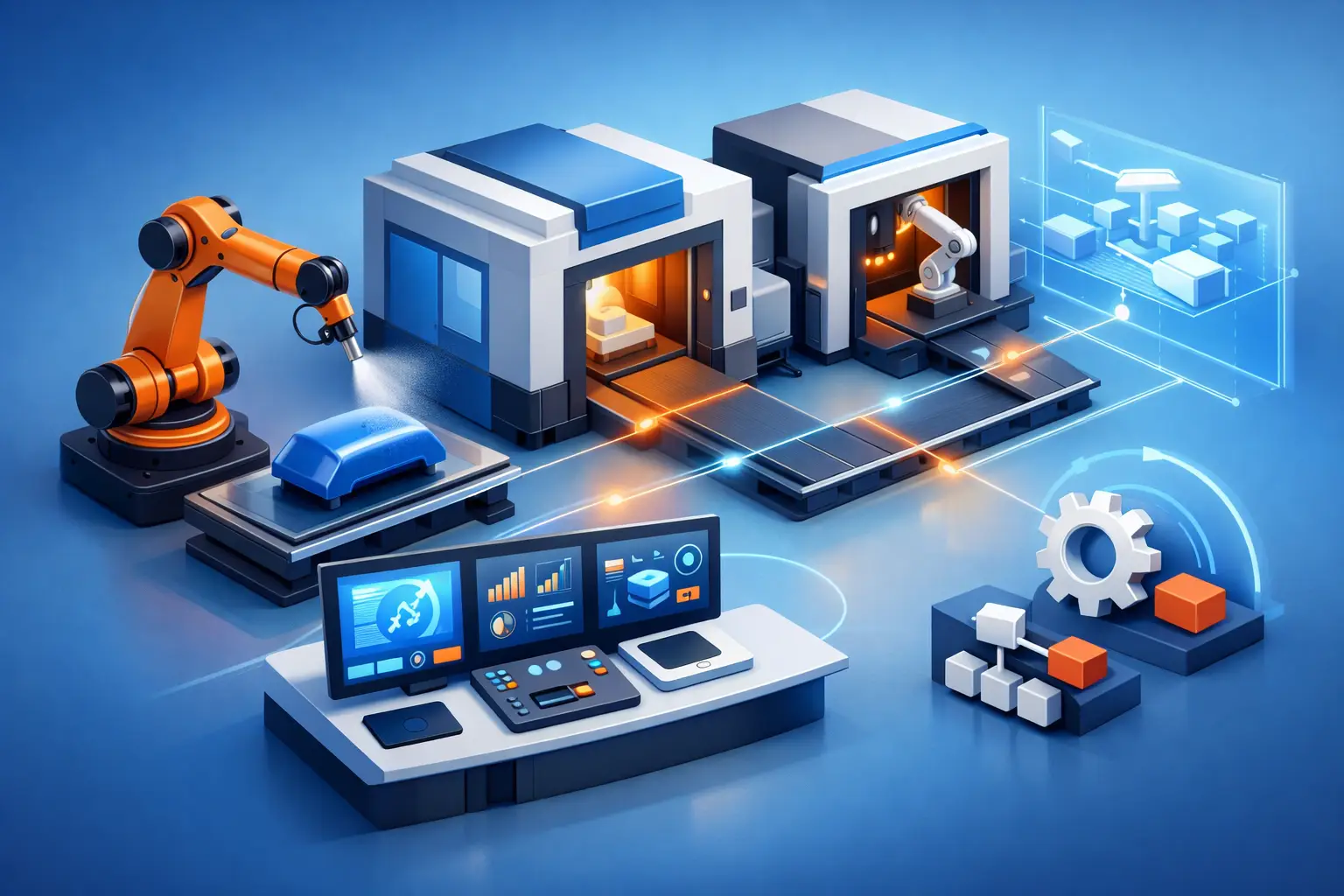
When a coating process moves from development into production, the main risk rarely sits in the coating chamber alone. It sits at the interfaces – between handling and deposition, between recipe and traceability, and between throughput targets and actual process stability. A sound coating equipment integration strategy addresses those interfaces early, before a technically strong coating process becomes a production bottleneck.
For manufacturers in medtech, electronics, automotive, aeronautics and other regulated or performance-critical sectors, integration is not a secondary engineering task. It defines whether a Parylene, plasma, PVD or CVD process can deliver reproducible quality under real operating conditions. The coating may be measured in microns or nanometres, but the integration challenge is often decided by material flow, fixture design, software architecture and validation logic.
Why coating equipment integration strategy matters
Many investment decisions still begin with the coating technology itself. That is understandable, but incomplete. The more relevant question is not only which process produces the required barrier, dielectric, tribological or biocompatible property. The real question is how that process will function inside the customer’s production environment over months and years.
A coating system that performs well in isolation may still fail commercially if loading times are excessive, substrate preparation is inconsistent, maintenance interrupts critical production windows, or quality data cannot be assigned cleanly to each batch. In high-value manufacturing, these weaknesses are expensive. They affect yield, qualification effort, delivery reliability and, in regulated markets, audit readiness.
That is why a coating equipment integration strategy should be treated as part of process development, not as a downstream implementation exercise. It links technical feasibility with industrial viability.
Start with the component, not the machine
The best integration projects begin with the component profile. Geometry, material mix, tolerances, cleanliness requirements, masking needs and target function all shape the correct equipment concept. A medical implant with demanding biocompatibility and documentation requirements calls for a different integration logic than an electronics assembly requiring dielectric protection at high volume.
This sounds obvious, yet many projects are constrained too early by a preferred machine format. In practice, that can lead to compromised fixture concepts, unnecessary manual handling or oversized systems with poor utilisation. A custom integration approach should instead work backwards from the part, the coating objective and the production environment.
In Parylene applications, for example, deposition uniformity and penetration into complex geometries may be central. In plasma or hybrid thin-film processes, the decisive factors may include surface activation windows, pretreatment stability or the interaction between vacuum process steps. The integration strategy must therefore reflect the full process chain, not just the deposition stage.
The four integration layers that decide project success
A reliable coating equipment integration strategy usually rests on four connected layers: process, mechanics, automation and quality assurance. Weakness in one layer tends to surface elsewhere.
Process integration
This layer defines how substrates enter, pass through and leave the coating step. It includes cleaning, drying, masking, fixturing, loading density, recipe selection, unloading and post-process inspection. The key issue is consistency. If the upstream process introduces variability in surface condition or component orientation, even a highly precise coating system will struggle to produce repeatable results.
Process integration also determines takt compatibility. Some coating technologies operate in batch logic, while the surrounding production may be designed around continuous flow. That mismatch is manageable, but only if buffer design, batch sizing and scheduling are addressed from the outset.
Mechanical integration
Mechanical integration covers interfaces to handling systems, footprint constraints, utilities, maintenance access and environmental control. In brownfield environments, this is often where ideal concepts meet reality. Ceiling height, media routing, vibration sensitivity or cleanroom zoning can force significant redesign.
It is rarely efficient to treat these constraints as a late-stage installation issue. A compact system may reduce floor space but create poor service access. A high-throughput layout may improve output but complicate operator ergonomics or contamination control. The correct answer depends on production priorities and available infrastructure.
Automation and data integration
In industrial practice, the coating process is only as useful as the data and control structure around it. Recipe management, user rights, batch tracking, alarm handling and communication with MES or ERP environments are part of the equipment concept, not optional extras.
For regulated sectors, the stakes are higher. Process parameters, batch histories and operator interventions may need to be documented in a way that supports qualification and audit trails. For high-volume industrial users, the focus may sit more strongly on OEE, remote diagnostics and maintenance planning. Both cases require deliberate architecture choices.
Quality integration
Quality assurance cannot sit solely at the end of the line. A coating process with demanding adhesion, thickness or functional performance targets needs in-process control points that reflect actual risk. That may involve witness samples, thickness verification, surface energy checks, vacuum monitoring, leak testing or SPC-based evaluation of recurring process signals.
The point is not to add measurement for its own sake. The point is to define where process capability must be proven and where deviations can be detected before they become scrap or field failures.
Common mistakes in coating equipment integration strategy
One recurring mistake is scaling a laboratory process directly into production without reassessing handling and repeatability. Lab success often depends on highly skilled operators and low part variability. Production does not. It demands stable fixtures, defined loading logic and controlled interfaces to upstream and downstream steps.
A second mistake is underestimating cleaning and preparation. In many coating applications, surface condition is the hidden driver of adhesion and long-term performance. If cleaning is treated as a separate procurement package, the integrated system may inherit avoidable variability.
A third mistake is specifying throughput too simplistically. Capacity is not only chamber volume or cycle time. It also depends on loading efficiency, maintenance intervals, rework rates and batch release logic. A smaller, well-integrated system can outperform a larger but poorly matched installation.
Customisation versus standardisation
Decision-makers often face a legitimate trade-off here. Standard platforms can shorten delivery times, simplify spare parts strategy and reduce initial project complexity. Customised systems, however, are often necessary when component geometry, regulatory requirements or process interactions exceed standard machine logic.
The right coating equipment integration strategy does not treat customisation as a prestige feature. It applies it where it creates measurable value – for example in substrate carriers, automation interfaces, chamber configuration, software permissions or contamination control. Elsewhere, standardised modules may be the more economical option.
For that reason, experienced partners typically combine proven subsystems with application-specific engineering. This reduces avoidable risk while preserving the process precision needed for demanding products.
Integration should be validated, not assumed
An equipment concept is only credible when its assumptions are tested. That usually means structured feasibility work, followed by pilot-scale trials and then staged industrial validation. The exact sequence depends on the market and application, but the principle remains constant: each integration decision should be linked to evidence.
For a medtech component, that evidence may focus on biocompatibility, particulate behaviour, traceability and process reproducibility. In electronics, it may focus more on dielectric strength, moisture barrier performance and throughput stability. In mechanical applications, wear reduction, friction behaviour or corrosion resistance may dominate. The equipment concept should reflect those priorities from the beginning.
This is where a development partner with coating expertise and machine-building capability brings a practical advantage. Instead of handing process definition to one supplier and system implementation to another, the project can be engineered around functional outcomes and validated interfaces.
What decision-makers should ask before investing
Before approving a coating line, it is worth asking a few precise questions. Where does process variability currently enter the chain? Which parameters actually predict coating performance? How will the system behave under maintenance, operator changeover and mixed product scenarios? And which elements of the installation must be fixed today, versus designed for later expansion?
Those questions often reveal whether the project is being specified as a machine purchase or as a production capability. The distinction matters. A machine can be installed quickly. A production-capable coating process requires tighter engineering discipline.
NTTF Coatings addresses this by combining application-specific process understanding with custom equipment design, which is often what complex industrial environments require.
A useful closing thought is this: the coating itself may be the visible value, but integration is what makes that value repeatable. If the interfaces are engineered with the same precision as the thin film, scale-up becomes far more predictable.
