
When a component fails because of stick-slip, adhesive wear or micro-seizure, the root cause is often not the base material alone but the behaviour of its surface under load. That is exactly where low friction DLC coating becomes relevant. For technical decision-makers, the question is rarely whether friction matters. The real question is which coating concept will reduce friction without creating new issues in adhesion, dimensional stability or process repeatability.
What low friction DLC coating actually does
DLC stands for diamond-like carbon, a family of amorphous carbon-based thin films with properties that can be tuned across a relatively wide range. In practice, a low friction DLC coating is selected when components must slide reliably, resist wear and maintain functional performance over long operating periods. Depending on the coating architecture and the counterpart material, DLC can achieve a very low coefficient of friction while also providing high hardness and good chemical resistance.
That combination is attractive because conventional design compromises are often uncomfortable. A lubricated metallic contact may offer acceptable friction, but lubrication can migrate, age or be incompatible with the application. A harder substrate may improve wear behaviour, yet remain vulnerable to galling. A polymer solution may reduce friction, but not survive the thermal, mechanical or regulatory boundary conditions. DLC addresses a different layer of the problem – literally at the surface, where contact mechanics decide service life.
The phrase itself can sound deceptively simple. There is no single universal DLC. Hydrogenated and hydrogen-free variants, metal-doped systems and multilayer structures differ significantly in friction behaviour, internal stress, hardness and environmental response. This matters because a coating that performs well in dry running at room temperature may behave differently under vacuum, elevated temperature, high humidity or in contact with aggressive media.
Why low friction DLC coating is used in industry
In industrial terms, friction is rarely an isolated KPI. It drives wear, heat generation, energy losses, noise and long-term drift in component behaviour. A low friction DLC coating is therefore typically specified to improve system-level performance rather than to optimise one laboratory value.
In medical technology, coated instruments and moving assemblies may require smooth actuation, reduced particulate generation and stable function over repeated cycles. In automotive and mechanical engineering, valve train elements, pump parts, shafts, guides and precision contacts often benefit from lower wear and reduced tendency to scuff. In electronics and fine mechanics, the thin-film nature of DLC is valuable where tolerances are tight and the coating must protect without fundamentally altering geometry.
The economic case is also straightforward. Lower friction can reduce energy input, but the more decisive gain is often longer life and more stable process capability. Less wear means fewer rejects, longer maintenance intervals and more predictable field performance. For heavily loaded or difficult-to-access components, that can justify the coating investment very quickly.
Low friction DLC coating is not a standard commodity
A common procurement mistake is to treat DLC as a generic specification. From an engineering perspective, that is risky. The performance of a low friction DLC coating depends on the interaction of substrate material, component geometry, pre-treatment, interlayer design, deposition method and the real operating environment.
Adhesion is a good example. High hardness alone does not help if the coating cannot survive the stresses generated during operation. Substrate preparation, cleaning quality, plasma activation and the transition layer between substrate and DLC all influence whether the system remains stable. For steels, titanium alloys, non-ferrous metals or polymers, the coating stack may need to be adapted considerably.
Counterpart pairing is equally important. Friction values published in datasheets are typically measured under defined test conditions. They are useful as orientation, but not as a direct prediction of field behaviour. A polished steel counterpart, a ceramic counterface and a rough mating part with embedded debris will interact very differently with the same DLC layer. Engineers assessing feasibility should therefore look beyond nominal friction coefficients and examine tribological pairing as a whole.
Where the limits and trade-offs sit
DLC is highly capable, but not universal. That nuance matters in serious development projects.
One trade-off concerns temperature. Many DLC systems perform extremely well within defined thermal windows, but friction and structural stability can change if those limits are exceeded. Another concerns contact pressure and impact loading. A very thin hard film can reduce adhesive wear effectively, yet poorly designed edge geometry or high local stresses may still trigger premature failure.
Environment also plays a role. Some DLC variants show excellent dry-running behaviour, while others interact strongly with humidity or specific lubricants. In some applications, the best result is not the lowest possible friction coefficient but the most stable friction behaviour over time. That distinction is important for control systems, actuators and precision assemblies where consistency matters more than a headline number.
There is also a manufacturing consideration. If the component has deep recesses, blind holes, sharp transitions or mixed functional zones, deposition uniformity must be assessed carefully. Thin-film technology is precise, but not indifferent to geometry. A coating strategy should therefore be aligned with both part design and fixture concept from the outset.
How low friction DLC coating is evaluated properly
A technically sound selection process starts with the application, not with the catalogue. The key questions are practical: what type of motion occurs, what loads are present, which counterpart is involved, what media are present and what failure mode must be prevented.
From there, coating evaluation should combine material analysis and application-near testing. Hardness, thickness, adhesion and surface roughness are essential baseline data. Tribological testing under representative loads and environmental conditions is then needed to distinguish promising systems from merely plausible ones. In demanding sectors, this is often followed by endurance trials on real components or pilot batches under serial production conditions.
For regulated industries and high-reliability applications, process capability is as important as coating performance. A low friction DLC coating that performs exceptionally in one trial but cannot be reproduced within narrow tolerances is not a reliable industrial solution. Stable deposition parameters, validated pre-treatment and traceable quality assurance are therefore not secondary issues. They are part of the coating’s technical value.
Integration into production requires more than coating know-how
Many projects reach a turning point once the coating itself has been selected. The next question is whether the process can be integrated economically and repeatably into the production environment.
For some manufacturers, external coating services remain the best route, especially for specialised parts, fluctuating volumes or early-stage industrialisation. For others, in-house capability becomes relevant when throughput, confidentiality, logistics or regulatory control justify a dedicated system. In that context, surface engineering and plant engineering should not be separated too strictly. The best technical outcome often comes from aligning coating design, substrate handling, fixturing, cleaning, plasma process steps and inspection strategy within one coherent process chain.
This is where an engineering-led partner adds measurable value. NTTF Coatings, for example, operates at the intersection of thin-film expertise, application-specific process development and custom equipment design. For customers with demanding friction and wear requirements, that integrated perspective can shorten development cycles and reduce the risk of transferring a promising laboratory result into an unstable production process.
Typical applications where DLC creates a measurable advantage
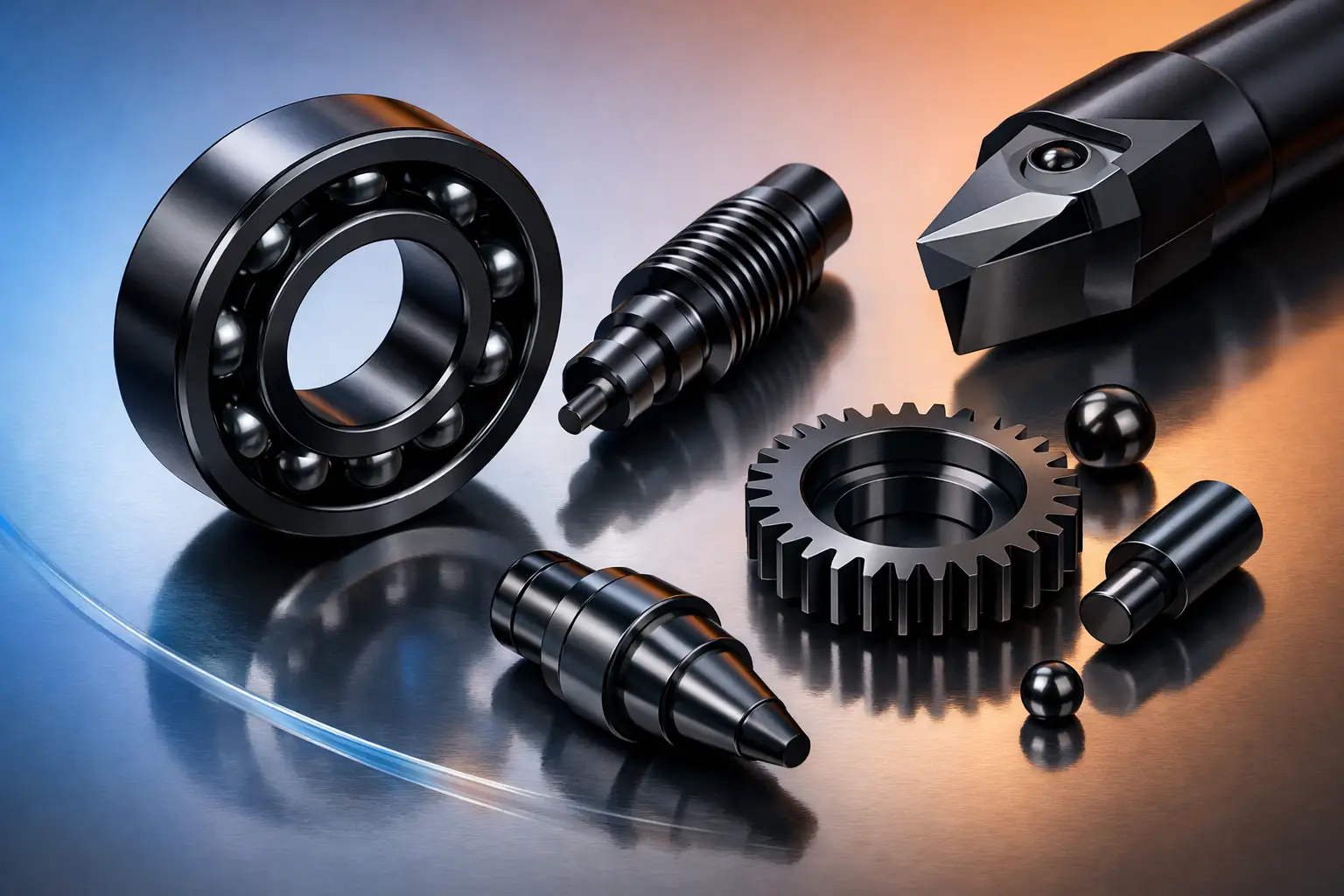
The strongest cases for low friction DLC coating tend to share a few characteristics. The component is usually exposed to sliding or mixed friction, lubricant reliability is limited or undesirable, and wear directly affects system performance. Precision bearings, valve elements, pump components, cutting and forming tools, medical instruments and miniature mechanical assemblies are typical examples.
In each of these cases, the coating is not acting alone. It works as part of a functional system that includes substrate choice, surface finish, geometry and operating regime. That is why successful projects often begin with a materials and design discussion rather than a request for a standard layer. If the coating requirement is framed too narrowly, important optimisation potential is missed.
A useful rule is this: the more demanding the application, the less sensible it is to specify DLC by name alone. What matters is the right low-friction surface system for the exact duty cycle, environment and manufacturing context.
For teams working on highly stressed or function-critical parts, that perspective usually leads to better decisions. Not every component needs DLC. But where friction, wear and reliability intersect at the surface, a well-engineered DLC solution can create a disproportionate gain in performance, durability and process stability. The worthwhile next step is not to ask whether DLC is good in general, but whether a precisely matched coating architecture will solve the specific problem your component is facing.
