
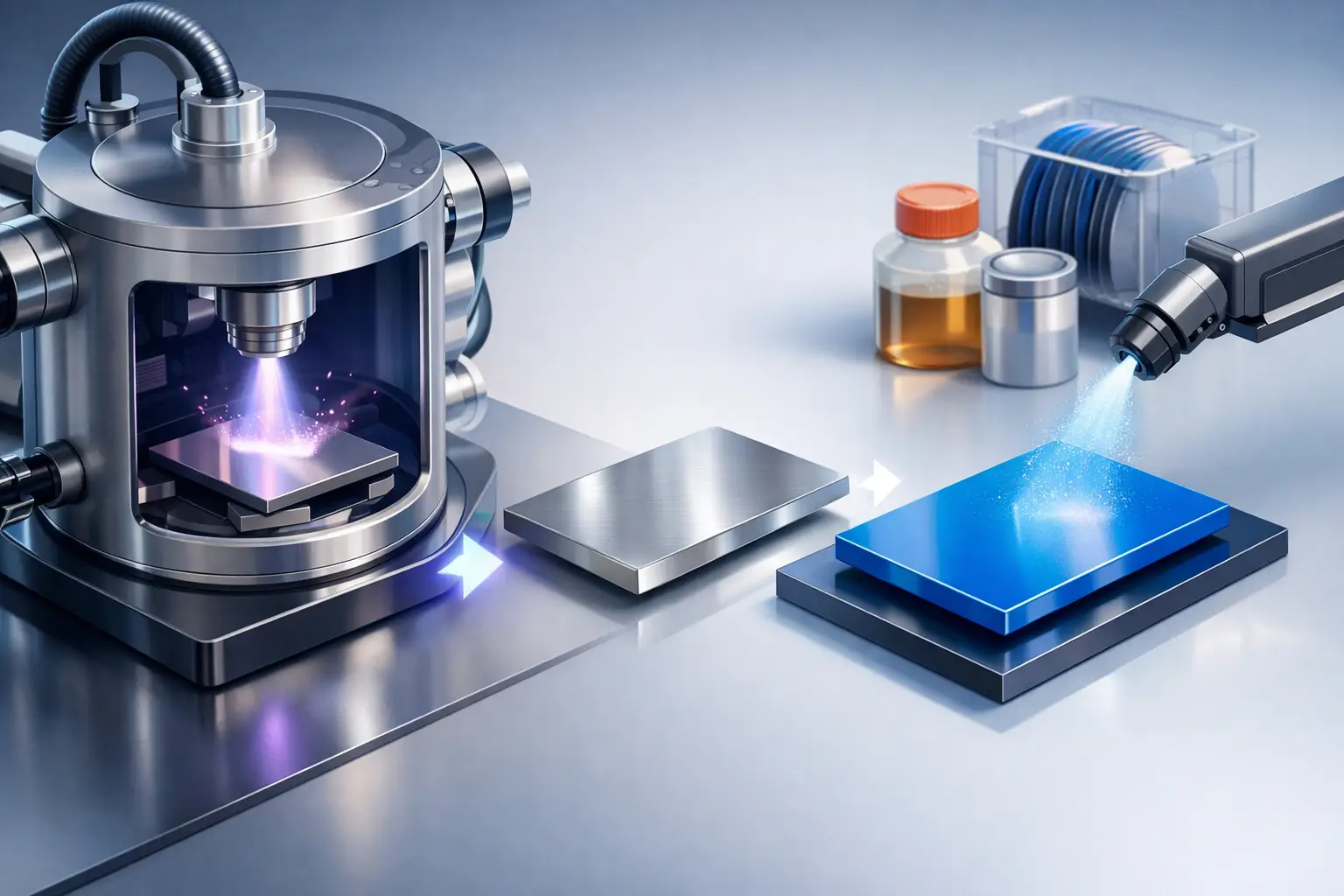
A coating can fail long before it enters service. In many cases, the weak point is not the coating chemistry itself, but the nanometre-thin layer of organic residue, adsorbed moisture or handling contamination left on the surface. That is why plasma cleaning before coating is often a decisive process step in high-performance applications where adhesion, reproducibility and long-term stability are non-negotiable.
For technical decision-makers, the question is rarely whether cleaning matters. The real question is whether conventional cleaning is sufficient, or whether a plasma-based pretreatment delivers measurable advantages for the substrate, coating system and production environment in question. The answer depends on material class, contamination profile, component geometry and the functional demands placed on the finished part.
What plasma cleaning before coating actually does
Plasma cleaning is not simply another washing step. It is a surface-activation and decontamination process in which a low-pressure or atmospheric plasma interacts with the outermost molecular layers of a component. Depending on gas composition and process settings, the plasma can remove organic residues, reduce weak boundary layers, alter surface energy and create chemically active sites that support subsequent coating adhesion.
This effect is especially relevant where standard wet chemistry reaches its limits. Solvent cleaning may remove visible contamination, but trace hydrocarbons, release agents or process films can still remain. These residues are often enough to impair nucleation, reduce wetting or create local adhesion defects. Plasma addresses precisely this near-surface zone – typically without attacking the bulk material when the process is correctly designed.
In practice, plasma cleaning before coating can serve several functions at once. It can clean, activate and condition the surface for the next process step. That combination is one reason it is widely used ahead of Parylene deposition, PVD and CVD processes, adhesive bonding and other thin-film applications where interface quality determines product performance.
Why adhesion problems often start at the interface
In industrial coating projects, adhesion is often discussed as if it were a property of the coating alone. Technically, that is too narrow. Adhesion emerges from the interaction between substrate, surface condition, pretreatment, coating chemistry and process sequence. If the interface is inconsistent, even a highly developed coating system can behave unpredictably.
A typical example is the difference between nominally identical parts from two suppliers. The base material may be specified the same way, yet one batch carries machining oil residues, another has higher oxide loading, and a third has been packed in a way that promotes moisture uptake. Without a pretreatment step that equalises the surface condition, coating outcomes can drift even when all downstream parameters remain unchanged.
Plasma is valuable here because it creates a more defined starting point. For regulated sectors such as medical technology, electronics or aerospace-related applications, that improvement in reproducibility is often as important as the absolute increase in adhesion itself.
Where plasma cleaning is particularly useful
Plasma cleaning before coating is especially effective for components with complex geometries, sensitive materials or demanding cleanliness requirements. Fine structures, internal contours and delicate assemblies can be difficult to treat uniformly with abrasive or aggressive wet-cleaning methods. Plasma offers a dry and controlled alternative with high penetration into accessible surface regions.
It is commonly selected for polymers, elastomers, metals, ceramics and hybrid material systems. On polymers, the process often increases surface energy and improves wettability. On metals, it can remove organic contamination and support more stable film formation. On mixed-material assemblies, it can help establish a more consistent interfacial condition across different surface chemistries.
That said, plasma is not universally the first answer. Heavy particulate contamination, thick grease layers or corrosion products generally need to be removed beforehand by suitable upstream cleaning. Plasma is highly effective in the final conditioning of the surface, but it is not a substitute for every cleaning challenge.
Plasma cleaning before coating in real production settings
In development trials, plasma treatment often looks straightforward. In production, the picture is more nuanced. The relevant question is not only whether plasma improves adhesion in principle, but whether it does so reliably within cycle-time, traceability and cost targets.
This is where process design matters. Treatment time, chamber pressure, power input, gas type, fixture concept and the interval between cleaning and coating all influence the result. If activated surfaces are stored too long or exposed again to ambient contamination, the gain can partially decay. For some substrates, the timing between pretreatment and coating must therefore be tightly controlled.
The same applies to component handling. Gloves, packaging materials and transport trays can all reintroduce contamination after cleaning. In well-engineered lines, plasma is not viewed as a standalone step, but as part of an integrated surface preparation strategy that includes incoming part condition, fixturing, transfer and coating sequence.
Low-pressure or atmospheric plasma?
Both approaches can be effective, but they serve different industrial needs. Low-pressure plasma offers high process control, homogeneous treatment conditions and very good suitability for demanding thin-film applications. It is often the preferred route where reproducibility, documentation and precise parameter control are priorities.
Atmospheric plasma can be attractive for inline integration and localised treatment. It is often used where components are large, throughput is high or only selected areas require activation. However, the treatment window may be narrower depending on geometry, line speed and the consistency of the component presentation.
Choosing between the two is therefore not a matter of hierarchy, but of fit. For sophisticated coating systems with strict performance requirements, the decision should be based on substrate behaviour, cleanliness targets and the overall production architecture rather than on equipment preference alone.
How to assess whether plasma pretreatment is justified
The business case for plasma cleaning before coating should not be reduced to equipment cost or added process time. The more relevant measure is the total effect on yield, field reliability and qualification effort. If pretreatment reduces adhesion failures, rework, batch variability or premature product failure, its value extends well beyond the cleaning station.
A structured assessment usually starts with a few practical questions. What contamination is actually present on the part? Which failure mode is being addressed – poor wetting, delamination, pinhole formation, inconsistent film growth or something else? Is the substrate stable under plasma exposure, and which gas chemistry supports the intended effect without causing unwanted surface damage?
Surface analytics and application-specific testing are decisive at this stage. Contact angle data can be useful, but it is rarely sufficient on its own. Adhesion testing, ageing studies, microscopy and, where relevant, electrical or biocompatibility assessments are needed to confirm that the pretreatment improves the final component function rather than just producing a better-looking laboratory result.
Typical limits and trade-offs
Plasma treatment is precise, but precision does not eliminate trade-offs. Highly reactive surfaces can age after activation. Some polymers may show surface reorientation over time, reducing the benefit if coating is delayed. Certain materials can also be overtreated, leading to embrittlement, unwanted etching or changes in appearance.
There is also the question of throughput. For high-volume manufacturing, the treatment step must align with takt time and maintenance planning. Gas consumption, chamber loading strategy and cleaning validation all affect the economic picture. In some cases, a simpler cleaning route may be sufficient. In others, plasma becomes indispensable because the alternative is unstable coating performance and costly quality excursions.
This is why experienced process development matters. The aim is not to maximise plasma intensity, but to define the narrowest effective process window that reliably prepares the surface without creating new variables.
Why application-specific development is critical
No serious industrial programme should assume that one plasma recipe suits every substrate and coating combination. Stainless steel for an implantable component, a polymer housing for electronics and a precision part for defence applications each present different contamination mechanisms, risk profiles and validation requirements.
Application-specific development links plasma parameters to the intended coating and end-use function. That includes the pretreatment atmosphere, exposure time, fixture design and the interface to downstream deposition. For companies integrating coating capability into their own production, it also includes machine architecture, automation and process monitoring.
This is where a specialist partner adds value. NTTF Coatings approaches plasma not as an isolated technology module, but as part of a complete surface-engineering solution shaped around substrate behaviour, coating objective and industrial scalability.
When plasma cleaning before coating is specified correctly, it does more than improve adhesion. It creates a controlled starting condition for the entire coating process. And in advanced manufacturing, that control is often the difference between a promising coating concept and a production-ready result.
