
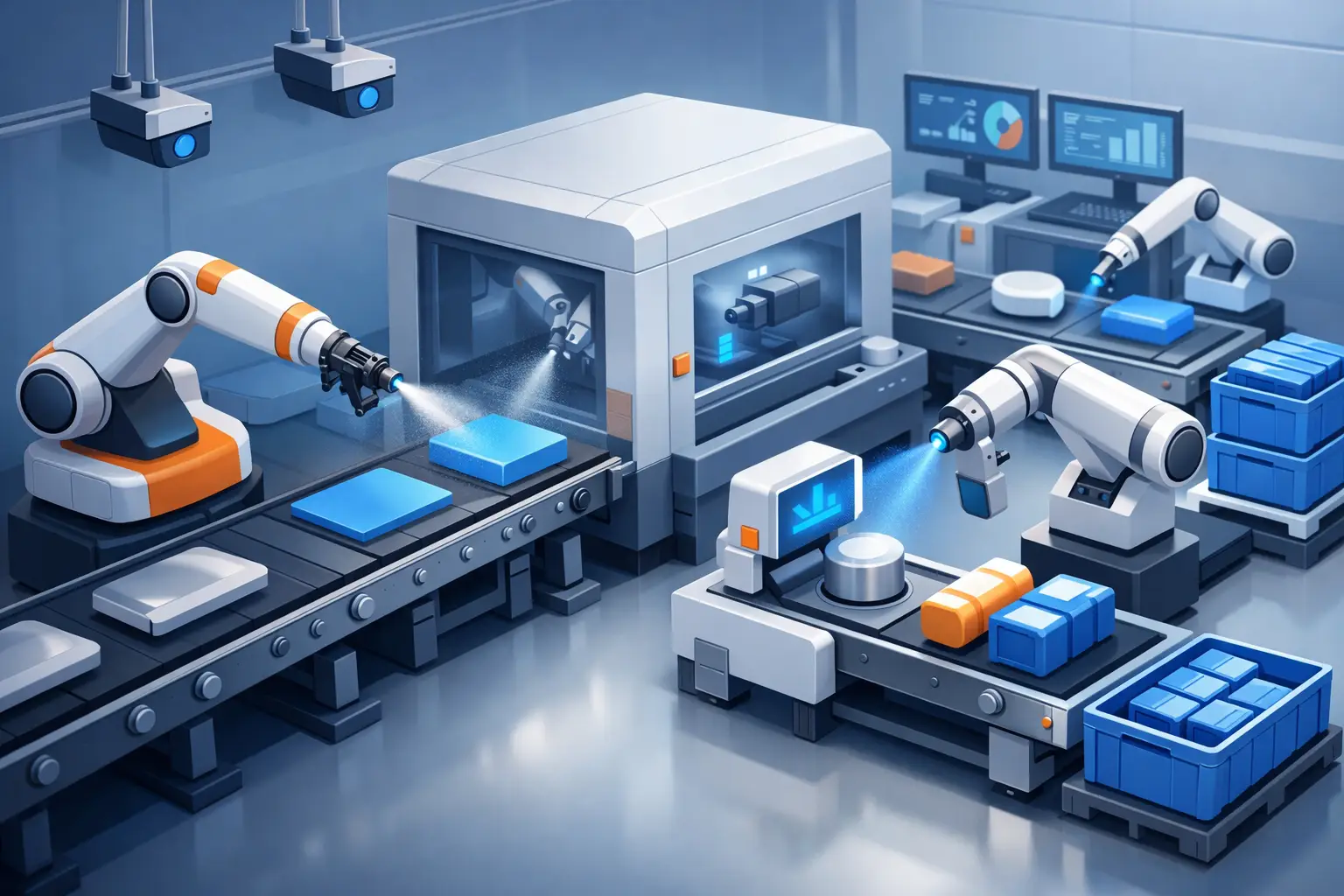
A manually operated coating process can produce excellent individual parts. The limitation becomes visible when production volumes rise, product variants multiply or every batch must be documented for an audit. Coating automation addresses this gap by converting specialist process knowledge into controlled, repeatable sequences – from component handling and chamber preparation to recipe execution, quality data and release.
For technically demanding surfaces, automation is not merely a means of reducing labour. It is an engineering decision that determines whether the functional performance achieved during development can be reproduced reliably in series production. This matters particularly for Parylene, plasma, PVD, CVD and hybrid thin-film processes, where minor deviations in preparation, loading, vacuum behaviour or treatment time may influence coating performance.
What coating automation must control
An automated coating system does more than move parts into and out of a chamber. It must control the parameters that have a direct effect on layer quality, while recording the evidence required to assess every production run. The right scope depends on the process and risk profile, but usually starts with defined loading, cleaning and pre-treatment steps.
For vacuum-based processes, chamber evacuation, leak checks, gas supply, pressure, temperature, source operation and deposition time form a connected process chain. In a Parylene process, for example, the reliable transfer and conversion of the precursor, the thermal conditions of the system and the distribution of the vapour all influence the resulting film. For plasma treatments, gas composition, power, pressure and exposure time affect activation, cleaning or surface-energy modification. Automated control makes these dependencies manageable and reproducible.
The second task is traceability. A meaningful system links each batch to a recipe version, part identification, operator permissions, material lot, measured process values and any deviations. This is particularly valuable in medical technology, electronics, aerospace and defence applications, where a coating is not decorative but integral to insulation, corrosion protection, biocompatibility, friction behaviour or environmental resistance.
Automation therefore has to be designed around the critical-to-quality characteristics of the part. A standard machine sequence is not enough if the coating result depends on a specific fixture orientation, a masked contact area, a defined dwell time after cleaning or a validated packaging step.
The case for coating automation in demanding applications
The most immediate benefit is repeatability. An operator can follow a work instruction carefully, yet manual steps inevitably introduce variation in timing, handling and documentation. Automated recipes establish tolerances for these variables and prevent unapproved parameter changes. This creates more consistent conditions for every batch without removing the need for qualified personnel.
Capacity is another factor, although it should not be assessed only as parts per hour. Automated loading concepts, parallel pre-treatment stations and planned chamber cycles can reduce waiting times between process steps. For applications with long deposition or curing phases, the ability to operate defined sequences outside normal staffing hours can materially improve asset utilisation.
There is also a quality advantage before the coating begins. Components often fail not because the deposition technology is unsuitable, but because preparation is inconsistent. Residues, fingerprints, particles, moisture or unsuitable packaging can compromise adhesion, barrier properties or electrical performance. Automation can enforce cleaning routes, controlled waiting periods and acceptance checks before parts enter the coating chamber.
For regulated production, the economic value lies in preventing avoidable rework and unclear batch histories. A complete electronic record does not replace validation, inspection or technical judgement. It does, however, provide a structured basis for root-cause analysis when coating thickness, appearance, adhesion or functional testing indicate an abnormal result.
Automation begins with the component, not the machine
The most common specification error is to select automation based solely on target volume. Throughput matters, but it is only one design input. The component geometry, material combination, permitted handling method and quality requirement are equally decisive.
Fine medical components may require low-contact fixtures that protect sensitive surfaces. Electronic assemblies may need selective masking and traceable orientation to ensure that coating reaches vulnerable areas without affecting connectors, test points or thermal interfaces. Large mechanical parts may require handling systems that prevent impact damage while maintaining a defined position within the chamber.
The coating technology also changes the automation concept. Parylene is highly conformal and suitable for complex geometries, but the loading density and arrangement influence vapour access and deposition distribution. PVD often requires specific line-of-sight management, rotation or planetary movement to achieve the required coverage. Plasma treatment may be integrated as a pre-treatment module, provided the transfer time and environmental exposure between treatment and coating remain controlled.
A sound feasibility phase examines these relationships with real components, not only drawings. It determines fixture design, useful chamber volume, loading pattern, target cycle time, inspection strategy and the process window. Only then can the system architecture be defined with confidence.
Where manual intervention remains necessary
Automation should be proportionate. Full automation is not automatically the best solution for low-volume, high-mix programmes or early-stage product development. Flexible manual loading with automated recipe control, sensor monitoring and digital batch records may offer better value than a complex robot cell.
Conversely, a high-volume product with stable geometry and validated specifications can justify automated feeding, vision inspection, part marking and downstream handling. The decisive question is not whether humans should be removed from the process. It is where human intervention introduces risk, limits capacity or prevents reliable documentation.
Technical staff remain essential for maintenance, parameter approval, exception handling and interpretation of quality data. A well-designed system makes their expertise more effective by reserving it for decisions that require engineering judgement.
Designing a reliable automated process chain
A coating installation should be specified as an interconnected process, rather than as a deposition chamber with accessories. The process chain normally includes incoming inspection, cleaning, drying, masking or fixturing, pre-treatment, coating, post-treatment, de-masking, inspection and packaging. Not every application needs every stage, but each transition should be assessed for contamination risk, handling damage and traceability.
The control system needs a clear recipe structure. Approved parameters should be protected by role-based access, while authorised changes are versioned and recorded. Critical process signals should be monitored against defined limits, with meaningful alarms rather than a large volume of non-actionable notifications. If a vacuum target is missed or a gas flow falls outside tolerance, the system must determine whether the cycle can continue, requires a hold state or must be rejected.
Data architecture deserves early attention. A coating system can generate temperatures, pressures, power values, flow rates, timings and equipment status information. Recording every signal at maximum frequency is rarely useful. The better approach is to define which values prove process conformity, which values support maintenance, and which data are needed for investigation or customer documentation.
Preventive maintenance must also be part of the automation concept. Wear components, filters, seals, source materials and sensors have predictable service requirements. Monitoring operating hours and process trends helps schedule intervention before coating quality is affected. This is particularly relevant where an unplanned chamber stoppage disrupts tightly scheduled production.
Validation, qualification and scaling
For regulated or safety-relevant applications, the installation must support a structured qualification strategy. This generally begins with demonstrating that the equipment is installed as specified, operates as intended and produces consistent results across the defined process window. The exact documentation depth depends on the industry, the intended function of the coating and the customer’s quality system.
Automation provides a valuable foundation, but validation is not achieved by software alone. The relationship between recorded process data and the relevant coating property must be established. Depending on the application, this may include film thickness, dielectric strength, adhesion, corrosion resistance, wettability, particle cleanliness, optical behaviour or biocompatibility-related requirements.
Scaling from pilot operation to series production also requires care. A larger chamber or higher loading density does not automatically reproduce the deposition conditions of a smaller development system. Gas dynamics, thermal distribution, source capacity and fixture geometry may change. A development partner with both coating expertise and custom equipment capability can translate proven layer performance into an industrial process rather than treating scale-up as a simple capacity increase.
At NTTF Coatings, this integrated view is central to system design: the coating requirement, component behaviour and production environment must be resolved together. The result is not a standard line adapted after installation, but a process concept shaped around the actual performance requirement.
Selecting the right level of investment
The business case should balance capital expenditure against quality risk, labour demand, yield, documentation requirements and future product variants. A highly specialised automated system can deliver excellent productivity for a stable part family, yet become restrictive when products change frequently. Modular stations and configurable tooling may provide a more durable investment where the product portfolio is expected to evolve.
It is equally worth defining acceptance criteria before procurement. These should cover not only nominal throughput but also coating uniformity, recipe repeatability, uptime targets, changeover time, data availability, maintenance access and operator safety. Factory acceptance testing with representative parts gives far more useful evidence than a demonstration using generic samples.
The best starting point is a precise description of the coating function the component must retain throughout its service life. Once that requirement is clear, automation can be assigned to the process steps where control, documentation and repeatability create the greatest technical value.
