
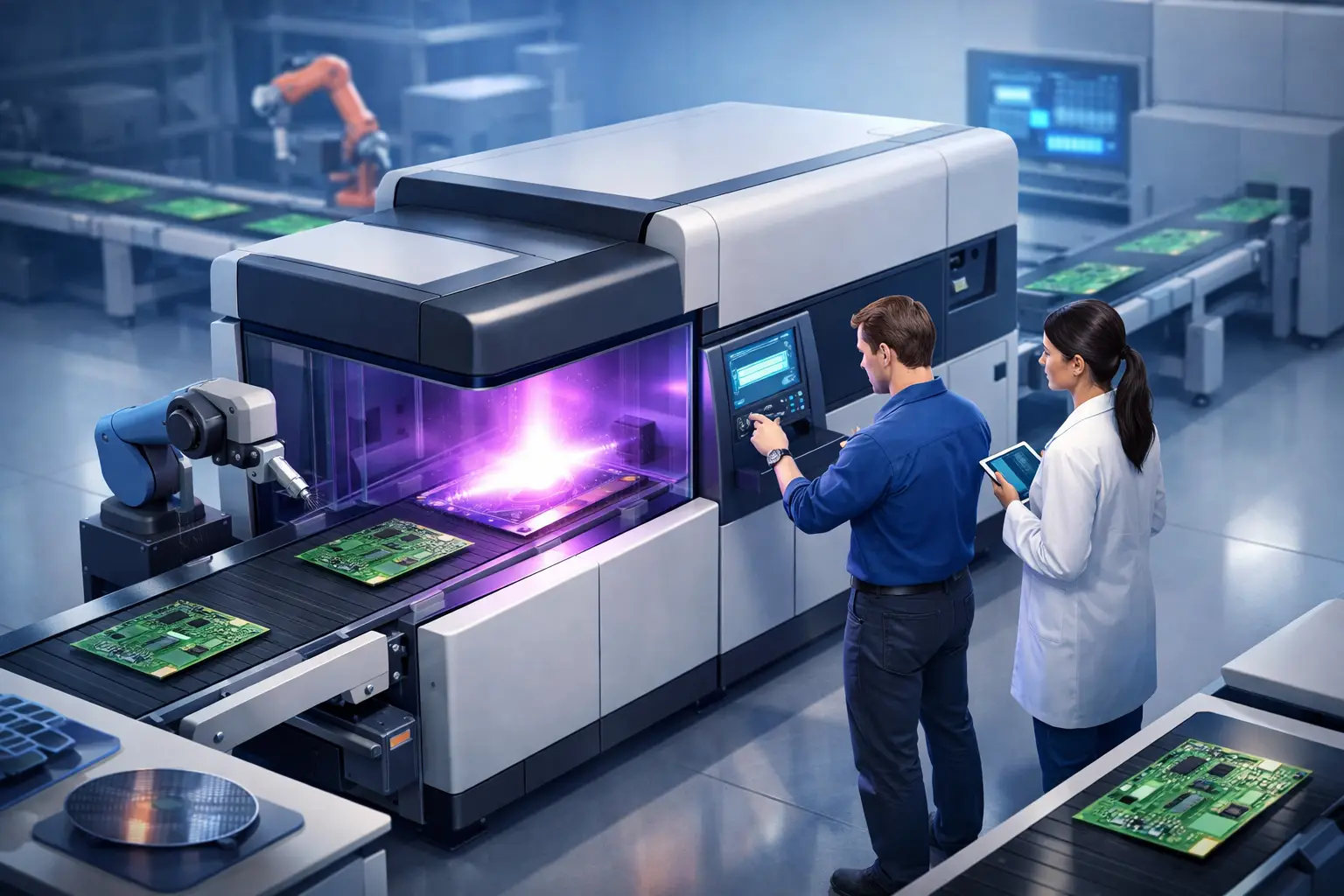
A bonding failure at the end of an otherwise stable production line rarely begins at the adhesive station. It often starts with an uncontrolled surface: low surface energy, release-agent residues, oxidation, fingerprints or material variation between batches. This inline plasma systems guide explains how continuous plasma treatment turns surface activation from a manual intervention into a defined, monitorable manufacturing step.
For technical decision-makers, the key question is not simply whether plasma improves wettability. The decisive question is whether the treatment window can be maintained across every part, every shift and every production condition. A well-designed inline plasma system provides that control while respecting takt time, component geometry, material sensitivity and downstream process requirements.
What an inline plasma system does
Inline plasma systems treat components as they pass through a production cell, conveyor section or automated handling station. In most industrial applications, atmospheric-pressure plasma is used because it can be integrated without vacuum chambers or batch evacuation cycles. Electrical energy excites a process gas, creating reactive species that interact with the outermost molecular layers of a surface.
The result may be cleaning, activation, fine-scale decontamination or a change in surface chemistry. On polymers, plasma treatment commonly introduces polar functional groups that improve the wetting and anchoring behaviour of adhesives, inks, coatings or potting compounds. On metals, glass and ceramics, it can remove organic contamination and prepare the surface for reliable joining or coating.
The effect is highly localised. Plasma generally modifies only the uppermost nanometres of the material and does not replace mechanical cleaning where substantial particulate contamination, burrs or oils are present. It also does not automatically solve a poor adhesive selection or an unsuitable curing profile. Its value lies in creating a reproducible interface between a prepared substrate and the next manufacturing operation.
Inline plasma systems guide: start with the application
System selection should begin with the functional failure mode, not with the plasma source. A manufacturer seeking stronger adhesive bonds has different process requirements from one preparing medical components for coating, cleaning electronic assemblies before encapsulation or activating sealing surfaces for overmoulding.
Define what must improve and how it will be measured. Depending on the application, this may be contact angle, surface free energy, peel strength, pull-off strength, leak rate, coating adhesion, electrical reliability or reduced variation in a validated functional test. A target expressed only as “better adhesion” leaves too much room for misinterpretation during process development.
Equally important is the substrate condition before treatment. Material grades, fillers, mould-release agents, machining emulsions, storage time and prior cleaning steps can all influence results. The same nominal polymer can behave differently after moulding, extrusion or repeated recycling. In regulated production, this variability must be identified before the plasma process is fixed.
Atmospheric or low-pressure plasma?
Atmospheric plasma is usually the practical choice for continuous, high-throughput manufacturing. It supports compact integration into conveyors, robot cells and automated assembly systems. Treatment can be applied selectively, with nozzle geometry and robot paths matched to the functional area. This makes it particularly effective where only a bonding track, seal land or coating zone requires activation.
Low-pressure plasma remains appropriate where components require treatment on internal surfaces, in deep recesses or across complex three-dimensional geometries that are difficult to access with an atmospheric nozzle. It can also offer a highly controlled process atmosphere. The trade-off is batch handling, vacuum-cycle time and a larger equipment footprint. Neither approach is universally superior. The correct choice depends on accessibility, throughput, required treatment uniformity and the validation strategy.
Plasma source and process gas
The source type determines the shape, intensity and controllability of the plasma zone. Rotary systems can cover wider areas, while linear nozzles and jets allow precise treatment tracks. Multiple heads may be necessary for broad components, parallel lanes or complex geometries. The aim is not maximum plasma power; it is sufficient and uniform treatment within the allowable thermal and material limits.
Compressed air is suitable for many activation and cleaning tasks. Nitrogen or other process gases may be selected where the desired surface chemistry, oxidation control or sensitive material behaviour requires a different approach. Gas quality matters. Oil, moisture and particulates in the supply can undermine a precisely tuned plasma process before the substrate reaches the treatment zone.
Designing the process window
An inline installation is only as reliable as the process window behind it. Key variables include power, frequency, gas flow, nozzle-to-part distance, treatment speed, exposure time, overlap between passes and component orientation. These parameters interact. Raising power may compensate for faster line speed in one application but create excessive heat or local material changes in another.
A structured development programme therefore tests the real combination of substrate, pretreatment, plasma parameters and downstream material. Coupon trials are useful for initial screening, but they must be followed by trials on production-representative parts. Edges, recesses, moulded textures and handling features frequently create effects that flat laboratory specimens do not reveal.
Surface activation also has a time dependency. Some polymers undergo hydrophobic recovery, with the surface gradually losing part of its elevated polarity after treatment. The rate depends on the polymer, environment and contamination exposure. For that reason, the interval between plasma treatment and bonding, printing or coating must be defined and controlled. In many cases, the most reliable configuration places plasma directly upstream of the downstream application step.
Mechanical integration is process engineering
Plasma heads should be treated as production equipment, not as an accessory mounted above a conveyor. The system must maintain a consistent working distance despite tolerances in the component, fixture and transport mechanism. A difference of a few millimetres can be significant where the plasma plume has a narrow effective treatment zone.
Part presentation is equally critical. Components must arrive in a repeatable orientation, and the relevant surface must remain accessible. Robots offer flexibility for variable geometries, but they add cycle-time, programming and maintenance considerations. Conveyor-based systems can be highly efficient for stable part families, provided that part spacing, speed and positional repeatability are controlled.
Exhaust extraction requires careful design. It must remove generated by-products and support a safe workplace without disturbing the plasma zone or drawing contaminants back towards the treated surface. Where plasma is used before sensitive electronics, optical elements or medical components, particle management and clean handling must be assessed across the complete cell, not in isolation.
Verification: prove treatment, not just machine operation
A plasma generator can report power and gas flow while the component remains undertreated because of incorrect distance, blocked nozzles, part misalignment or contaminated gas. Machine parameters are essential, but they are not by themselves evidence of surface performance.
Verification should combine equipment monitoring with application-relevant quality controls. Contact-angle or dyne testing can provide rapid indications for selected materials, although these methods need disciplined sampling and interpretation. For critical products, destructive bond testing, coating-adhesion testing or functional testing should establish the relationship between process settings and finished-part performance.
Traceability should record the parameters that genuinely affect quality: programme version, treatment recipe, gas supply status, head position where monitored, conveyor speed, component identification and relevant alarms. The required depth depends on risk class and regulatory environment. In medical technology, aerospace and defence applications, the validation concept must demonstrate not only that a setting works, but that it remains controlled through changeovers, maintenance and long-term production.
Common integration errors and how to avoid them
The most frequent error is specifying plasma from a single surface-energy value or a generic material data sheet. Real components carry the history of their manufacture, logistics and handling. Process development must use representative parts and downstream materials.
A second error is treating plasma as a substitute for upstream cleanliness. Heavy oils, silicone residues and particles may require dedicated cleaning before activation. Plasma can be highly effective as a final precision treatment, but it is not an unlimited contamination-removal method.
Third, teams sometimes commission the plasma station before agreeing how its effect will be verified. This leads to a system that appears operational but cannot be confidently released into serial production. Acceptance criteria, sampling plans and reaction procedures for deviations should be defined during development, not after installation.
Finally, maintenance planning is often underestimated. Nozzles, electrodes, filters, gas conditioning and extraction systems require inspection at intervals based on actual operating conditions. A preventive plan with documented checks is less costly than diagnosing intermittent bonding defects after parts have progressed through assembly.
When a tailored system is justified
Standard plasma modules can be appropriate for simple, stable applications. A tailored system becomes justified when component geometries vary, functional zones are narrow, throughput is demanding or the process must meet stringent traceability and validation expectations. It is also relevant when plasma must be coordinated with dispensing, coating, curing, vision inspection or automated material handling.
For these projects, the equipment concept should be developed alongside the surface process. NTTF Coatings combines plasma expertise with application-specific plant engineering, allowing treatment parameters, mechanics, control architecture and quality assurance to be considered as one production solution rather than as separate purchases.
The best inline plasma installation is not the one with the highest stated output. It is the one that delivers the required surface condition at the required location, within the available cycle time, and provides evidence that it will continue to do so long after the first successful sample has left the line.
