
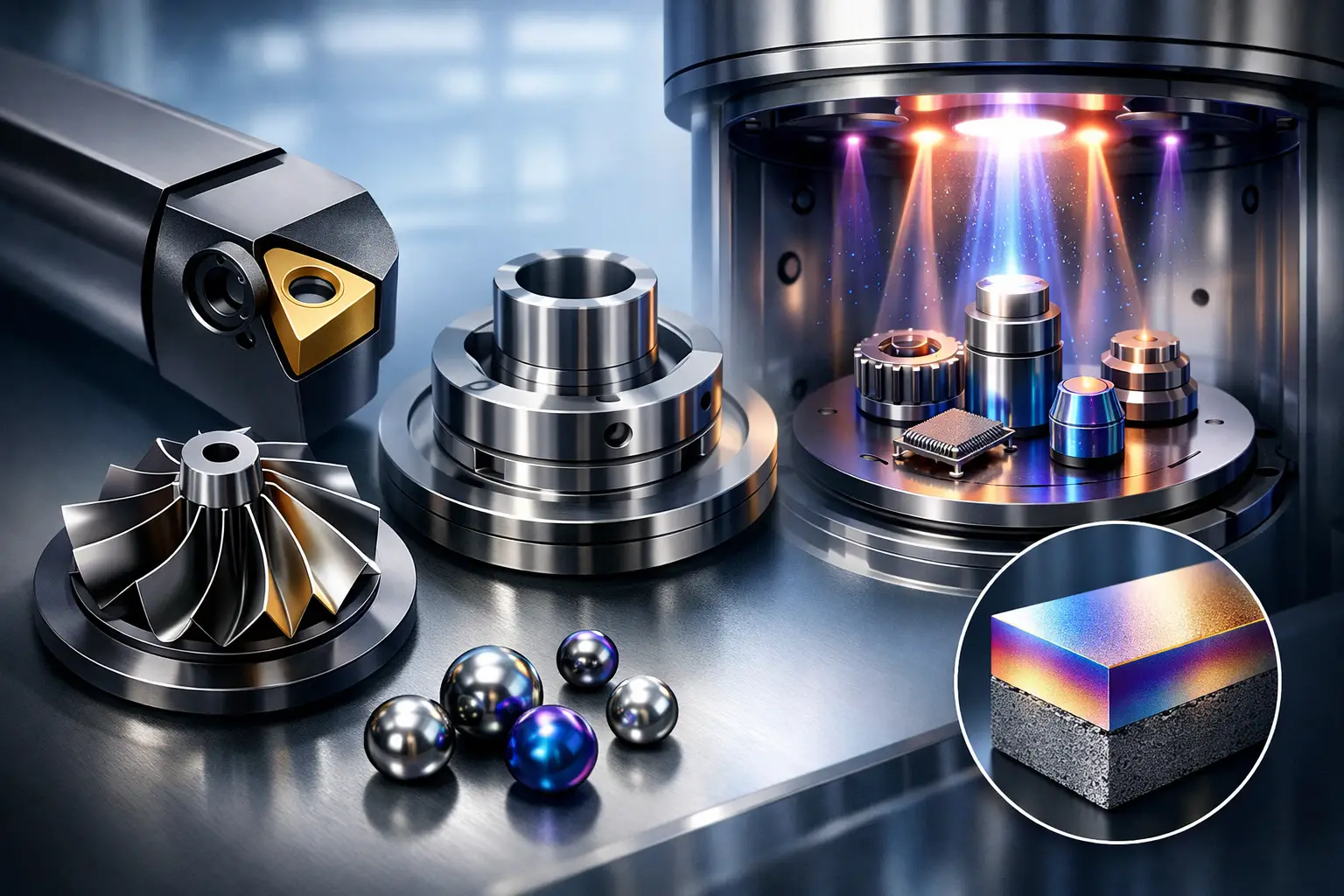
A PVD specification guide is most valuable before a coating material is selected, not after test parts have failed. For critical components, a PVD coating is not simply a thin protective layer. It is a functional system comprising substrate, pre-treatment, interlayer, coating architecture, post-treatment and verification method. Each element affects whether the specified performance is achieved consistently in production.
This matters wherever component failure has a high technical or economic consequence. In cutting and forming tools, the specification may target wear resistance and reduced material adhesion. For medical or electronic components, it may need to address biocompatibility, particle generation, electrical behaviour or chemical stability. In aerospace, automotive and defence applications, reproducibility across batches and traceable process control are often as significant as the nominal coating hardness.
Start the PVD specification guide with the component function
A useful specification begins with the operating condition, rather than a request for a familiar coating name. The question is not whether a component needs titanium nitride, chromium nitride or a carbon-based system. The question is what failure mechanism must be controlled under the actual service conditions.
Define the contact pair, load regime, sliding speed, temperature, lubrication state and exposure to corrosive media. A coating that performs well against adhesive wear in a lubricated forming application may not be appropriate for dry sliding, cyclic thermal loads or chloride-containing environments. Likewise, high hardness alone does not guarantee long service life. Excessive residual stress, insufficient adhesion or an unsuitable counterpart material can cause premature failure even where laboratory hardness values appear favourable.
The specification should therefore state the intended functional outcome in measurable terms. This may include a maximum wear rate, a target coefficient of friction within a defined test setup, a minimum corrosion resistance, a permissible particle count or a required number of operating cycles. Where an exact limit cannot yet be defined, an application-relevant comparison against an uncoated or currently used component can provide a sound development baseline.
Define the substrate before defining the coating
PVD processes deposit layers with precision on an atomic scale, but they do not correct unsuitable base material properties or poor component condition. The substrate grade, heat treatment, hardness range, surface roughness and cleanliness must be included in the technical specification.
Surface topography deserves particular attention. A very rough substrate can increase mechanical interlocking in some cases, but high asperities may also remain exposed after coating and become local stress concentrators. Conversely, an excessively smooth surface can be unfavourable where lubricant retention or defined optical behaviour is required. The correct roughness range depends on coating thickness, contact mechanism and end use.
Edges, burrs and sharp transitions are equally important. PVD layers generally follow the underlying geometry. A sharp cutting edge may be intentional on a tool, but an uncontrolled burr at a functional edge can lead to local coating thinning, nodules or damage during handling. The drawing should identify critical radii, masked zones, contact surfaces and dimensional features that must remain within tolerance after coating.
Assess thermal compatibility early
Many PVD coating systems require elevated process temperatures. The allowable thermal load must be established for hardened steels, precipitation-hardened alloys, aluminium alloys, polymer-adjacent assemblies and components with soldered, bonded or pre-assembled features. Even when the coating temperature is below the substrate’s nominal tempering temperature, a prolonged thermal cycle can influence dimensional stability or material properties.
If temperature sensitivity is a constraint, it should be identified at the enquiry stage. This enables process parameters, fixturing and coating architecture to be developed around the component rather than forcing an unsuitable standard process onto the part.
Specify coating architecture, not only coating material
A material designation alone leaves too much open to interpretation. PVD coatings can be monolithic, multilayered, nanostructured or graded through the thickness. They may include adhesion-promoting interlayers or tailored top layers to manage friction, oxidation resistance or chemical interaction.
The specification should define the coating system and the functional purpose of its architecture. For example, an interlayer may be required to support adhesion on a particular substrate, while a multilayer design may help interrupt crack propagation under cyclic loading. In a high-temperature application, the priority may be thermal stability and oxidation resistance rather than low room-temperature friction.
Thickness must also be specified as a range with a justified tolerance. More thickness is not automatically better. A thicker layer can increase protection in some wear mechanisms, yet it may reduce edge sharpness, affect tight-fit assemblies or increase the risk of stress-related failure. On precision parts, the coating allowance must be integrated into the dimensional chain. This includes bores, threads, sealing faces and moving interfaces.
Colour should not be used as the primary acceptance criterion. Visible appearance can be useful for process monitoring, but it is influenced by layer thickness, surface finish, viewing angle and coating chemistry. Functional verification requires defined technical measurements.
Account for geometry and fixturing
PVD is fundamentally a line-of-sight process, although chamber movement, part rotation and target configuration can improve coverage on complex parts. Deep holes, narrow slots, internal channels, undercuts and closely packed assemblies require early assessment. A nominal thickness measured on an exposed witness coupon may not represent coating growth inside a recessed feature.
A complete PVD specification guide should identify the surfaces that require guaranteed coverage, the surfaces that may be masked, and any areas where a cosmetic variation is acceptable. It should also clarify whether electrical contact points, clamping surfaces or subsequent joining zones must remain uncoated.
Fixturing is part of process engineering, not an administrative detail. The way components are mounted affects line-of-sight exposure, heat transfer, mechanical protection and batch capacity. For high-value components, purpose-designed fixtures can reduce handling marks, improve thickness distribution and make the process more reproducible. For serial production, they are often essential to stable cycle times and reliable quality.
Set acceptance criteria that can be measured
A coating specification becomes actionable when every critical requirement is connected to an appropriate verification method. The chosen test must reflect the application and the component geometry. A scratch test can provide comparative adhesion information, but it does not replace an application-specific fatigue, wear or corrosion test. Similarly, a hardness value measured on a flat coupon may not predict behaviour at a coated micro-edge.
Typical acceptance planning considers coating thickness, surface condition, adhesion, hardness, roughness, visual appearance and dimensional change. Depending on the application, it may also include corrosion testing, friction testing, electrical resistance, chemical resistance, particle cleanliness or optical properties. Test methods, sampling frequency, test locations and acceptance limits should be agreed before qualification begins.
For regulated industries, traceability needs equal attention. The specification should define batch identification, component status, process records, inspection documentation and rules for handling non-conforming parts. Where customer-specific validation is required, qualification samples should be processed using the same equipment, preparation route and fixturing concept intended for series production. A successful development result obtained under non-representative conditions is not sufficient evidence of production capability.
Plan qualification around the actual risk
Qualification effort should be proportionate to the consequences of failure. A decorative or non-critical wear layer may require limited validation. A coating on an implantable device component, a safety-relevant actuator or a precision electronic assembly requires a more comprehensive plan that considers long-term behaviour, lot-to-lot consistency and interactions with adjacent materials.
It is often sensible to begin with a structured feasibility phase. This can establish substrate suitability, pre-treatment requirements, coating adhesion, dimensional impact and first functional results. The next stage should confirm repeatability across several batches, preferably with production-representative loading and inspection. Only then should the process be fixed for serial release.
Changes must be managed with the same discipline. A different substrate supplier, polishing method, heat treatment batch, cleaning chemistry or fixture can alter coating results. The specification should distinguish between parameters that are fixed, parameters with approved operating windows and changes requiring requalification.
When a standard PVD specification is not enough
Standard specifications are useful for straightforward parts, but demanding applications often expose their limits. A component may require coating only on selected surfaces, controlled performance inside a complex geometry, unusually low friction against a specific polymer, or a thermal budget that conflicts with conventional processing. These are engineering questions that need application-specific development.
NTTF Coatings approaches such projects by connecting coating technology with component design, process integration and verification requirements. This is particularly relevant where industrial coating services must later transition into an in-house production system, or where a customised plant is required to support controlled, repeatable manufacture.
The strongest PVD specification does not promise a generic layer property. It creates a controlled route from component function to measurable production quality, leaving sufficient room to refine the process where the application demands it.
