
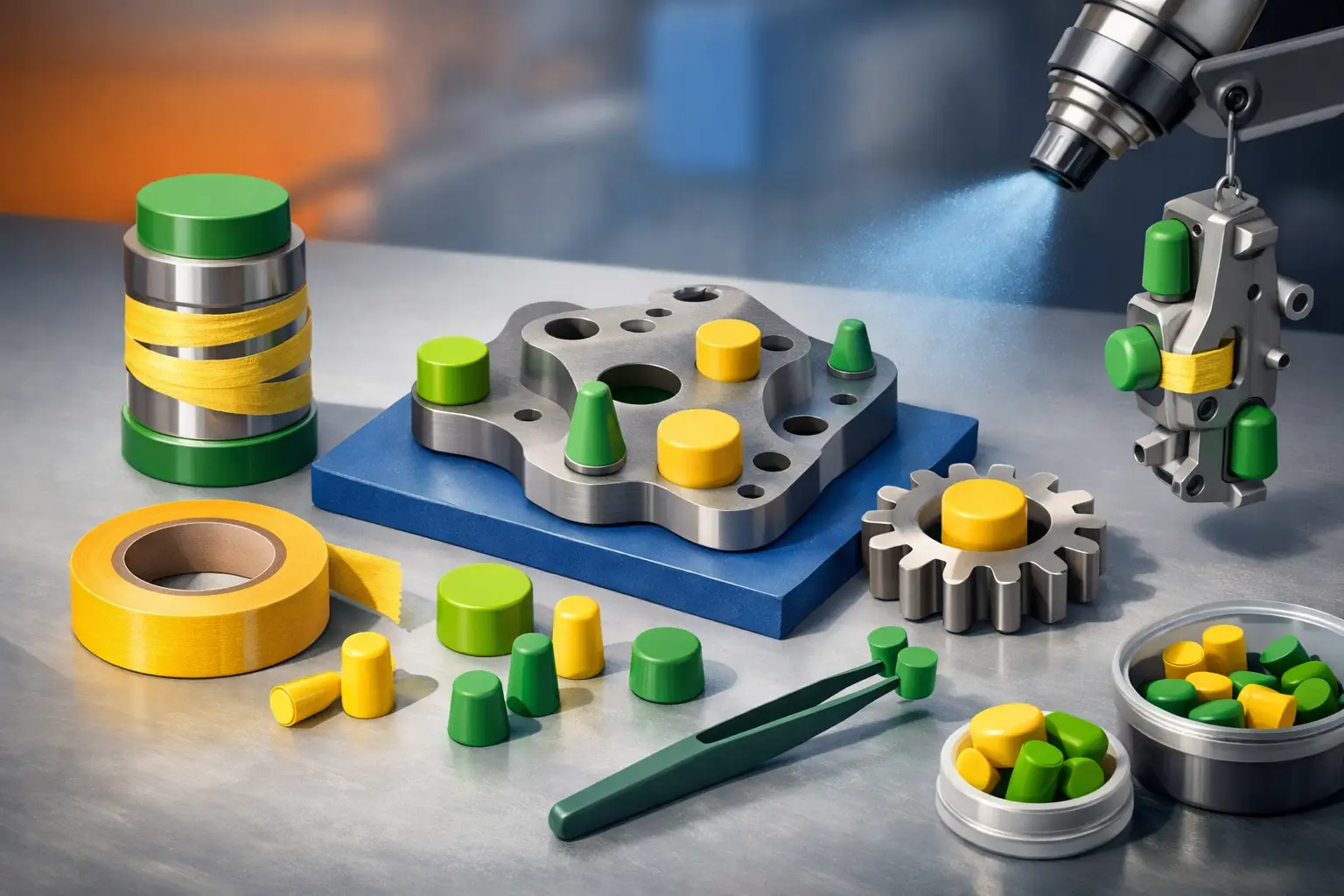
Masking is often the factor that determines whether a high-performance coating improves a precision component or compromises its function. Knowing how to mask precision components means defining exactly where a coating must stop, how sharply that boundary must be controlled and whether the masking approach remains stable through the full process window.
For medical devices, electronic assemblies, precision mechanics and aerospace parts, an uncoated area is rarely incidental. It may be a sealing land, electrical contact, bearing surface, optical zone, adhesive interface or a dimensionally critical fit. The masking method must protect that function without introducing particles, residues, edge defects or unacceptable variation between batches.
Start with the functional requirement, not the masking material
The first question is not whether to use tape, caps or a fixture. It is what the uncoated area must achieve after coating. A connector contact requires low electrical resistance. A sealing face requires defined surface geometry and cleanliness. A bonded joint may need a surface with sufficient energy for reliable adhesion. Each requirement leads to different tolerances for coating encroachment, edge definition and possible residue.
These boundaries should be specified on the component drawing or in a dedicated masking specification. Define the masking zone, permissible coating overlap, required edge quality and the relevant reference dimensions. For a highly loaded sealing surface, a tolerance of several tenths of a millimetre may be unacceptable. For a non-functional handling area, a wider transition zone may be entirely suitable.
The coating process also matters. PVD and many plasma processes are predominantly directional, so shadowing and component orientation influence the deposited layer. Parylene is deposited from the vapour phase and is highly conformal. It reaches recesses, edges, internal features and complex geometries that would be protected by line-of-sight assumptions in other processes. A mask concept that works for a directional process may therefore fail when used for Parylene.
How to mask precision components with a process-safe design
Effective masking is an engineered interface between component geometry, coating chemistry and production handling. It should be developed as part of the coating process, not added after the coating specification has been released.
Classify every surface before selecting a method
A practical starting point is to divide surfaces into three groups: surfaces that require full coating coverage, surfaces that must remain completely free of coating, and transition zones where a defined coating edge is acceptable. This classification prevents a common error: applying a general masking solution to features with fundamentally different functional demands.
For example, a threaded section may tolerate a controlled transition, while a microfluidic port or precision electrical contact may require complete protection. Similarly, a bore may need to remain open but still allow coating on the surrounding face. The required geometry of the uncoated area determines whether a plug, precision cap, tape die-cut or dedicated fixture is appropriate.
Choose materials for vacuum, temperature and chemistry
Masking materials must withstand the actual coating environment. Their suitability cannot be judged solely by room-temperature handling. In vacuum processes, some polymers, adhesives and elastomers release volatile constituents. This outgassing can contaminate chamber surfaces, affect deposition behaviour or leave residues on the component.
For Parylene processes, masks also need to maintain their fit during evacuation and deposition. A tape that initially appears well bonded may lift at edges, creating feathered coating boundaries. In plasma-based pre-treatment or cleaning steps, a material can erode, embrittle or become difficult to remove. Thermal loads, process duration and plasma exposure must therefore be considered together.
Metal masks and precision-machined fixtures offer excellent dimensional stability, particularly for repeat series. They are often preferable for high-value parts and narrow tolerance zones. Their limitation is that they require close control of contact geometry: even a small gap can permit vapour access or generate an extended transition edge. Elastomer caps and plugs can conform well to cylindrical geometries, but their cleanliness, ageing behaviour and compatibility with process conditions must be qualified.
Control the mask-to-part interface
The coating edge is governed less by the visible outline of the mask than by the interface between mask and component. Where a mask contacts the substrate tightly, the coating boundary is generally more controlled. Where there is a gap, the coating can travel beneath the mask, particularly in conformal vapour deposition.
A sharp edge is not always the correct target. Extremely abrupt transitions can be vulnerable to mechanical damage or create a local stress concentration. In other cases, such as electrical terminals, a narrow and well-defined boundary is essential. The appropriate edge profile depends on coating thickness, substrate geometry, the intended service environment and post-coating assembly operations.
Surface finish also influences the result. Rough or textured substrates are more difficult to seal with flat tape or rigid tooling. Fine machining marks may create channels beneath a mask. In such cases, a compliant material or a differently designed contact profile may be necessary. For critical applications, evaluate the masking concept on representative production surfaces rather than on idealised test coupons.
Cleanliness is part of masking quality
Masking does not replace cleaning. It adds another handling step, which can introduce fingerprints, fibres, silicone transfer, adhesive residue and particles. These defects may be inconspicuous before coating yet become highly visible after deposition or cause local adhesion failures.
Components should be cleaned according to substrate, contamination type and downstream coating requirements before masking. The masking material itself needs controlled storage and preparation. Cutting tape manually at the workstation, for instance, may be adequate for prototypes but is rarely sufficient for reproducible precision production. Die-cut formats, dedicated placement aids and defined handling procedures reduce variation.
After demasking, inspect not only the masked surface but also the transition region. Residues can impair conductivity, bonding or optical performance. If cleaning after demasking is required, the method must not damage the newly deposited thin film or alter the functional properties of the uncoated surface.
Design fixturing around both masking and deposition
Fixtures do more than hold components in a chamber. They establish orientation, protect sensitive features, determine handling repeatability and influence coating access. In many cases, the fixture itself can serve as the primary mask.
A custom fixture is especially valuable where parts have recurring geometry, large batch volumes or demanding dimensional tolerances. It can locate components from a controlled datum, protect contact surfaces through defined compression and reduce manual masking operations. This improves repeatability while shortening set-up time and reducing the risk of operator-dependent variation.
However, fixturing has trade-offs. Excessive clamping force can mark soft substrates or distort thin-walled parts. Insufficient force can create gaps. Complex fixtures may also be difficult to clean and costly to modify if component geometry changes. The most effective designs balance masking precision with accessibility, maintenance and throughput.
For components with cavities, channels or multiple functional faces, it may be necessary to assess several orientations or use separate process steps. Coating coverage and masking performance must be considered as one geometry problem. A design that protects a contact surface perfectly but prevents the required coating from reaching an adjacent internal feature does not meet the component requirement.
Validate the complete sequence, including demasking
Masking performance should be validated using production-representative parts, coating thicknesses and loading configurations. Visual inspection alone is not enough where function depends on boundary position, electrical behaviour, adhesion or corrosion protection.
The validation plan should examine coating encroachment, edge consistency, residue, particle generation and the condition of the protected surface. Depending on the application, this may include dimensional measurement, microscopy, electrical contact resistance testing, leak testing, adhesion assessment or functional assembly tests. In regulated sectors, traceable records of materials, mask configuration, process parameters and inspection criteria support repeatable quality.
Demasking deserves equal attention. Removing a cap or tape too quickly can lift the coating at the transition edge. Removing it too late may increase residue or make separation difficult. The correct procedure depends on coating type, thickness, substrate sensitivity and mask construction. Define the sequence, tools and acceptance criteria rather than leaving removal technique to individual judgement.
Scale only after the masking window is understood
A hand-applied masking process can prove feasibility, but it may not prove manufacturability. When production volumes increase, the relevant questions change: How long does masking take per part? Which features are difficult to access? How often must consumables be changed? Can the method be inspected before coating? What happens when component tolerances drift within their drawing limits?
These questions often justify a move from generic tapes and plugs to purpose-designed masks, loading tools or semi-automated handling. The investment is not simply about labour reduction. It creates a more stable process window, lowers scrap risk and makes coating quality less dependent on individual technique.
For complex geometries or regulated applications, masking development should therefore run alongside coating development. A coating can only deliver its intended protection, electrical performance or biocompatibility when it is present precisely where it is required and absent where function demands it. Treat the mask as a controlled production tool, and the finished component will reflect that level of engineering discipline.
