
How does parylene coating work in practice?
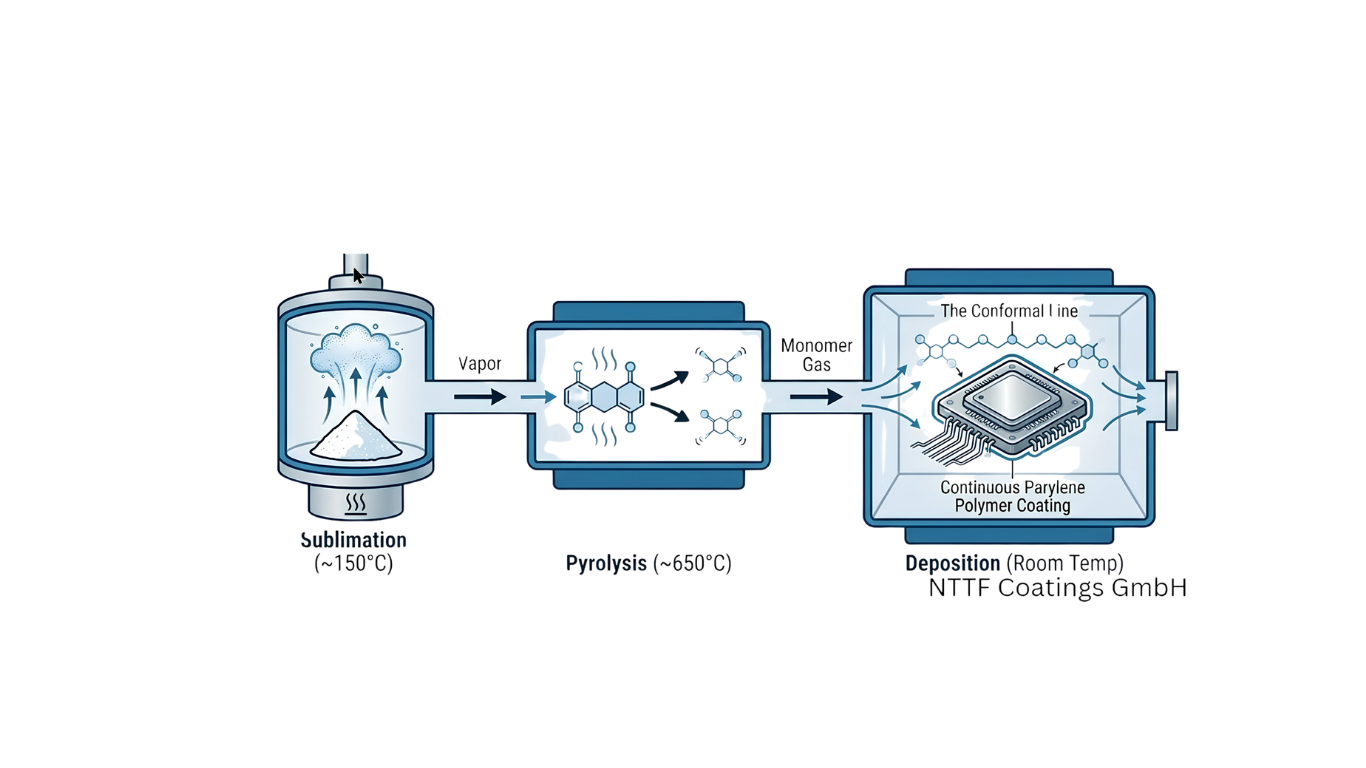
The process is based on chemical vapour deposition, but with a specific sequence that makes parylene distinct from many other thin-film technologies. A solid parylene dimer is first vapourised under controlled temperature. This vapour is then thermally cleaved into a reactive monomer. The monomer enters a deposition chamber under vacuum, where it adsorbs on the component surface and polymerises directly into a solid film.
This reaction happens at the surface of the part, molecule by molecule. Because the monomer is in gaseous form and the chamber operates under low pressure, the coating can reach corners, edges, undercuts and internal features that are difficult or impossible to cover evenly with wet-chemical systems. The result is a continuous polymer layer with very consistent thickness across complex three-dimensional components.
For technical decision-makers, the key point is this: the coating does not flow and then dry. It forms in situ from the vapour phase. That is why parylene is known for exceptional conformity and why it is used where conventional lacquers, epoxies or dipped polymers reach their limits.
The four process stages that determine coating quality
Although the principle sounds straightforward, coating quality depends on tight process control in every step.
1. Vapourisation of the dimer
The raw material starts as a stable solid dimer. In the first stage, it is heated until it becomes vapour. The temperature profile must be stable, because fluctuations here affect the amount of precursor entering the system and therefore the deposition rate.
2. Pyrolysis to create the monomer
The vapour then passes through a high-temperature pyrolysis zone. Here, the dimer molecule is split into reactive monomers. This conversion is critical. If pyrolysis is incomplete, the deposition efficiency drops and film properties can become inconsistent.
3. Deposition in the vacuum chamber
The monomer enters the coating chamber, where the parts are positioned. Because the molecules are small and mobile in the vacuum environment, they distribute throughout the chamber and settle on all exposed surfaces. On contact with the substrate, they polymerise into parylene.
4. Film growth and thickness control
The coating grows gradually until the available monomer is consumed. Thickness is controlled primarily through the quantity of precursor introduced, along with chamber conditions and part loading. In industrial applications, reproducibility depends on how well these parameters are matched to part geometry, fixture design and batch size.
That last point is often underestimated. Parylene coating is not just a material choice. It is a process-engineering task.
Why parylene coats so uniformly
The main strength of parylene lies in its conformal deposition behaviour. Unlike liquid systems, there is no surface tension, no drainage effect and no edge pull-back during curing. That matters for microelectronics, sensors, medical components and precision mechanics where local weak points are unacceptable.
A uniform film means more than a neat cross-section under the microscope. It directly affects dielectric performance, corrosion resistance, chemical barrier properties and friction behaviour. If a protective layer thins out at edges or bridges across fine structures, the functional risk rises. Parylene avoids many of these failure modes because it deposits evenly at the molecular level.
This does not mean every part is automatically easy to coat. Deep blind holes, shielded cavities or densely stacked assemblies can still challenge mass transport inside the chamber. Good fixture design, chamber loading strategy and process validation remain essential.
What happens on the surface itself?
The polymerisation step takes place spontaneously when the reactive monomer reaches the component surface. No curing oven, catalyst bath or post-crosslinking step is required in the usual sense. The film builds up as a thin, continuous polymer chain network directly on the substrate.
Surface preparation, however, remains crucial. Contamination from oils, particulates, release agents or oxide layers can impair adhesion. Depending on the substrate, pretreatment may include cleaning, drying, masking and plasma activation. For demanding applications, adhesion promotion is often not optional but part of a validated process window.
This is one of the most important trade-offs in parylene projects. The coating itself is extremely uniform, but long-term performance still depends on substrate compatibility and preparation quality. A high-end deposition process cannot compensate for an unstable surface condition.
Which properties make parylene valuable?
Parylene is used because it combines several functional advantages in one thin film. It offers very good barrier performance against moisture and many chemicals, strong dielectric properties, low added mass and excellent conformity. Certain parylene types also support biocompatible applications, which is highly relevant in medical technology.
In electronics, this can mean reliable insulation without heavily changing component dimensions. In mechanical assemblies, it can mean lower friction or protection against environmental attack. In medical applications, it can provide a chemically stable and tissue-compatible interface, provided the overall system is validated accordingly.
Different parylene variants, such as parylene C, N or F-based grades, shift the balance of properties. Chemical resistance, dielectric behaviour, thermal stability and permeability are not identical across all types. Material selection therefore depends on the operating environment, not on the name parylene alone.
Where the process creates real industrial value
The answer to how does parylene coating work becomes commercially relevant when it is linked to use case and risk profile.
In medical technology, parylene is often chosen for implant-adjacent components, instruments or device elements where biocompatibility, insulation and dimensional precision are critical. In electronics, it protects assemblies, sensors and connectors against humidity, condensation and media exposure without flooding sensitive structures. In aerospace, defence and automotive environments, it supports reliability under aggressive climatic and chemical conditions. In precision engineering, it can improve surface function while keeping tolerances under control.
For production environments, another advantage matters: parylene is a dry, solvent-free deposition process. That can simplify cleanliness requirements and reduce some of the variability associated with wet coatings. Yet scaling still requires engineering discipline, especially where takt time, fixture capacity, masking effort and traceability play a major role.
Limits and trade-offs engineers should assess early
Parylene is highly capable, but it is not the right answer for every component.
First, masking can be demanding. Because the coating is so conformal, it will cover virtually every exposed area. Contact zones, optical surfaces, bond pads or assembly interfaces may need precise masking concepts, and these can influence cost and throughput.
Second, adhesion must be engineered. On metals, polymers, elastomers or ceramics, adhesion behaviour can differ significantly. Pretreatment and adhesion promoters may be required, especially if the part sees thermal cycling, sterilisation, flexing or chemical exposure.
Third, film thickness has to match the function. Very thin coatings are excellent for preserving geometry, but barrier life and dielectric strength depend on the specification. Thicker is not always better either, because process time, stress behaviour and economics also matter.
Finally, not every requirement should be solved by parylene alone. In some cases, hybrid stacks with plasma treatment, PVD or additional functional layers make more sense than a single coating approach. That is especially true when wear resistance, conductivity or optical behaviour must be combined with barrier performance.
How does parylene coating work when brought into production?
In development, the process can look deceptively simple: clean the part, mask it, load the chamber, deposit the film. In production, success depends on reproducibility. That means stable precursor dosing, validated chamber parameters, repeatable fixture concepts, qualified pretreatment and reliable inspection methods.
For regulated sectors, documentation and process capability are just as important as the coating result itself. Coating thickness measurement, adhesion testing, visual inspection and batch traceability need to align with the component’s risk class and end-use environment. A technically strong parylene process is therefore not just about deposition chemistry. It is about building a controlled manufacturing route around that chemistry.
This is where experienced process development creates value. Companies such as NTTF Coatings work at the intersection of coating service, application-specific engineering and custom system design, which is often decisive when a technology must move from feasibility to industrial deployment.
If you are evaluating parylene for a sensitive component, the most useful question is rarely whether the material works in principle. It is whether the full process chain can be adapted to your geometry, substrate, regulatory context and production logic without compromising reliability where it matters most.
