
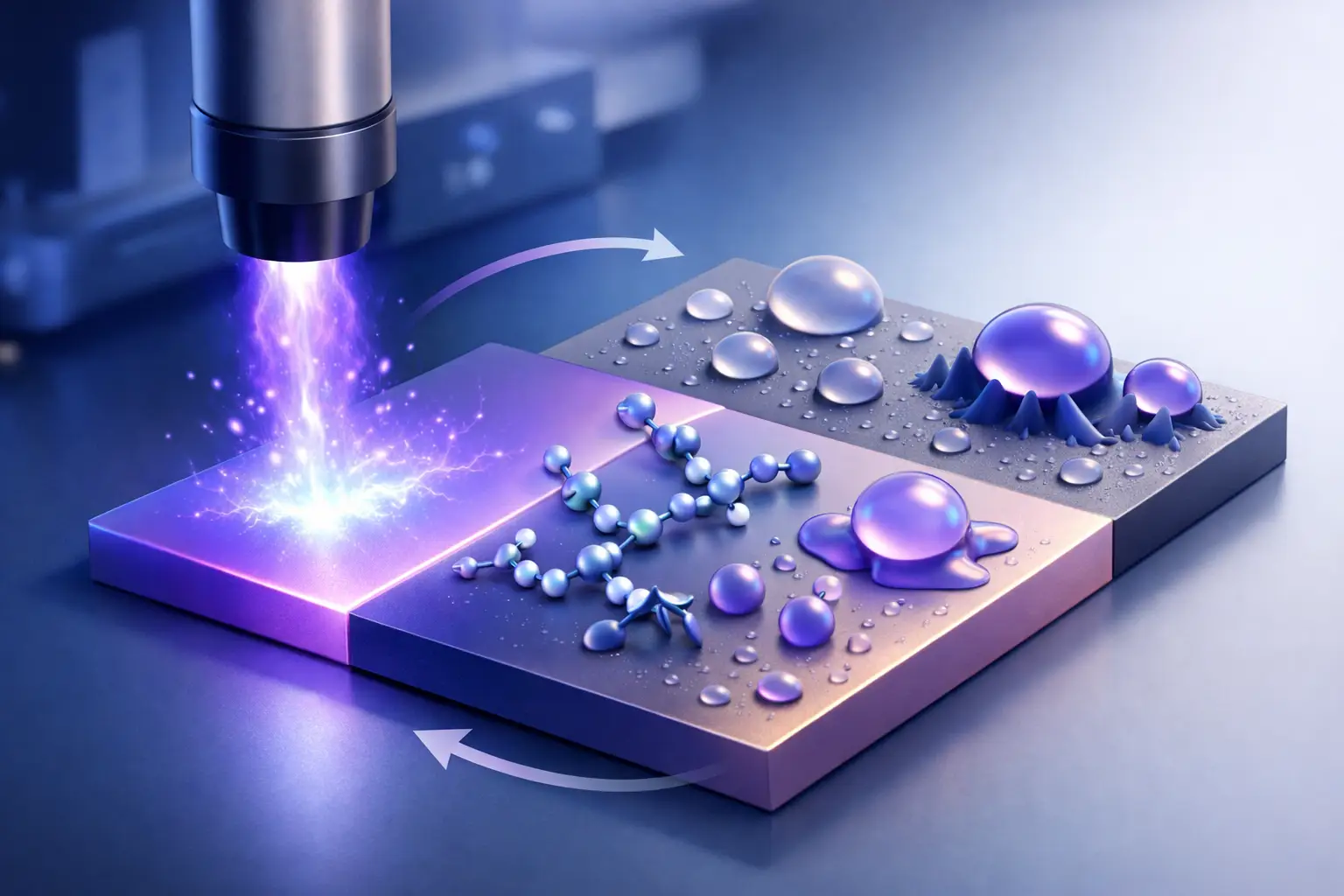
Plasma surface treatment
A bonded joint that fails in peel testing rarely fails without warning. In many cases, the adhesive itself is not the root cause. The real issue sits one level deeper – insufficient surface energy, unstable wetting behaviour or contamination at the interface. That is exactly where plasma surface treatment for adhesion becomes technically decisive.
For manufacturers working with polymers, elastomers, metals or hybrid material combinations, adhesion is not a single parameter. It is the result of a controlled interface. If that interface is inconsistent, the downstream process becomes inconsistent as well, whether the next step is bonding, coating, printing, sealing or overmoulding. Plasma treatment addresses this challenge at the surface, precisely where adhesion is formed.
Why plasma surface treatment for adhesion matters
Many engineering materials are difficult to bond in their untreated state. Polyolefins such as PE and PP are classic examples, but the challenge extends far beyond them. Technical plastics, finely machined metals, ceramic components and miniaturised electronic parts can all present surface conditions that limit adhesive performance. Low surface energy, organic residues, release agents and weak boundary layers reduce the interaction between substrate and adhesive.
Plasma treatment modifies only the outermost molecular layers of the component. This is one of its central strengths. Bulk properties remain unchanged, while the surface becomes more receptive to subsequent functionalisation. In practical terms, that can mean better wetting, stronger chemical interaction and a more reproducible bond line.
For industrial users, the benefit is not abstract. Improved adhesion can reduce field failures, raise process capability, widen the material selection window and lower scrap rates. In regulated sectors such as medical technology or aerospace, the relevance is even greater because weak adhesion is not merely a quality issue – it can become a compliance and liability issue.
What plasma actually changes at the surface
Plasma is an ionised gas containing electrons, ions, radicals and excited species. When this reactive environment interacts with a material surface, several effects can occur simultaneously. Organic contaminants can be removed, the surface can be activated through the introduction of polar functional groups, and fine-scale etching can increase the effective interaction area.
The exact mechanism depends on the substrate and the plasma process. On many polymers, oxygen-containing plasmas increase polarity and therefore surface energy. That improves the ability of adhesives, inks or coatings to wet the surface uniformly. On metallic substrates, plasma can remove residual hydrocarbons and support a cleaner, more stable interface before bonding or coating.
This distinction matters because not every adhesion problem is solved by the same surface effect. Sometimes the main task is cleaning. Sometimes it is chemical activation. Sometimes a light nano-scale roughening contributes to mechanical anchoring. An effective process is therefore not defined by the word plasma alone, but by the correct plasma chemistry, power density, treatment time and process integration.
Atmospheric or low-pressure plasma?
The choice between atmospheric and low-pressure plasma is not a question of better or worse. It is a question of application fit.
Atmospheric plasma is often attractive for inline production. It can be integrated directly into automated manufacturing cells, treating components immediately before dispensing adhesive, applying a coating or printing. This short interval between activation and the next process step is often beneficial, especially on polymers where surface ageing can reduce the activation effect over time. Atmospheric systems are particularly useful when throughput, cycle time and integration into existing production lines are key drivers.
Low-pressure plasma, by contrast, offers a highly controlled process environment. Because treatment takes place under vacuum, gas composition, pressure and plasma uniformity can be adjusted with great precision. This is often advantageous for complex geometries, sensitive components and demanding cleanliness requirements. In electronics, medical technology and high-value assemblies, the process window offered by low-pressure plasma can be a decisive advantage.
The trade-off is straightforward. Atmospheric plasma usually supports higher inline flexibility, while low-pressure plasma often delivers tighter control and more homogeneous treatment on intricate parts. The right choice depends on geometry, substrate, required throughput and qualification strategy.
Plasma surface treatment for adhesion in demanding industries
In medical technology, adhesion is rarely just about holding two parts together. Bonded interfaces may need to withstand sterilisation, bodily fluids or long service intervals without releasing particles or degrading in an uncontrolled manner. Plasma pretreatment can support reliable bonding on catheters, housings, sensor components and polymer-based assemblies where conventional primers are undesirable or difficult to validate.
In electronics manufacturing, component miniaturisation raises the bar for surface preparation. Fine-pitch structures, sensitive substrates and mixed-material assemblies leave little room for process drift. Plasma treatment can improve adhesion for conformal coatings, encapsulants and structural bonds while helping to remove low-level organic contamination that would be difficult to address mechanically.
Automotive, aeronautics and defence applications bring a different profile of requirements. Here, thermal cycling, vibration, moisture exposure and media resistance often define long-term performance. Adhesion has to remain stable under mechanical and environmental stress, not only under initial laboratory conditions. Plasma treatment can support this by creating a more controlled interfacial state before bonding or coating, though validation under application-specific ageing conditions remains essential.
Process stability depends on more than activation
A common mistake is to view plasma treatment as an isolated improvement step. In reality, its value depends on how well it is embedded into the full production chain.
The condition of the incoming part is critical. Mould release agents, machining oils, fingerprints, storage conditions and packaging residues can all influence treatment effectiveness. Plasma can remove a defined contamination load, but it is not a universal substitute for poor upstream cleanliness control. If contamination fluctuates significantly from batch to batch, adhesion results will fluctuate as well.
The interval between treatment and bonding also matters. Some activated surfaces maintain their higher surface energy for a useful period, while others show relatively fast hydrophobic recovery. This is particularly relevant for certain polymers. In such cases, process design should minimise delay between plasma activation and the next manufacturing step.
Verification is equally important. Dyne inks may provide a quick indication of wettability, but they do not replace application-specific testing. Peel strength, shear strength, environmental ageing, microscopy and surface analytics may all be required depending on the risk profile of the product. Technical decision-makers should expect plasma qualification to be tied to the end use, not treated as a generic equipment setting.
Where plasma has limits
Plasma is highly effective, but it is not a cure-all. If the adhesive chemistry is fundamentally unsuited to the substrate or the service environment, pretreatment alone will not solve the problem. The same applies when the bonded design introduces stress peaks that exceed what the interface can tolerate. Surface preparation can strengthen the interface, but it cannot compensate indefinitely for poor joint design.
Material sensitivity must also be considered. Excessive treatment can damage delicate substrates, alter appearance or affect critical dimensions on very fine structures. In some cases, aggressive activation may even create short-term gains that compromise long-term stability. This is why parameter development should be evidence-based rather than driven by the assumption that more treatment automatically means better adhesion.
Another practical limit concerns economics. For high-volume production, a technically excellent plasma process still needs to fit cycle time, maintenance strategy and overall equipment effectiveness targets. For low-volume, high-value applications, the balance may tilt more strongly towards performance and qualification certainty. The right process window is therefore both technical and commercial.
From laboratory result to industrial implementation
The most reliable way to implement plasma treatment is to treat it as part of a broader surface engineering strategy. That means starting with the functional requirement: what must the interface endure, for how long, under which environmental conditions? From there, substrate behaviour, adhesive chemistry, cleaning route, plasma process and verification plan can be aligned.
For companies that need not only a treatment result but a scalable production concept, this systems perspective becomes especially important. A laboratory coupon showing improved adhesion is useful, but it is not the same as a validated process on real components with defined tolerances and traceable parameters. That transition from feasibility to industrial repeatability is where engineering depth matters most.
This is also why specialised partners such as NTTF Coatings are valued in technically demanding sectors. The challenge is rarely a standalone coating or plasma step. It is the development of a reproducible interface solution that fits the component, the regulatory context and the production environment.
Plasma surface treatment for adhesion is best understood not as an add-on, but as a precision tool for controlling the interface where product performance is decided. When the process is properly matched to substrate, adhesive and production logic, it can shift adhesion from a recurring risk to a stable design parameter. That is often the difference between a bond that merely passes initial testing and one that performs reliably in service.
