
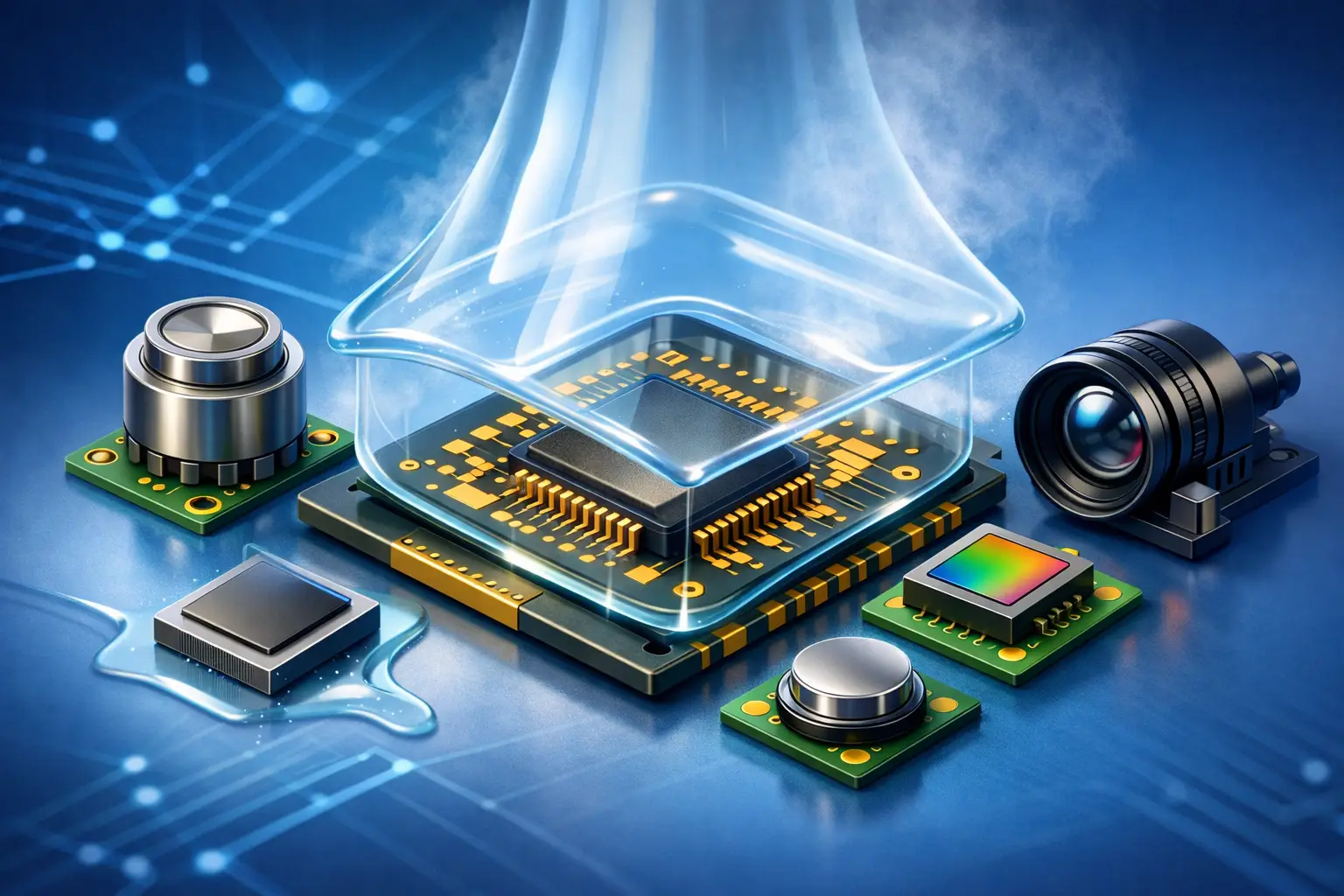
A sensor that performs flawlessly on the test bench can still fail in service for very ordinary reasons: moisture ingress, ionic contamination, dielectric drift or chemical attack at the wrong interface. That is exactly where parylene coating for sensor components becomes technically relevant. For many sensor designs, the challenge is not just achieving sensitivity or miniaturisation, but preserving those properties over time under real operating conditions.
Why parylene coating for sensor components is used
Sensors are rarely exposed to a single stress factor. In medical devices, they may face sterilisation media, bodily fluids and strict biocompatibility requirements. In industrial electronics, they encounter humidity cycling, cleaning agents, particles and voltage-related risks. In automotive, aeronautics and defence applications, the same component may also see vibration, thermal change and chemically aggressive environments.
Parylene addresses this combination of demands because it forms an ultra-thin, pinhole-minimised polymer film by vapour deposition. The process creates a conformal coating that follows complex geometries, narrow gaps and delicate structures far more evenly than many liquid-applied systems. For sensor components with exposed leads, sharp edges, microstructures or mixed-material assemblies, this conformality is often the decisive advantage.
The technical value is not limited to one property. Depending on the parylene type and process window, the coating can improve dielectric insulation, reduce moisture penetration, provide a chemical barrier and support stable function without significantly increasing mass or changing geometry. On highly sensitive parts, that low coating thickness matters. A solution that protects the component but disturbs its response is not a solution at all.
What makes parylene suitable for sensitive sensor architectures
Many coatings perform adequately on simple housings or large metal parts. Sensor components are different. They often combine metals, ceramics, polymers and semiconductors in one compact assembly, and those interfaces are where failure mechanisms begin. A useful coating must therefore do more than cover the surface. It must deposit uniformly, adhere reliably and remain consistent at the dimensions the application actually requires.
Parylene is deposited from the gas phase under vacuum, which allows it to coat three-dimensional and high-aspect-ratio structures with remarkable uniformity. This is particularly relevant for MEMS-based sensors, pressure sensors, biosensor elements, optical sensor subassemblies and miniaturised electronic sensor packages. In such cases, edge coverage and access into recessed features are not secondary details. They directly affect field reliability.
Its dielectric behaviour is another reason it is specified. For sensor electronics and signal paths, insulation performance must be predictable, not merely nominal. A thin conformal layer with stable electrical properties can help prevent leakage currents and protect fine conductive features without the bulk associated with potting or overmoulding.
At the same time, parylene is not universally neutral in its effect. On some sensing principles, any added layer can influence response time, thermal transfer or surface interaction. Thickness selection, masking strategy and coating placement therefore need to be developed around the sensing function itself rather than treated as a generic finishing step.
Where the coating delivers measurable benefit
The most obvious benefit is environmental protection, but in sensor applications the more valuable outcome is often signal stability over service life. Moisture and contaminants do not always cause immediate failure. They can introduce drift, noise or calibration change long before the component stops working. For systems that depend on precise threshold values or repeatable measurement windows, that gradual degradation is expensive.
A correctly specified parylene layer can reduce these effects by isolating critical regions from humidity and chemical exposure while preserving the dimensional precision of the underlying assembly. This makes it relevant for temperature sensors, flow sensors, pressure sensors, implantable or wearable medical sensors, and electronic sensor boards operating in harsh industrial surroundings.
In medical technology, biocompatibility and surface inertness may be as important as barrier performance. In electronic and industrial sectors, the driver is often reliability under condensation, salt exposure or aggressive cleaning chemistry. In both cases, the same principle applies: the coating is valuable when it protects function, not only appearance.
Limits and trade-offs in sensor design
No serious engineering discussion about coatings should ignore trade-offs. Parylene is highly effective in many sensor applications, but it is not an automatic fit for every component.
For example, if the sensor relies on direct contact between its active surface and the surrounding medium, a full-surface coating may block the very interaction that enables measurement. Gas sensors, certain electrochemical sensors and some optical systems can require selective coating or tightly controlled masking. Likewise, if rapid thermal exchange is central to performance, even a very thin polymer film may alter response characteristics enough to matter.
Adhesion is another area where engineering discipline matters. Parylene can perform extremely well, but adhesion depends on substrate chemistry, cleanliness, surface activation and the interfaces present in the real assembly. Plastics, metals and ceramics do not behave identically. If the component includes residues from previous process steps, adhesion problems often appear later in the field rather than during initial inspection.
That is why process development should include substrate-specific pretreatment, realistic environmental testing and a clear view of the sensor’s operating principle. In demanding applications, coating design is inseparable from component design.
Process control matters more than nominal material choice
Specifying “parylene” alone is rarely sufficient. Different parylene variants offer different balances of dielectric properties, barrier behaviour, thermal performance and chemical resistance. The right choice depends on the exposure profile, the sensor architecture and the regulatory framework of the target industry.
Just as important is process control. Thickness uniformity, chamber loading, fixturing, masking precision and pretreatment all influence the final result. Two components coated with the same nominal material can behave very differently if the process chain is not tightly controlled.
For technical decision-makers, this is the point where supplier capability becomes critical. A coating partner should be able to discuss not only the deposited polymer, but also fixture design, selective masking, adhesion promotion, validation strategy and, where required, the transfer into reproducible series production. In regulated markets, traceability and process consistency are not optional add-ons. They are part of the technical specification.
This is also where custom equipment can become strategically relevant. If parylene coating for sensor components is to move from prototype work into stable production, the coating system itself must fit the part geometry, batch logic and quality requirements. Standard plant layouts are not always adequate for sensitive or high-value sensor assemblies.
Typical application scenarios across industries
In medical technology, parylene is often considered for implantable or body-contacting sensors because it combines thin-film protection with favourable biocompatibility characteristics. In these cases, dimensional control and freedom from harmful interactions are central.
In industrial electronics, the focus is more often on insulating fine structures and protecting sensor boards or packages from humidity, condensation and chemically active atmospheres. Here, long-term electrical stability and reduced maintenance risk tend to drive the business case.
Automotive and aeronautics applications add another layer of complexity through vibration, temperature variation and extended qualification cycles. The coating must not only survive harsh conditions but do so reproducibly across larger volumes and strict documentation frameworks.
For defence-related systems, reliability under non-ideal storage and operating conditions is frequently a decisive factor. Sensitive sensor components in these environments benefit from coatings that protect against environmental degradation without adding unnecessary bulk or mechanical stress.
How to evaluate suitability early
The most efficient projects start with a functional question rather than a material request. What exactly must the coating protect against, and which sensor characteristics must remain untouched? Once those boundaries are clear, coating thickness, masking zones, pretreatment and test methods can be defined more realistically.
Early feasibility work should include representative substrates, actual assembly states and application-relevant exposure tests. Flat coupons can provide useful screening data, but they rarely capture the true complexity of sensor parts with cavities, interfaces and local field effects. It is usually more effective to qualify the process on near-series geometry as early as possible.
For companies planning industrial scaling, the route from development sample to repeatable production should also be considered from the outset. That includes batch handling, inspection criteria and the question of whether coating remains an external service or becomes part of internal manufacturing. Providers such as NTTF Coatings typically add the most value when they can support both the process definition and the production strategy.
Sensor performance is often discussed in terms of software, calibration and semiconductor design. Yet many failures originate at the surface, where the environment meets the component. A well-developed parylene solution does not change the sensing principle. It gives that principle a far better chance of surviving reality.
