
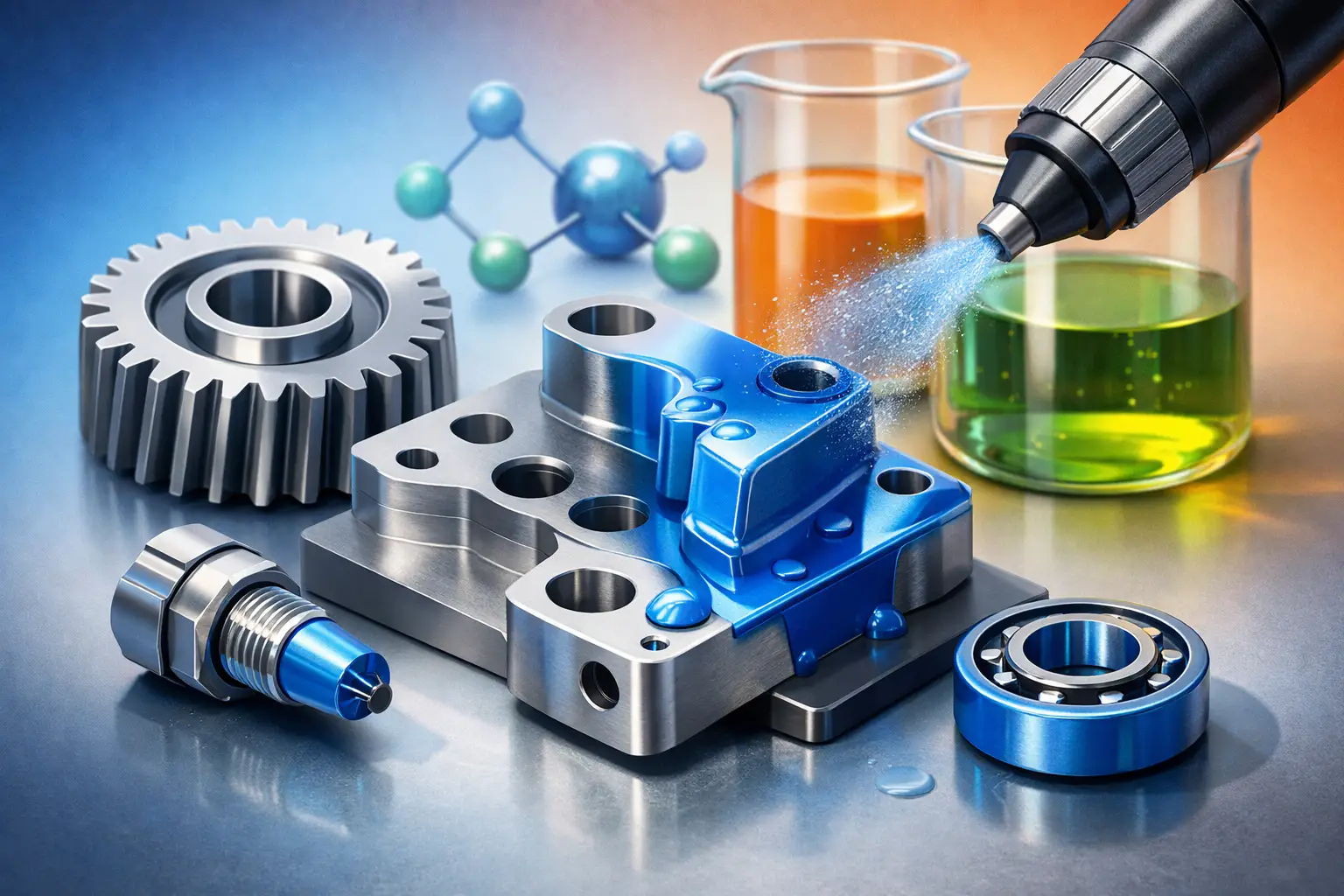
A valve seat that drifts out of tolerance by a few microns after repeated chemical exposure does not fail dramatically. It fails quietly – through swelling, surface attack, particle formation or a gradual rise in friction. That is exactly why a chemical resistant coating for precision parts is rarely a cosmetic add-on. In critical assemblies, it is often the difference between stable function and creeping process risk.
Precision parts present a distinct coating challenge. They are not simply small components. They are parts whose geometry, surface energy, electrical behaviour, friction profile and dimensional accuracy all matter at the same time. Any coating selected for chemical resistance has to protect the substrate without undermining the feature that makes the part precise in the first place.
Why chemical exposure becomes a precision problem
Chemical attack is usually discussed in terms of corrosion or visible degradation. For precision components, the more relevant issue is functional drift. Acids, alkalis, solvents, cleaning agents, fuels, hydraulic media and sterilisation chemistries can alter a surface long before the base material looks visibly damaged.
In medical technology, repeated exposure to disinfectants can affect miniature mechanisms, sensor housings and guide elements. In electronics, flux residues, aggressive cleaning media and ambient contaminants can compromise insulation performance and long-term reliability. In mechanical engineering and automotive applications, chemically loaded atmospheres, lubricants and process fluids can trigger wear, corrosion initiation or dimensional instability at interfaces where tolerances are unforgiving.
The consequence is not always immediate failure. More often, it appears as higher actuation forces, leakage, unstable signal quality, particulate contamination or shortened maintenance intervals. For technical decision-makers, this is where coating strategy moves from material protection into process assurance.
What a chemical resistant coating for precision parts must achieve
A suitable coating must do more than resist one aggressive substance in a laboratory snapshot. It has to perform under actual operating conditions, which means considering concentration, temperature, dwell time, cycling, mechanical load and interaction with the substrate.
For precision parts, four criteria usually determine whether a coating is genuinely fit for purpose. First, it must provide a reliable barrier against the relevant media. Second, it must maintain dimensional control, especially on tight fits, sealing surfaces and microstructured features. Third, it must adhere consistently to the underlying material, including metals, polymers, ceramics or mixed-material assemblies. Fourth, it must remain reproducible across batches and scalable into production.
That sounds straightforward, but trade-offs are common. A thick protective layer may improve barrier performance while compromising a finely defined tolerance chain. A coating with excellent chemical inertness may have limitations in tribological performance. Another may protect well against solvents but perform less convincingly under thermal cycling or plasma sterilisation. Selection therefore depends on the application, not on a generic promise of resistance.
Coating technology depends on geometry and function
The wrong question is, “Which coating is best?” The better question is, “Which coating architecture fits the part, the media and the failure mode?”
Conventional wet coatings can be suitable for larger industrial parts, but they often reach their limits with highly precise geometries, blind holes, inner surfaces or miniature assemblies. Where edge build-up, uneven thickness or curing-related stress are problematic, thin-film processes become far more attractive.
Parylene coatings, for example, are often specified when uniform, pinhole-free coverage is required on complex three-dimensional geometries. Because the deposition process is vapour-based, the coating can conform closely to intricate structures without the line-of-sight constraints seen in some other technologies. That makes it relevant for components where chemical resistance must be combined with electrical insulation, low friction or biocompatibility.
Plasma-based and hybrid thin-film processes can extend the design space further. They allow surface properties to be tailored with greater precision, whether the target is adhesion promotion, barrier performance, surface activation or a defined functional top layer. PVD and CVD processes may also be appropriate where hardness, wear resistance or additional functional properties must be engineered alongside chemical stability.
For many applications, the best answer is not a single coating family but a coordinated process chain. Pretreatment, activation, adhesion control and post-process verification often determine real-world performance just as much as the nominal coating material.
Chemical resistance is never a standalone specification
A recurring mistake in procurement and development is to define chemical resistance too broadly. Components are described as needing to be “resistant to solvents” or “safe against disinfectants” without stating the actual chemical profile, exposure scenario or acceptance criteria.
That leaves too much room for interpretation. Ethanol exposure is different from peroxide-based sterilisation. Short-term splashing is different from permanent immersion. Room temperature operation is different from repeated thermal cycling in chemically active media. Even the cleaning regime can be more aggressive than the operational environment itself.
A technically sound specification starts with the media map. Which chemicals occur, in what concentration, at which temperatures, for how long, and under which mechanical conditions? Only then does the conversation about coating selection become meaningful.
For precision parts, this specification work should also include the allowable change in dimensions, roughness, friction behaviour, dielectric properties and particle generation. A coating can survive the chemistry and still be wrong for the component if it disrupts assembly or functional performance.
Where failures often begin
Most coating failures on precision parts do not begin with catastrophic dissolution. They begin at interfaces and details.
Sharp edges may see altered local thickness. Poorly prepared surfaces can reduce adhesion long before the coating encounters the target medium. Trapped contamination from prior manufacturing steps can create weak points. Mixed substrates within one assembly can behave differently during pretreatment and deposition. Even handling after coating may introduce defects that only become visible after chemical exposure.
This is why process development matters. In high-specification sectors, coating quality is not defined only by the deposited layer. It is defined by the stability of the entire route – substrate assessment, cleaning, masking concept, fixturing, process control, inspection and validation against the real application profile.
For regulated industries, this becomes even more significant. Reproducibility, traceability and documented process windows are not administrative extras. They are part of the technical value of the coating solution.
How to evaluate a chemical resistant coating for precision parts
Qualification should be anchored in the component’s actual duty cycle rather than in generic material data. That usually means combining chemical exposure trials with functional testing.
If the part is a micro-mechanical element, friction and wear should be assessed after exposure, not just before. If it is an electrical component, insulation stability and surface leakage may matter more than visual appearance. If it is used in fluid handling, sealing performance and particle behaviour may be decisive. For miniature medical components, sterility-related processing and repeated cleaning cycles can be as important as the operational media itself.
Accelerated ageing can be useful, but only if the acceleration mechanism reflects the application. A harsh soak test may identify gross incompatibilities, yet still miss failure modes caused by cyclic stress, local attack or repeated assembly movement. The objective is not to produce the harshest test. It is to produce the most informative one.
At this point, an experienced development partner adds value by translating field conditions into a qualification plan that is technically meaningful and realistic for production scale-up. That is often where projects either become efficient or drift into costly iteration.
Integration into production is part of the decision
For industrial users, coating performance alone is not enough. The process must also fit the manufacturing model. Batch size, throughput, masking effort, inspection strategy and compatibility with existing quality systems all influence the economic case.
A highly effective coating can still be the wrong choice if it introduces unstable lead times, excessive handling risk or poor repeatability across series production. Conversely, a carefully engineered thin-film process can reduce rejects, improve field reliability and support tighter functional windows, even if the initial qualification phase is more demanding.
This is particularly relevant for companies deciding between outsourced coating and in-house process integration. Both models can be valid. The decisive factor is whether the application requires flexible project-based support, serial coating capacity or a custom-built coating system aligned with internal manufacturing requirements. Providers with expertise in both coating services and plant engineering can assess that choice more realistically because they understand not only the coating chemistry but also the production consequences.
NTTF Coatings works precisely in this intersection – where application-specific coating development, industrial reproducibility and customised system design must align.
The better question is not resistance alone
When engineers ask for chemical resistance, they are often really asking for functional stability over time. That broader perspective leads to better decisions. The right coating should not merely survive contact with aggressive media. It should preserve what makes the component valuable: its tolerance, its reliability, its electrical or mechanical performance, and its consistency in production.
For precision parts, that usually rules out generic answers. The technically sound route starts with the actual media, the real geometry and the real failure mechanism. From there, coating technology becomes less of a catalogue choice and more of an engineered surface solution. That is where durable performance usually starts.
