
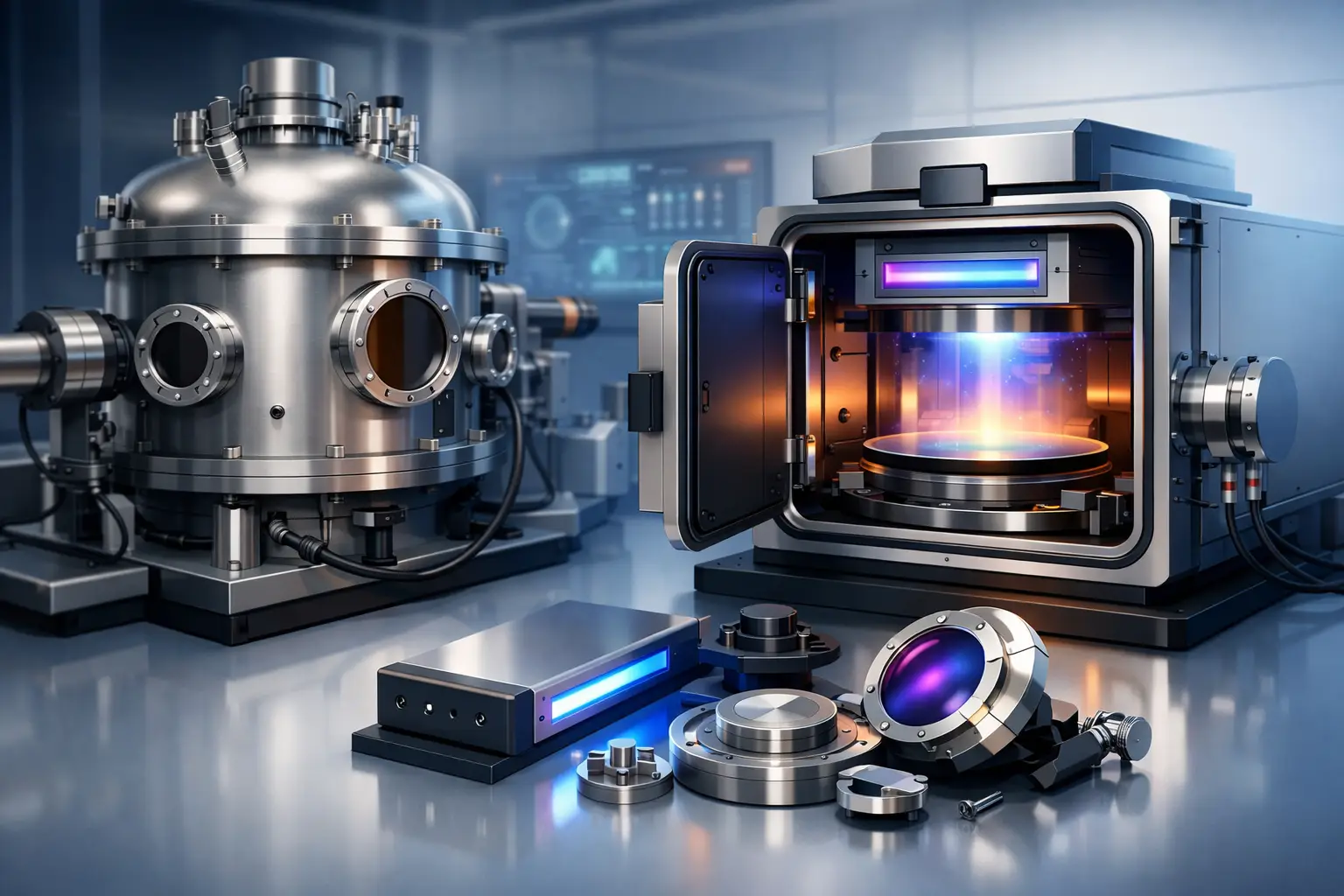
A coating chamber retrofit is rarely driven by the age of a vacuum vessel alone. The decisive trigger is usually a measurable loss of process capability: coating thickness drifts between batches, cycle times increase, maintenance intervals shorten, or a proven product can no longer be manufactured with the required repeatability. For manufacturers of medical devices, electronics, aerospace components and precision engineering parts, these deviations affect more than output. They can put qualification status, delivery reliability and product performance at risk.
Replacing an entire coating system may appear to be the straightforward answer. In many cases, however, the chamber, pumping architecture or handling concept still provides a sound mechanical basis. A technically well-planned retrofit can renew the components that determine coating quality while retaining assets that remain fit for purpose. The result is not merely a modernised machine, but a coating process aligned with current production, quality and regulatory requirements.
When a coating chamber retrofit is the better investment
The decision between retrofit and replacement depends on the condition of the existing system and on the future process window. A chamber with intact geometry, reliable vacuum integrity and sufficient internal volume can often be retained. Conversely, severe corrosion, structural damage, incompatible chamber materials or a fundamentally inadequate loading concept may make a new system the more economical route.
A retrofit is particularly compelling when the current plant has proven its value for a specific component family, but individual subsystems no longer meet the required standard. Typical examples include obsolete control hardware, insufficient sensor resolution, unstable temperature control, limited recipe management or pumps that no longer achieve the pressure behaviour needed for reproducible deposition.
For Parylene processes, plasma activation and PVD or CVD applications, the relevant question is not simply whether a system still runs. It is whether it can maintain the pressure, temperature, gas flow, plasma conditions and handling sequence needed to produce the specified functional layer. A chamber that completes a cycle without alarms may still be incapable of delivering consistent barrier performance, adhesion, electrical insulation or biocompatibility.
Start with process capability, not component replacement
A successful coating chamber retrofit begins with an engineering assessment of the complete process chain. Replacing a controller without analysing the vacuum system, loading arrangement and process chemistry can shift the problem rather than solve it. Thin-film processes are interdependent: a change in one subsystem can alter deposition rate, film morphology, adhesion or particle formation elsewhere.
The assessment should compare actual operating data with the performance required for the next years of production. This includes base pressure, pump-down profile, leak rate, temperature stability, gas delivery accuracy, power supply behaviour and cycle repeatability. Where historical data are incomplete, controlled test runs and targeted measurements provide a more reliable starting point than assumptions based on machine age.
Equally important is the component geometry. A coating that performs well on flat test coupons may behave differently on deep recesses, sharp edges, lumens, assembled electronic modules or densely packed fixtures. Retrofitting the chamber therefore often requires reviewing not only the process equipment, but also racks, masks, rotation mechanisms and loading density.
Vacuum performance and contamination control
Vacuum stability is central to many high-performance coating processes. Ageing seals, valve seats, feedthroughs and pump components can introduce leakage, backstreaming or extended evacuation times. These effects may appear minor in isolation, yet they influence residual gas composition and the consistency of the deposition environment.
A retrofit may include revised sealing concepts, modern vacuum valves, dry pumping technology, improved filtration or a redesigned foreline arrangement. The appropriate configuration depends on the process. For example, a system handling sensitive monomers or reactive precursors requires a different approach to exhaust treatment and contamination prevention than a chamber operated for metallic PVD layers.
The chamber interior also deserves attention. Deposits accumulated over years can become a source of particles or uncontrolled outgassing. Surface refurbishment, replaceable liners and a maintenance concept tailored to the coating chemistry can improve cleanliness while reducing unplanned stoppages.
Controls, data integrity and recipe management
Control technology is often the most visible part of a coating chamber retrofit, but its value lies in more than a new human-machine interface. Modern controls enable precise sequencing, reliable interlocks, condition monitoring and traceable recording of critical process parameters.
For regulated production, the ability to document each run is especially valuable. Batch-specific records can capture pressures, temperatures, gas flows, power levels, deposition times and alarm events. This supports deviation analysis and gives quality teams a stronger evidence base when assessing product conformity.
Recipe management must be designed around authorised process windows rather than operator convenience alone. Clear access levels, parameter limits and change logging reduce the risk that a proven process is unintentionally altered during daily operation. Where integration with manufacturing execution or quality systems is required, interfaces should be specified at the engineering stage, not added as an afterthought.
Retrofitting for the coating technology in use
The technical priorities vary substantially by process. A generic upgrade package is therefore rarely sufficient.
In Parylene coating systems, the relationship between vaporisation, pyrolysis, chamber conditions and cold-trap performance determines deposition behaviour. Upgrading temperature zones, improving thermal insulation or refining precursor dosing can help stabilise film formation. Yet higher throughput is not automatically beneficial. If loading density rises without considering gas transport and component shadowing, thickness distribution and conformality may deteriorate.
For plasma processes, power delivery, matching behaviour, gas distribution and electrode condition directly influence activation, cleaning or functionalisation results. Retrofitting may involve a new RF generator, improved matching network, mass flow control or chamber-specific electrode design. The objective is a controlled plasma environment that supports repeatable surface energy and adhesion, not simply a higher nominal power rating.
PVD and CVD systems place additional emphasis on source condition, substrate positioning, heating, gas handling and particle control. Depending on the required layer, a retrofit may incorporate upgraded sputter sources, evaporation equipment, substrate rotation, bias capability or optical process monitoring. Here, precision on an atomic level must be translated into practical manufacturing stability across the full batch.
Qualification must be planned alongside engineering
A retrofit changes the equipment state and may change the coating outcome. For critical applications, qualification cannot begin after installation has been completed. It should be planned in parallel with the technical concept.
The scope depends on the application, risk class and applicable quality framework. At minimum, manufacturers should define the critical quality attributes of the coating before the project starts. These may include thickness range, adhesion, pinhole density, corrosion resistance, dielectric properties, friction behaviour, optical characteristics or biological compatibility.
A structured approach normally covers four connected phases:
- Baseline characterisation establishes the current machine condition and identifies the gap to the required process capability.
- Design specification defines equipment functions, critical parameters, safety requirements, interfaces and acceptance criteria.
- Installation and functional testing verifies that the rebuilt system performs as specified under controlled conditions.
- Process validation or requalification demonstrates that representative components meet their defined coating requirements over repeated runs.
This approach prevents a common and costly mistake: completing a technically successful upgrade, then discovering that the documentation or test evidence does not support release for production. It also makes it easier to distinguish machine-related variation from variation caused by pre-treatment, component batches or handling.
Plan the retrofit around production realities
Downtime is often the strongest argument against a retrofit, particularly where coating capacity is constrained. The answer is careful project sequencing rather than accepting avoidable risk. Engineering, procurement, software preparation and factory acceptance testing can frequently be completed before the existing chamber is taken out of service.
Critical assemblies should be pre-built and tested where possible. The shutdown window can then focus on installation, connection, commissioning and agreed acceptance runs. Spare parts strategy matters as well. A modernised chamber remains dependent on consumables and wear components, so maintainability should be assessed alongside process performance.
Cost evaluation should include more than the capital expenditure. Compare expected lifetime, energy use, maintenance effort, yield loss, qualification burden and the cost of unplanned downtime. A lower initial retrofit cost is not necessarily advantageous if it leaves an obsolete subsystem in place or fails to create sufficient capacity for future products. Equally, full replacement can be disproportionate when the chamber structure and core process concept remain technically suitable.
A retrofit as a platform for future process development
The strongest retrofit projects do not merely restore a previous state. They create controlled headroom for new requirements: tighter tolerances, additional product variants, improved traceability or a transition from development batches to serial production. This requires a system architecture that can accommodate future sensors, process modules or automation without compromising the validated process.
At NTTF Coatings, retrofit concepts are assessed in the context of the intended coating function, component geometry and production environment. That perspective is essential because the technically correct upgrade is determined by the application, not by a standard parts list.
Before committing to a replacement decision, establish which process variables truly limit quality and capacity. A chamber retrofit delivers its full value when it is engineered as a controlled improvement to the coating process - with measurable acceptance criteria, traceable implementation and a clear route from pilot runs to dependable production.
