
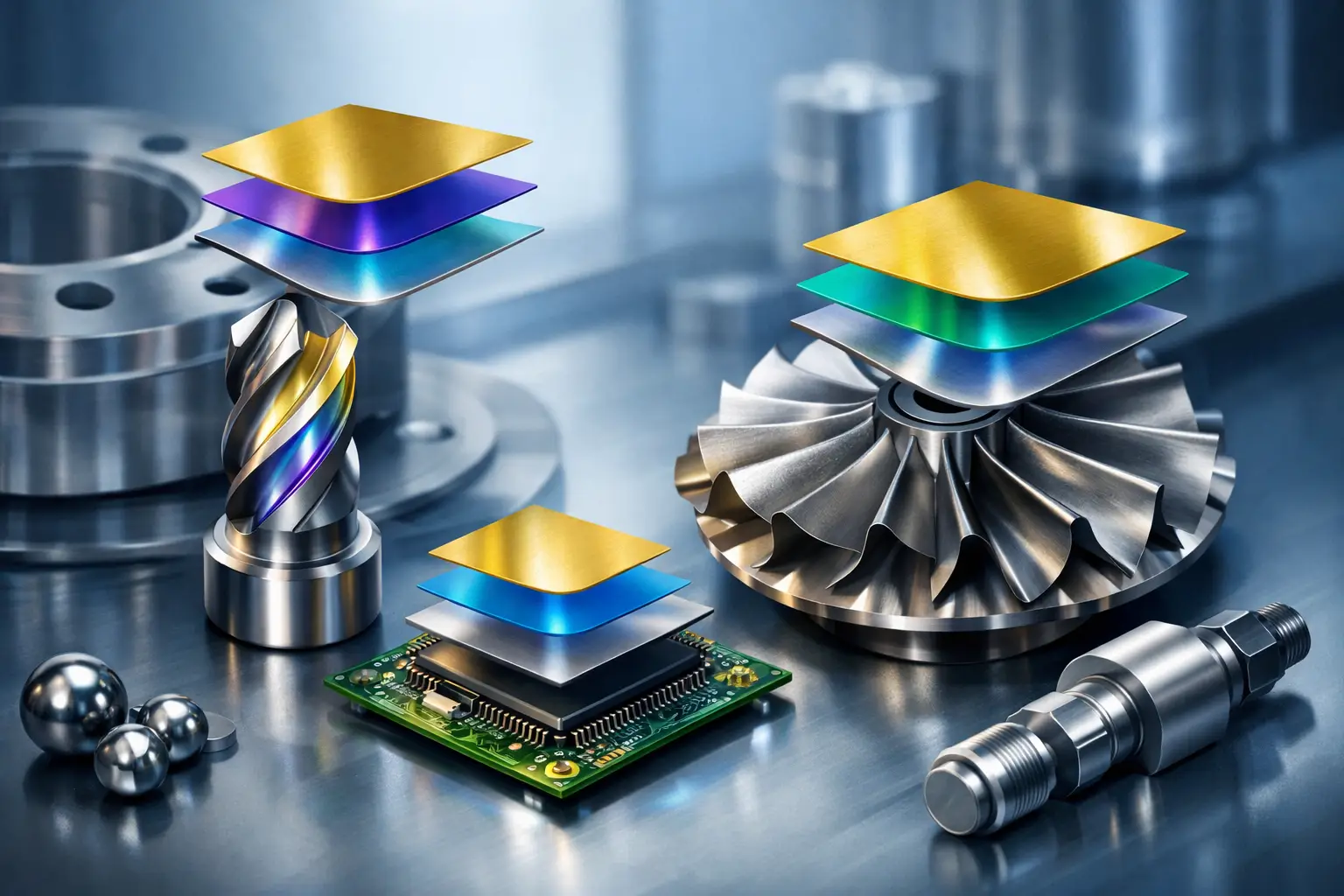
A coating that performs well in isolation can still fail at the component level. Adhesion may be insufficient on the chosen substrate, a hard layer may be too brittle under cyclic loading, or the required electrical function may conflict with corrosion protection. Hybrid thin film advantages arise precisely where one material class cannot meet the full requirement profile. By combining complementary coating chemistries and deposition mechanisms, hybrid systems enable functional surfaces that are engineered around the component, its environment and its manufacturing route.
For technical decision-makers, the relevant question is therefore not whether a hybrid coating is more advanced than a single-layer solution. It is whether a defined layer architecture can reduce a specific failure risk, improve product performance or make a production process more reliable. The answer depends on substrate material, geometry, operating conditions, regulatory requirements and target service life.
Why hybrid thin film advantages matter in practice
A hybrid thin film combines at least two material or process principles in one coordinated coating architecture. This may involve inorganic and organic layers, plasma-activated interfaces, PVD functional layers, CVD barrier layers or polymeric topcoats. The individual layers do not simply sit alongside one another. Their order, thickness, interface chemistry and thermal compatibility determine whether the overall system performs as intended.
This approach is particularly relevant where parts are exposed to several stresses simultaneously. A sensor housing, for example, may require moisture protection, electrical insulation, low particle generation and compatibility with subsequent assembly. A medical component may need controlled surface energy, chemical resistance and biocompatibility without materially changing critical dimensions. A single coating can address one or two of these points, but may introduce limitations elsewhere.
Hybrid systems allow these requirements to be separated and then reconnected within a defined process window. A thin adhesion-promoting layer can prepare a difficult substrate. A dense inorganic layer can contribute barrier performance or hardness. A conformal polymer layer can protect edges, cavities and complex geometries. The result is not a universal coating, but a purpose-designed functional stack.
The technical basis of a hybrid layer system
Each layer has a defined role
The value of a hybrid system lies in functional allocation. Rather than asking one layer to provide every property, the coating architecture assigns specific tasks to individual layers. An interface layer may improve bonding to stainless steel, aluminium, glass or polymer substrates. A middle layer may provide dielectric behaviour, wear resistance or a diffusion barrier. The outer layer may determine friction, wettability, chemical resistance or handling characteristics.
This principle gives engineers more adjustment options than a monolithic coating. Layer thicknesses can be varied independently within practical limits. Material combinations can be selected to manage thermal expansion differences. Surface pretreatment can be tuned to establish reproducible adhesion before the functional layers are deposited.
Interfaces decide whether the system works
The interface between two layers is often more critical than the bulk material itself. Contamination, surface oxides, insufficient activation or unsuitable process temperatures can lead to delamination long before the intended layer properties are reached. For this reason, hybrid coating development begins with substrate analysis and component cleanliness, not with the final topcoat.
Plasma processes can play a central role at this stage. They can clean, activate or chemically modify surfaces before subsequent deposition. This helps create controlled bonding conditions, particularly for low-energy polymers, complex metal alloys and parts with demanding cleanliness specifications. The coating process must then maintain these conditions consistently from batch to batch.
Thin layers preserve geometry
Many industrial components cannot tolerate a significant dimensional change. Tight fits, microfluidic channels, electrical contacts, moving mechanisms and miniature assemblies all impose strict limits on coating thickness. Thin film technology allows functional properties to be added while preserving defined tolerances.
That does not mean thinner is always better. A barrier layer that is too thin may not provide adequate defect tolerance. A wear layer may need enough thickness to withstand the expected contact pressure and number of cycles. The correct thickness is an engineering parameter derived from the application, not a standard catalogue value.
Hybrid thin film advantages for critical applications
The primary benefit is the ability to combine properties that would otherwise compete. A coating can be designed to improve corrosion resistance without neglecting electrical insulation. It can provide a low-friction outer surface while maintaining strong adhesion to the substrate. It can protect sensitive electronics against moisture and chemicals while reaching recessed areas that conventional line-of-sight processes may not cover adequately.
A second advantage is improved durability through layered stress management. Hard inorganic films can offer excellent mechanical and barrier properties, but they may be sensitive to deformation or local stresses in certain applications. A compatible intermediate or polymeric layer can help accommodate strain, reduce crack propagation or protect vulnerable interfaces. Whether this is beneficial depends on loading mode, substrate stiffness and operating temperature.
Third, hybrid architectures support more precise surface functionality. Electrical behaviour, optical properties, wetting, friction and biocompatibility are not merely material characteristics. They are influenced by surface chemistry, roughness, layer continuity and the interaction of the finished part with its environment. By combining technologies, these variables can be adjusted with greater control.
Finally, hybrid coating can improve process integration. In regulated or high-value manufacturing, a technically effective layer is not enough. The process must be validated, documented and reproducible at the required output. A well-designed hybrid process defines pretreatment, handling, masking, deposition sequence, inspection and traceability as one manufacturing system. This is especially relevant when coating is transferred from feasibility work into serial production.
Typical industrial use cases
In medical technology, hybrid thin films can support the protection of electronic modules, sensor components and metallic instruments where chemical resistance and material compatibility are both required. Depending on the device and patient-contact scenario, biocompatibility assessments, cleaning methods and sterilisation exposure must be included in the specification from the beginning.
For electronics and sensor technology, hybrid systems are useful where moisture, ionic contamination and temperature cycling threaten long-term reliability. Conformal layers can protect complex assemblies, while additional functional films can support dielectric performance, adhesion or local shielding requirements. Component geometry and uncoated contact areas must be considered early, particularly where masking is necessary.
In mechanical engineering and automotive applications, the focus often lies on friction behaviour, wear resistance, corrosion protection and service life. A hybrid design can be appropriate for precision parts that encounter lubricants, abrasive particles or repeated movement. However, a coating cannot compensate for unsuitable base material selection, poor surface finish or inadequate lubrication design. The complete tribological system must be evaluated.
Aeronautics and defence applications frequently require a combination of low weight, environmental resistance, electrical function and documented process stability. Here, the qualification route may be as demanding as the coating performance itself. Material batches, process parameters and inspection criteria need to be defined in a manner that supports consistent evidence across the supply chain.
How to specify a hybrid coating effectively
A useful project specification starts with the failure mechanism rather than the preferred deposition method. Is the component failing through corrosion, abrasion, moisture ingress, electrical leakage, particle release, poor adhesion or chemical attack? Identifying the dominant risk makes it possible to select relevant tests and prevents unnecessary complexity in the layer stack.
The next step is to define the real boundary conditions. These include substrate composition, surface roughness, geometry, allowable thickness, operating temperature, media exposure, mechanical loading and expected lifetime. For electronic assemblies, voltage, insulation resistance and thermal cycling may be decisive. For moving components, contact pressure, counterbody material and lubrication are equally relevant.
Testing should reflect the application rather than rely solely on generic coating data. Adhesion tests, climate exposure, salt spray, chemical immersion, dielectric testing, abrasion testing or cyclic mechanical loading may all be appropriate, but their value depends on how closely they represent field conditions. A coating that passes a standard laboratory test is not automatically suitable for a complex assembly.
Where a hybrid solution may not be the right choice
Hybrid systems add capability, but they also add process steps, qualification effort and interface risks. If a single established coating meets the requirement reliably, a more complex architecture may offer little economic benefit. Similarly, when extremely high throughput, low unit cost or very simple geometries dominate the decision, a hybrid process must justify its additional manufacturing effort.
Material compatibility also sets clear limits. Deposition temperatures, vacuum conditions, plasma exposure and curing steps must not damage sensitive substrates, adhesives, solder joints or embedded electronics. In some cases, the best solution is to modify the component design, improve substrate preparation or select a different base material rather than add further coating layers.
The strongest hybrid coating programmes are therefore developed as joint engineering projects. They connect application analysis, material selection, process design, qualification and scale-up instead of treating coating as the final production step. For demanding components, that early technical discipline is often what turns a promising layer stack into dependable performance over the full service life.
