
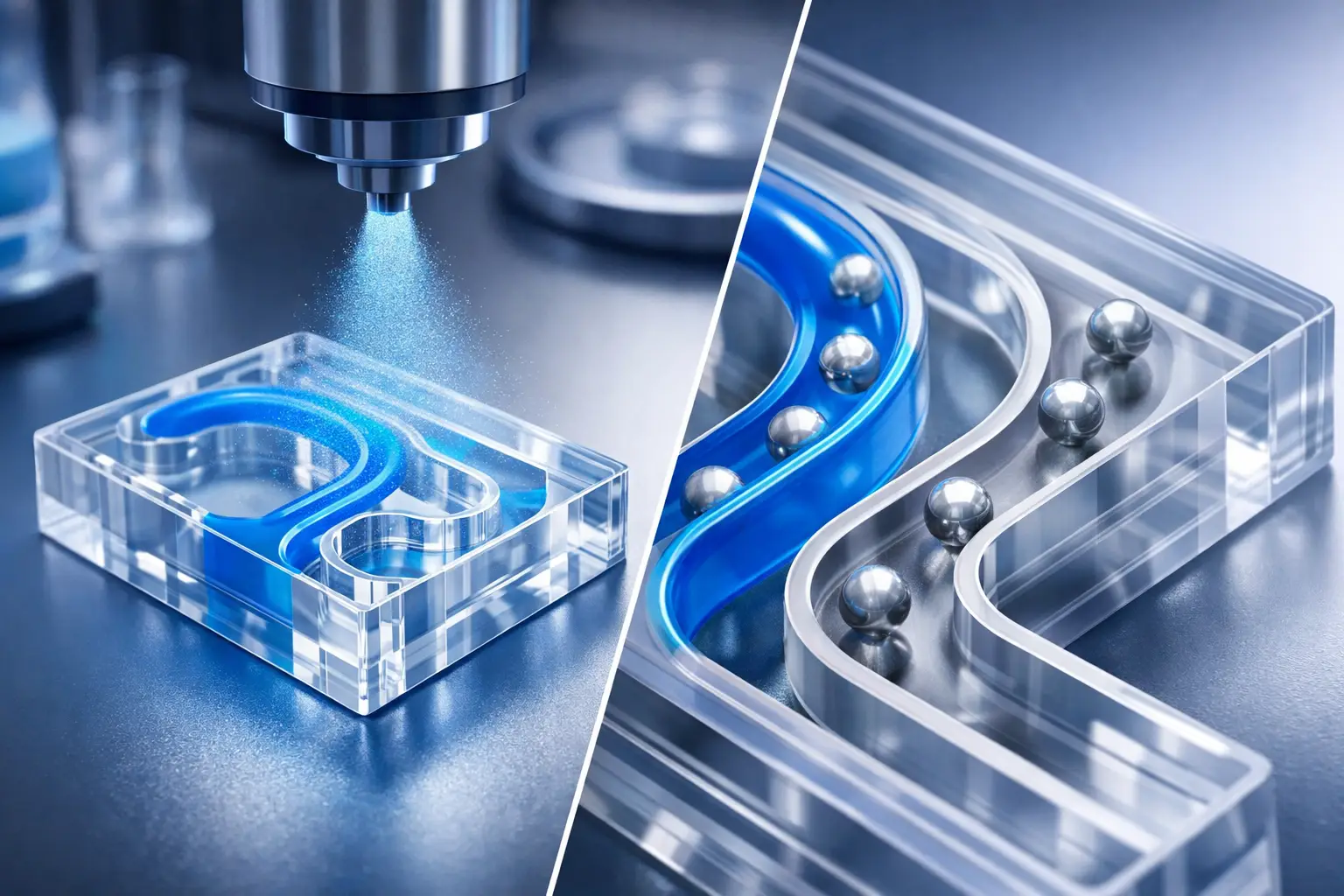
A microfluidic manifold, catheter lumen or cooling passage can fail long before its external surface shows any sign of exposure. If the functional surface sits inside a narrow channel, protection must reach it with controlled thickness and without obstructing flow. So, can Parylene coat internal channels? In many cases, yes. Its vapour-deposition mechanism makes Parylene exceptionally well suited to conformal coating of accessible internal geometries. But reliable results depend on channel design, aspect ratio, surface condition and a process developed for the component rather than a nominal coating thickness alone.
Why Parylene reaches internal surfaces
Parylene is deposited through a room-temperature chemical vapour deposition process. A solid dimer is vapourised, thermally cleaved into reactive monomer molecules and introduced into a deposition chamber under vacuum. These molecules travel through the chamber and polymerise directly on exposed surfaces, forming a continuous, pinhole-free polymer film.
Unlike spray, dip or many liquid coating systems, Parylene is not carried by a liquid vehicle. There is no meniscus, drainage path or surface-tension effect preventing material from entering narrow features. The gaseous monomer can diffuse into bores, lumens, cavities and channels, coating all surfaces it can physically access. This is the origin of Parylene’s well-known conformality.
However, conformality should not be confused with unlimited penetration. The monomer is consumed as it polymerises. Along a long or restrictive channel, the available monomer concentration can decrease with depth. The coating may therefore be continuous but thinner towards the centre of the channel, or may not meet the required minimum thickness at its deepest point. For high-value components, this distinction is decisive.
Can Parylene coat internal channels with uniform thickness?
Uniformity inside a channel is governed by molecular transport and reaction kinetics. The relevant question is not simply whether the channel has an opening, but how easily vapour can enter, travel through and leave the feature while deposition takes place.
A short, straight bore with openings at both ends is generally favourable. Vapour can enter from either side, and displaced gas can escape. A long blind hole is more demanding because the monomer must travel to the base through one entrance, while residual gas and reaction by-products have limited routes out. Curved channels, dead legs, sudden reductions in cross-section and porous assemblies introduce further restrictions.
The practical limit is commonly expressed through aspect ratio: channel length relative to hydraulic diameter. There is no universal threshold at which Parylene stops working. A given geometry may perform well at one target thickness but become difficult when a thicker barrier layer is required. The chemistry grade, chamber loading, fixture orientation, deposition rate and pressure profile also change the result.
For that reason, feasibility should be established against a defined acceptance criterion. “Coated internally” is not a sufficient specification where corrosion resistance, dielectric performance, biocompatibility or fluid purity depend on a minimum thickness at the deepest location.
Geometry determines access
Internal channels should be assessed as a vapour-flow problem. Four features are particularly influential:
- channel diameter or hydraulic diameter;
- total path length and the presence of branches or bends;
- whether one or both ends are open during coating;
- transitions such as restrictions, valves, filters, seals or assembled interfaces.
Small dimensions alone do not rule out Parylene. A narrow but short and fully vented passage may coat more predictably than a much larger blind cavity with a complex internal profile. Equally, a channel that is technically reachable may be unsuitable if the allowed dimensional change is only a few microns and the required protective thickness consumes too much flow area.
Deposition is not a line-of-sight process
Parylene’s ability to reach concealed surfaces is a substantial advantage over line-of-sight technologies such as many PVD processes. It can protect the inside of metallic, polymeric or ceramic components where direct visual access is absent. This is valuable for miniature electronics housings, medical-fluidic components, precision sensors and corrosion-sensitive assemblies.
Yet the process remains dependent on open vapour paths. A sealed cavity cannot be coated internally after assembly. Trapped volumes can also retain moisture, cleaning residues or air, all of which may impair deposition quality. Where internal protection is required, coating before final closure is often the most reliable route. If assembly before coating is unavoidable, ventilation paths and masking concepts must be considered during design.
The process factors that decide channel coverage
Achieving repeatable internal coverage requires more than selecting a Parylene type and setting a nominal thickness. The component preparation and deposition recipe must work together.
Surface cleanliness is fundamental. Machining oils, mould-release agents, particulate contamination and residues from aqueous cleaning can remain inside passages that appear clean externally. Under vacuum, contaminants may outgas and interfere with adhesion or local film formation. Cleaning and drying methods must therefore be validated for the actual internal geometry, not only for open witness surfaces.
Adhesion promotion may also be required, particularly on metals, certain engineering polymers and complex multi-material assemblies. The appropriate pre-treatment depends on substrate, end-use environment and regulatory constraints. A treatment that improves external adhesion is only useful if it reaches the internal surface consistently.
Chamber loading is another underestimated variable. Components positioned closely together can shield openings or alter the local vapour distribution. Fixtures must hold parts securely while maintaining access to critical bores and lumens. For production work, the fixture is part of the coating process, not a secondary handling detail.
The deposition profile can then be tailored to balance throughput with penetration. Slower deposition conditions may support deeper transport in difficult geometries, but they can increase cycle time and must be assessed against coating performance. The correct approach is not to pursue maximum thickness or maximum speed independently. It is to demonstrate that the defined internal region achieves the required thickness, adhesion and functional performance with acceptable process capability.
Design choices that make internal coating more reliable
The most effective projects address coating access early in product development. A few design decisions can materially improve the probability of uniform coverage.
Where possible, provide access from both ends of a passage. Avoid unnecessary dead ends, sharp internal constrictions and junctions that create stagnant volumes. If a blind channel is essential, specify the protected length and required thickness at the base explicitly. This allows the coating process to be developed around the true functional requirement.
Consider dimensional tolerance from the outset. Parylene coats every accessible surface, so the channel diameter reduces by approximately twice the local film thickness. For a 10 µm coating, a cylindrical channel may lose around 20 µm in diameter, subject to internal thickness distribution. This can be negligible in a large cooling channel but significant in a precision dosing pathway or microfluidic system.
Material selection and assembly sequence matter as well. Components that combine elastomers, adhesives, metals and polymers may outgas differently under vacuum or react differently to pre-treatment. A coating trial should include the final material stack, joining methods and cleaning route wherever possible. Simplified test coupons are useful for screening, but they rarely capture the full behaviour of a finished internal assembly.
How internal coverage should be verified
External witness coupons alone cannot prove performance inside a restrictive channel. They can confirm that the chamber deposited material, but not that the critical internal surface received the specified thickness.
Verification methods should reflect the component and its risk profile. Sectioning and microscopic measurement provide direct evidence at selected locations. Purpose-designed test geometries can map penetration under controlled conditions. Gravimetric methods, electrical insulation tests, fluid exposure tests or corrosion testing may provide functional confirmation where destructive measurement of every component is impractical.
For medical technology or other regulated applications, the verification plan should define sampling, measurement location, acceptance limits and traceability before qualification begins. A technically impressive cross-section from one development part is not equivalent to a controlled production process. Repeatability across batches, fixtures and component lots must be demonstrated.
From feasibility trial to production process
Internal channel coating is best approached as an engineering task with clear inputs: substrate, channel geometry, target coating type and thickness, permitted dimensional change, service media, operating temperature and required verification. Those inputs make it possible to distinguish a promising laboratory result from an industrially stable process.
At NTTF Coatings, this means assessing the complete coating window, including pre-treatment, part handling, fixture design, deposition parameters and inspection strategy. For customers integrating Parylene into their own production, the same knowledge must be translated into equipment design, process monitoring and reproducible operating procedures.
The useful next step is not to ask whether an internal channel can be coated in principle. Provide a representative part or geometry, identify the surface that must perform, and define what success means at that location. That turns Parylene’s exceptional conformality into a measurable, production-ready advantage rather than an assumption.
