
A coating decision often looks straightforward until the component reaches qualification. The real question in parylene vs epoxy coating is not which material is better in the abstract, but which one remains reliable when geometry, media exposure, electrical performance and process windows become non-negotiable.
For technical teams in electronics, medical devices, aerospace and precision engineering, that distinction matters. Parylene and epoxy coatings can both protect surfaces, but they do so through very different deposition mechanisms, film structures and performance profiles. Those differences affect everything from edge coverage and dielectric behaviour to rework, throughput and long-term stability.
Parylene vs epoxy coating: the core technical difference
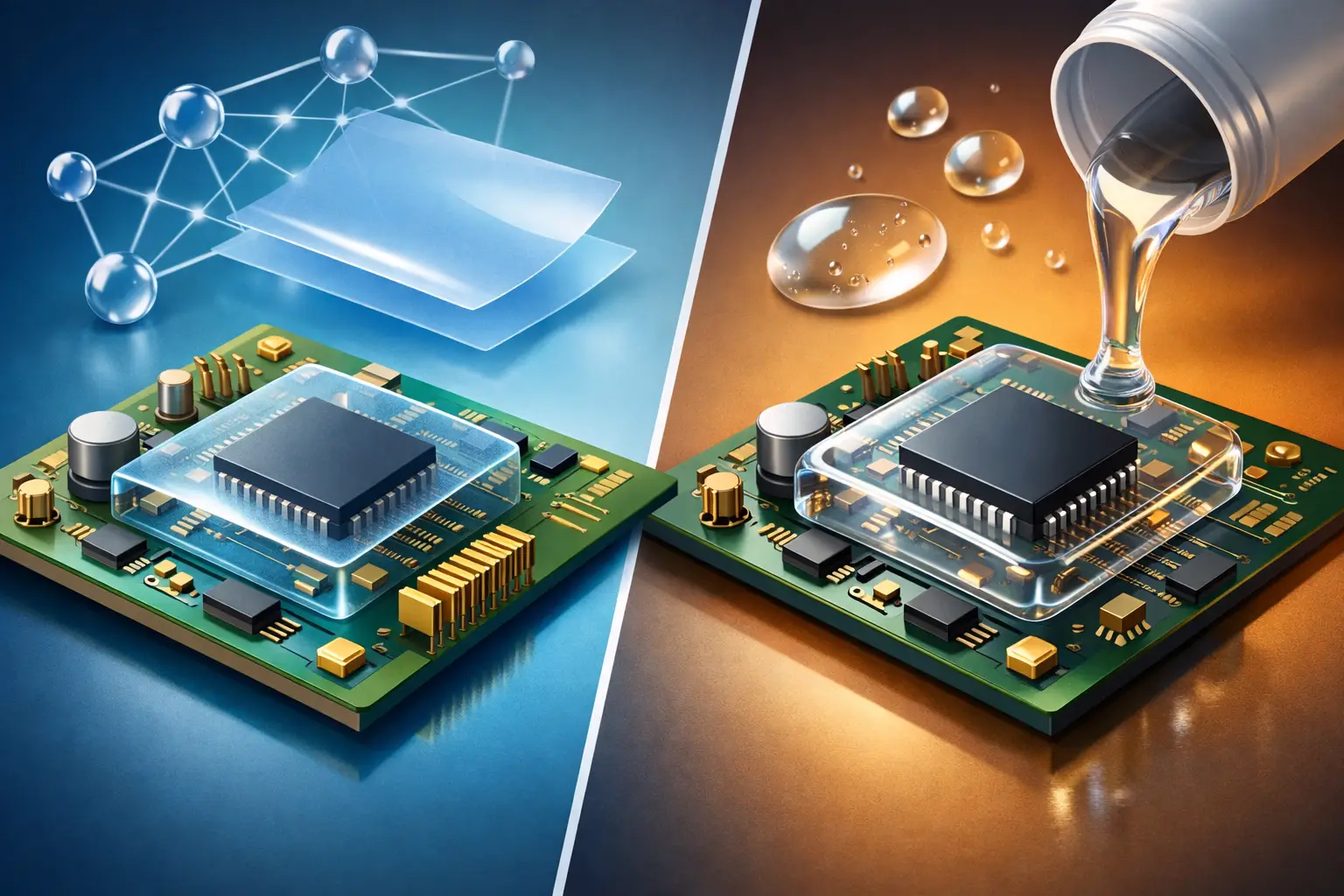
Parylene is a polymer deposited from the gas phase under vacuum. The coating forms through a CVD-type process and grows molecule by molecule on the substrate surface. That gives it a highly uniform, pinhole-minimised film, even on complex 3D geometries, internal cavities and sharp edges.
Epoxy coating is usually applied in liquid form by spraying, dipping, brushing or dispensing, then cured thermally or at ambient conditions depending on the system. It can build thicker films relatively easily and is widely used where mechanical protection, adhesion to prepared substrates and cost-efficient area coverage are the main requirements.
This process difference is decisive. Parylene is inherently conformal. Epoxy is application-dependent. If the component has fine structures, undercuts, narrow gaps or sensitive electrical zones, deposition physics becomes more relevant than the chemistry name on the data sheet.
Where parylene has a clear advantage
Parylene performs particularly well when thickness uniformity and complete coverage are critical. In miniaturised electronics, sensors, MEMS, implants or high-value assemblies, a few microns can determine whether a coating protects the function or disrupts it.
Because parylene deposits from the gas phase, it reaches surfaces that liquid coatings struggle to wet consistently. There is no meniscus formation, no solvent entrapment in the same way, and far less risk of local pooling at corners or thinning at edges. For densely packed PCBs or geometrically complex parts, that can translate into measurably higher process reliability.
Its barrier properties are another reason it is frequently chosen for demanding applications. Parylene provides very effective protection against moisture, chemicals and many corrosive influences at comparatively low film thicknesses. In sectors where weight, dimensional tolerance or electrical precision matter, this thin yet functional barrier is often preferable to a thicker conventional coating.
Biocompatibility can also be a deciding factor. Certain parylene grades are well established for medical technology because they combine chemical inertness with a controlled, reproducible coating architecture. Epoxy systems can also be formulated for specialised environments, but where prolonged contact with sensitive media or tissue-adjacent use is involved, validation requirements tend to favour coatings with a more established profile in regulated settings.
Where epoxy remains a practical choice
None of that makes epoxy obsolete. In fact, epoxy remains highly relevant where the application is less geometrically demanding and thicker protective layers are desirable. If the goal is encapsulation, mechanical reinforcement or broad-area coating on relatively accessible surfaces, epoxy may be the more pragmatic option.
Epoxy coatings can offer strong adhesion, good chemical resistance and useful mechanical toughness. They are often well suited to housings, larger assemblies, structural components and applications where local masking or selective application is acceptable. If a component does not require true conformality and can tolerate greater film thickness variation, epoxy can be efficient and economical.
The cure-based process can also integrate well into established production lines. Many manufacturers already work with liquid coating, mixing and curing infrastructure. That lowers the barrier to entry. For some use cases, especially where cost pressure is high and tolerances are more forgiving, epoxy is simply the right industrial compromise.
Thickness, tolerances and design freedom
One of the most consequential differences in parylene vs epoxy coating lies in thickness control. Parylene coatings are typically applied in thin, tightly controlled layers. This supports applications where connectors, contacts, moving parts or micro-scale features must remain within narrow dimensional tolerances.
Epoxy generally builds thicker films and is less uniform over complex shapes. That is not always a weakness. On exposed mechanical parts, a thicker layer may improve impact resistance or provide a more substantial physical barrier. But the same thickness can become a problem on miniaturised or tolerance-sensitive assemblies.
Design teams often discover this late. A coating that works on flat test coupons may interfere with clearances, mating parts or sensor response on the real component. Early coating selection therefore needs to reflect not just environmental exposure, but the actual geometry and function of the finished assembly.
Electrical performance and insulation behaviour
For electronics, insulation performance is rarely just a matter of quoting dielectric strength. Uniformity, absence of weak spots and behaviour around leads, solder joints and sharp features are equally important.
Parylene offers excellent dielectric properties in very thin layers and does so with highly consistent coverage. That makes it attractive for high-density electronics, fine-pitch assemblies and sensitive sensor systems. The coating can protect without significantly altering mass, profile or thermal behaviour.
Epoxy can also provide insulation, but its effectiveness is more sensitive to application quality. Voids, uneven wetting and edge effects may matter more, especially as geometries become smaller. On larger, less complex electrical components, this may be manageable. On high-value miniaturised systems, it can become a qualification risk.
Process integration and manufacturing reality
The right choice is not made in the lab alone. It must fit production.
Parylene requires a vacuum deposition process, controlled pre-treatment and disciplined masking where selective coating is required. That makes the process more specialised, but also highly reproducible when properly engineered. For companies scaling regulated or high-performance products, that repeatability is often worth more than a superficially simpler coating route.
Epoxy is more familiar in many factories, yet familiarity should not be confused with control. Liquid application introduces variables such as viscosity, pot life, wetting, operator influence, cure profile and solvent behaviour. On straightforward parts this is manageable. On critical components it can create variation that is difficult to eliminate without significant process development.
This is where an engineering-led approach matters. Coating selection should consider substrate preparation, masking concept, target thickness, inspection method, downstream handling and long-term field conditions as one integrated process chain rather than isolated steps.
Which industries tend to prefer which system?
Medical technology, implant-adjacent components, sensors and advanced electronics often favour parylene because the combination of conformality, thin-film control and chemical inertness aligns well with functional and regulatory requirements.
Automotive, industrial equipment and some mechanical assemblies may use either system depending on the component. If the part has complex geometry, electrical sensitivity or strict dimensional constraints, parylene tends to gain ground. If the requirement is broader protective coverage on larger, more accessible surfaces, epoxy may remain entirely appropriate.
Aerospace and defence applications often sit between these positions. Reliability under thermal, chemical and environmental stress is critical, but so are validation effort, repair strategy and supply-chain practicality. In these cases, selection usually comes down to the exact failure mode being addressed rather than a generic material preference.
How to choose in practice
If a component must be coated uniformly across complex geometry, with low thickness and high dielectric reliability, parylene is usually the stronger technical solution. If the component benefits from a thicker, mechanically tougher layer and the geometry is comparatively open, epoxy may be sufficient or even preferable.
The more demanding the component, the less useful broad claims become. Ask instead: what must the coating prevent, where is the design most sensitive, and which process can achieve that result repeatedly at production scale? Those questions usually clarify the decision faster than a long list of headline properties.
For many industrial projects, the decisive factor is not the coating itself but the development capability behind it. Material choice, pre-treatment, masking, deposition parameters and inspection need to work together. That is why technically demanding programmes are typically best served by a partner who can assess both coating performance and process implementation, from prototype through to serial production.
A good coating should not merely pass an initial test programme. It should give your component more design freedom, more process stability and fewer surprises once the product is in service.
