
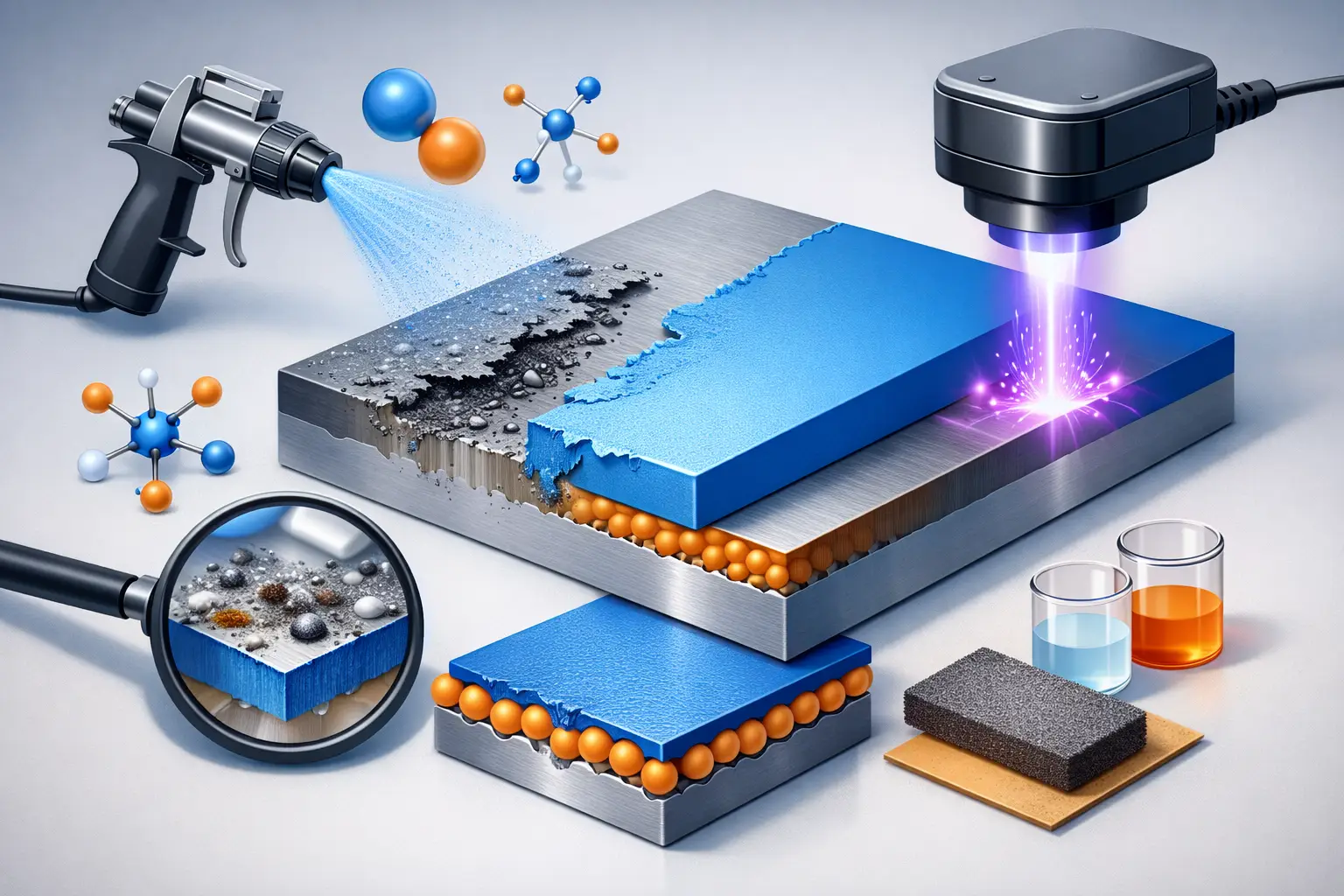
A coating rarely fails because the chemistry looked convincing on paper. In practice, adhesion breaks down at the interface – where substrate condition, process stability and coating design either work together or quietly undermine the result. That is why anyone asking how to improve coating adhesion should start with the full system, not with the coating material alone.
For technical decision-makers, the consequence is straightforward. Better adhesion is not achieved by adding a stronger layer in isolation. It comes from controlling surface energy, contamination, roughness, intermediate reactions, curing behaviour and mechanical stress across the entire process chain.
How to improve coating adhesion starts with the substrate
Every substrate brings its own adhesion logic. Stainless steel, aluminium, polymers, elastomers, ceramics and composite materials do not respond in the same way to pre-treatment or film deposition. A parameter set that performs well on one component geometry may underperform on another, even when the base material appears identical.
The first task is to understand what the coating actually has to bond to. Native oxides, absorbed moisture, mould release agents, machining oils, passivation layers or low-molecular-weight species on polymers can all reduce interfacial strength. In regulated sectors such as medical technology or aerospace, these effects matter not only for performance but also for reproducibility and validation.
Surface characterisation is therefore not a luxury step. Contact angle measurement, roughness analysis, microscopy and residue inspection provide the basis for choosing a viable route. If the substrate condition is not quantified, adhesion improvement becomes guesswork.
Cleanliness is usually the first limiting factor
Many adhesion issues are contamination issues in disguise. Parts may arrive visually clean and still carry residues that interfere with wetting or chemical bonding. Oils from machining, fingerprint contamination, packaging residues and additives blooming from polymer surfaces are common causes.
The right cleaning method depends on the substrate and the contamination profile. Aqueous cleaning may remove particulates and some ionic contamination effectively, while solvent cleaning may be required for organic residues. Plasma cleaning often adds value because it removes fine contamination while simultaneously activating the surface. The trade-off is that activation can decay over time, so the interval between pre-treatment and coating must be tightly controlled.
This is one of the most overlooked points in industrial production. A well-cleaned and activated part can still show poor adhesion if it sits too long before coating, or if it is repackaged in a way that reintroduces contamination.
Surface energy and roughness must be matched to the coating system
If a liquid or vapour-deposited coating cannot wet the surface properly, adhesion will remain inconsistent. Increasing surface energy is often central to improving bonding on polymers, fluorinated materials and other difficult substrates. Plasma processes are particularly effective here because they can tailor the surface at a very fine level without aggressive bulk treatment.
Roughness also matters, but more roughness is not automatically better. On some metallic components, controlled roughening improves mechanical anchoring. On precision parts, however, excessive roughness can create stress concentration points, voids or uneven film growth. For thin functional coatings, especially where barrier performance or electrical properties are critical, the optimum surface is often cleaner and more uniform rather than simply rougher.
This is why coating adhesion cannot be separated from coating function. A wear-protective PVD layer, a conformal Parylene coating and a plasma-polymerised functional film each interact with the substrate differently. The correct pre-treatment window is technology-specific.
Plasma pre-treatment is often decisive
For many advanced applications, plasma pre-treatment is the most controlled way to influence adhesion. It can remove organic residues, modify surface chemistry, increase surface energy and generate active sites for bonding. It also offers strong repeatability when integrated into a validated process.
Yet plasma is not a universal fix. Gas selection, power, pressure, exposure time and chamber loading all influence the result. Over-treatment may damage sensitive polymers or alter dimensions at the micro-scale. Under-treatment may create the appearance of activation without delivering durable adhesion. The process must therefore be developed against the actual component, not against a generic material data sheet.
Material compatibility is more important than nominal coating strength
A common procurement mistake is to compare coatings primarily by hardness, chemical resistance or thickness. Those metrics matter, but they do not answer the core adhesion question: will the coating accommodate the substrate’s mechanical, thermal and chemical behaviour over time?
If the coefficient of thermal expansion differs too strongly between coating and substrate, thermal cycling can generate interfacial stress. If the coating is too brittle for a flexible polymer component, cracking and edge delamination may follow. If the substrate outgasses during deposition, the interface may be compromised before the film is fully formed.
In other words, the best coating on paper may be the wrong coating in operation. Good adhesion comes from compatibility under real service conditions, including sterilisation, humidity, vibration, media exposure and repeated loading.
Primers and interlayers can solve difficult interfaces
Where direct bonding is unreliable, primers or functional interlayers can create a stable bridge between substrate and top coating. This is particularly relevant for low-energy polymers, mixed-material assemblies and components exposed to aggressive thermal or chemical cycles.
The value of an interlayer is not simply that it sticks to both sides. It must also remain stable during subsequent process steps and in service. A primer that improves initial cross-cut performance but degrades during ageing testing is not a solution. For technically demanding applications, interlayers should be assessed as part of the full stack, including deposition sequence, cure profile and environmental resistance.
Process control determines whether good adhesion can be repeated
A single successful sample proves possibility, not process capability. In serial production, coating adhesion depends on whether each variable stays inside a defined and monitored window. This includes incoming part quality, cleaning chemistry, drying conditions, fixture design, chamber loading, deposition parameters, cure cycle and handling after coating.
This is where many projects either become scalable or stall. If pre-treatment and coating are treated as separate operations without coordinated process control, variation accumulates at the interface. By contrast, when the line is designed as one controlled system, reproducibility improves significantly.
For manufacturers planning in-house capability, custom plant design plays an important role. The equipment should support the required cleanliness class, parameter stability, documentation depth and throughput profile. Process reliability is rarely achieved by adapting a standard machine too far beyond its intended use.
How to improve coating adhesion in development and validation
The right test strategy depends on the failure mode you need to prevent. Cross-hatch tests can be useful for quick screening, but they are often insufficient for high-performance applications. Peel testing, pull-off testing, scratch testing, thermal cycling, humidity ageing, salt spray exposure and media resistance testing provide a much better picture of long-term adhesion behaviour.
Crucially, testing should reproduce the real mechanical and environmental load case as closely as possible. A coating that passes a short laboratory test at room temperature may still fail after sterilisation cycles or prolonged exposure to automotive fluids. Development work should therefore include accelerated ageing and application-specific stress scenarios early enough to influence process design.
Microscopic failure analysis is especially valuable. It reveals whether failure is adhesive at the interface, cohesive within the coating, or related to substrate weakness. Each failure mode points to a different corrective action. Without that distinction, teams often change the wrong variable and lose time.
Adhesion improvement is a system engineering task
When coating projects become more demanding, especially in electronics, medtech, aeronautics or defence-related applications, adhesion can no longer be treated as a secondary quality attribute. It is a functional requirement tied directly to service life, compliance and total cost of ownership.
The most effective route is usually not a more aggressive coating step, but a better-engineered sequence: define the substrate state, remove contamination reproducibly, tune surface activation, match coating and interlayer chemistry, and validate under realistic conditions. That approach takes more discipline at the start, but it reduces scrap, field failures and late design changes.
At NTTF Coatings, this is typically where the technical value is created – not through standard parameter sets, but through application-specific process development and plant concepts built around the real operating window of the component.
If you need to improve coating adhesion, the useful question is not which coating is strongest. It is which interface can be engineered to remain stable under the exact conditions your component will actually face.
