
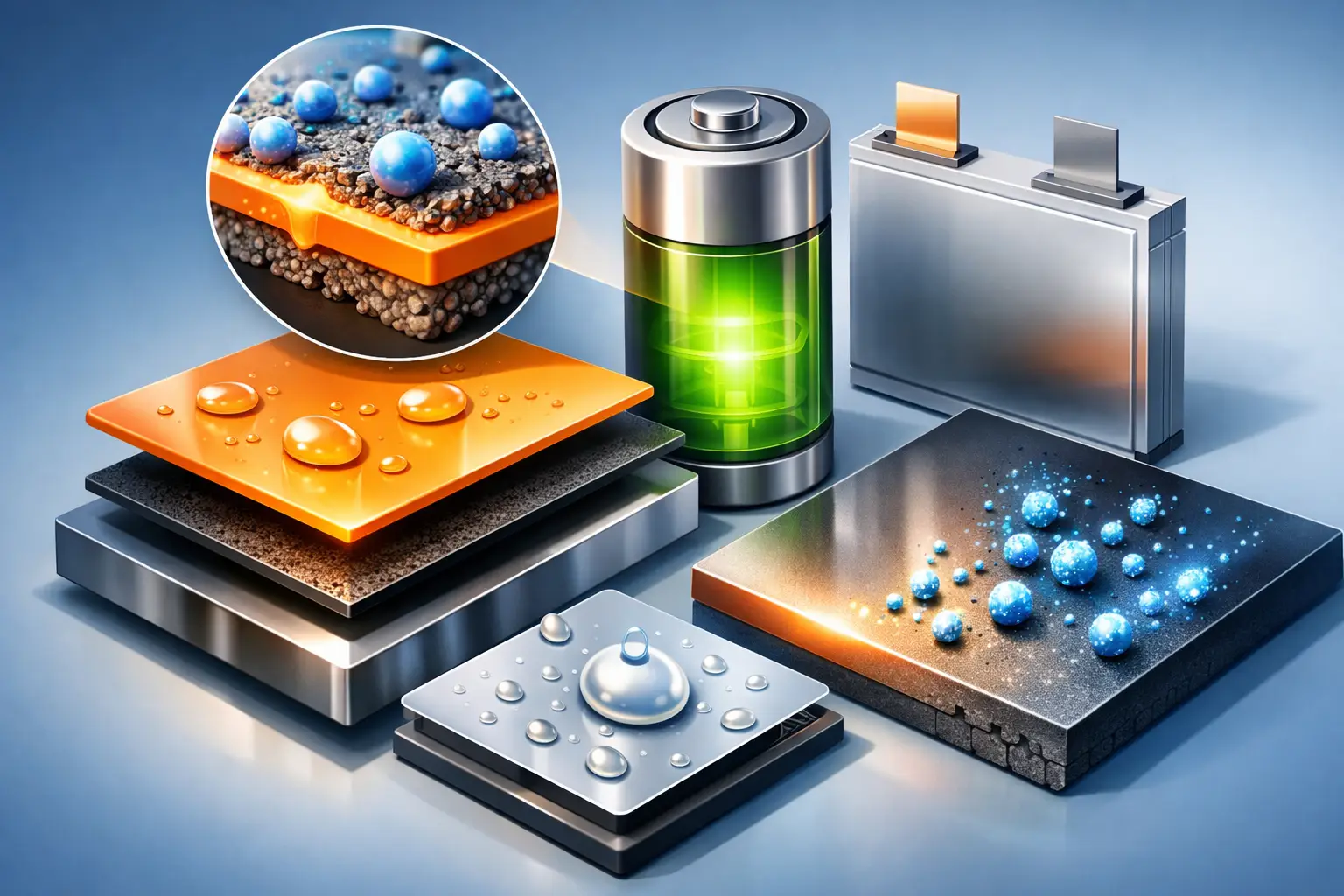
A battery component rarely fails because its bulk material is fundamentally unsuitable. More often, failure begins at the surface: electrolyte penetration, local corrosion, particle release, electrical leakage, poor adhesion or an interface that changes under thermal and mechanical cycling. Functional coatings for battery components address precisely these interfaces. They add defined protective or performance-enhancing properties without requiring a complete redesign of the component.
For cell manufacturers, module integrators and developers of battery systems, the relevant question is not simply which coating is available. It is whether a coating system can deliver its intended function over the required lifetime, on the actual substrate geometry, and within a reproducible production process. This requires a material-specific view of the component, its operating environment and the chosen manufacturing route.
Why battery surfaces need engineered functionality
Lithium-ion and emerging battery technologies place different materials in close proximity under demanding conditions. Current collectors, housings, busbars, connectors, sensor elements, insulating parts and sealing-related components may be exposed to humidity, electrolyte vapours, elevated temperatures, vibration, pressure changes and electrical fields. In many cases, the surface determines whether the component remains stable or becomes a source of degradation.
A functional coating can serve as a barrier against moisture or corrosive media, provide dielectric insulation, reduce friction during assembly, improve adhesion between material layers or control electrical contact at selected areas. The aim is not to coat every surface indiscriminately. It is to apply a defined layer where the functional risk exists and to preserve, or deliberately modify, the properties needed elsewhere.
This distinction matters particularly in battery production. A highly insulating layer on an intended contact zone can be as problematic as insufficient insulation near a high-voltage conductor. Coating design must therefore include masking strategy, coating selectivity, thickness tolerances and inspection criteria from the outset.
Functional coatings for battery components: key requirements
The requirements for a battery-related coating are usually interdependent. A layer with excellent chemical resistance may be difficult to apply uniformly to deep recesses. A thicker barrier can improve protection but may influence clearances, heat transfer or assembly forces. The technically appropriate solution depends on the component and the dominant failure mechanism.
Chemical resistance and corrosion protection
Metallic parts can be affected by moisture, salts, condensates and electrolyte-related media. Even small amounts of corrosion can raise contact resistance, weaken mechanical connections or generate contamination within sensitive assemblies. Coatings based on Parylene, plasma processes or carefully designed thin-film systems can form effective barriers where conventional finishes do not provide sufficient coverage or chemical stability.
Conformality is often decisive. Complex geometries, edges, bores and sharp transitions are known weak points for many coating systems. Vapour-deposited layers can cover such features with high uniformity, reducing pathways for corrosive species. However, barrier performance is only meaningful when surface preparation, layer adhesion and post-coating handling are controlled. A nominally suitable material cannot compensate for contamination or inadequate pre-treatment.
Electrical insulation without unnecessary bulk
Electrical isolation is a central requirement for numerous battery components, particularly in modules and packs with compact installation spaces. The challenge is to achieve sufficient dielectric strength at low layer thickness while maintaining dimensional accuracy and avoiding excessive mass or volume.
Thin, pinhole-controlled dielectric coatings are useful for housings, sensor interfaces, conductor-adjacent structures and selected metallic elements. The required thickness is governed by voltage level, geometry, edge radii, environmental exposure and the applicable test regime. It should not be selected from a catalogue value alone.
For demanding applications, dielectric testing must reflect real use. A coating may perform well in a dry laboratory test but behave differently after humidity storage, thermal ageing or repeated temperature cycling. Process development should therefore define test conditions that reproduce the relevant electrical and environmental stresses.
Thermal and mechanical stability
Battery systems experience temperature changes during charging, discharging, storage and external operation. Components with different coefficients of thermal expansion can impose considerable strain on a coating. Vibration and assembly loads add further mechanical stress.
A suitable coating must retain adhesion and functional continuity through these cycles. This is especially relevant at interfaces between metals, polymers and ceramics, where surface energy and expansion behaviour differ substantially. Plasma activation can improve adhesion by cleaning and chemically preparing the substrate prior to coating. In other cases, a hybrid layer design is appropriate, combining an adhesion-promoting interface with a protective top layer.
Thermal management also requires careful consideration. A coating that is beneficial for electrical isolation may limit heat dissipation if applied over an extensive area. Conversely, conductive or heat-spreading layers must be designed so that they do not compromise electrical safety. There is no universally correct coating stack: the thermal path and electrical path must be assessed together.
Selecting the right coating technology
The choice of process should follow the required function, substrate, geometry, production volume and validation obligations. Coating technology is not merely a purchasing decision. It is part of component engineering.
Parylene coatings are particularly relevant where conformal, thin and chemically resistant polymer layers are required. Their deposition from the gas phase enables coverage of complex three-dimensional geometries, including internal surfaces and fine structures, with minimal edge build-up. Depending on the Parylene type and process parameters, these layers can provide electrical insulation, moisture protection and corrosion resistance.
Plasma processes offer a different set of capabilities. They can remove organic contamination, activate low-energy polymer surfaces, modify wettability or prepare substrates for improved bonding. Plasma treatment can be a stand-alone functional step, but it is frequently most valuable as a controlled pre-treatment that improves the reliability of subsequent coating layers.
PVD, CVD and hybrid thin-film technologies become relevant when the target property involves high hardness, controlled conductivity, wear resistance, diffusion barriers or tailored optical and electrical behaviour. These processes offer precision on an atomic scale, but their suitability depends strongly on geometry, line-of-sight constraints, substrate temperature limits and the intended layer architecture.
From laboratory result to reproducible production
A coating that works on several samples is not yet an industrial solution. Battery components require process windows that account for incoming material variation, handling, batch loading, masking, curing or deposition conditions, inspection and traceability. This is particularly critical for applications in automotive, aerospace, defence and regulated technical sectors.
The first development step should define the functional target in measurable terms. Rather than requesting a general protective coating, specify the required dielectric strength after ageing, permissible change in contact resistance, corrosion test conditions, acceptable thickness range, adhesion criteria and component throughput. These parameters create a sound basis for selecting materials and equipment.
Representative parts should then be coated and tested under combined stresses. Thermal cycling alone is rarely sufficient. Where relevant, it should be combined with humidity exposure, chemical media, vibration, electrical loading and mechanical assembly tests. Cross-sectional analysis, adhesion testing and surface inspection help identify whether a failure originates in the layer itself, at the interface or in the component design.
Scale-up introduces further variables. Fixture design affects coating uniformity and handling damage. Masking must be reliable and removable without contaminating contact regions. Chamber loading, deposition rate and maintenance intervals influence reproducibility. For higher volumes, a tailored coating system can integrate these controls into the production environment rather than treating coating as an isolated external operation.
Design choices that prevent avoidable failures
Coating performance is improved when surface engineering is considered early in component development. Sharp edges should be reviewed because they can concentrate electrical fields and make uniform film formation more difficult. Crevices and trapped volumes may complicate cleaning, outgassing and coating access. Contact areas need clear definitions, including whether they require masking, local removal or a coating system designed for controlled conductivity.
Material combinations also deserve attention. Aluminium, copper, stainless steel, nickel alloys, engineering polymers and ceramic elements each present different adhesion and corrosion behaviours. A layer that bonds well to one substrate cannot automatically be transferred to another without validation. The same applies to recycled or reformulated base materials, where surface condition can change despite nominally identical material specifications.
For this reason, the most effective projects combine coating development with process and component expertise. NTTF Coatings approaches this work through application-specific process development, industrial coating capability and customised equipment design where in-house integration is required. The objective is a defined, verifiable coating function that remains stable beyond the prototype stage.
A surface strategy for longer battery service life
Battery innovation is often discussed in terms of cell chemistry and energy density. Yet the reliability of the wider system is equally shaped by the interfaces around the cell. Well-designed functional coatings can reduce corrosion risk, support electrical safety, protect sensitive electronics and stabilise component performance under real operating loads.
The useful starting point is therefore not a preferred process, but a clearly described failure risk. When that risk is translated into measurable surface requirements, coating technology becomes a practical engineering lever for durable, manufacturable battery components.
