
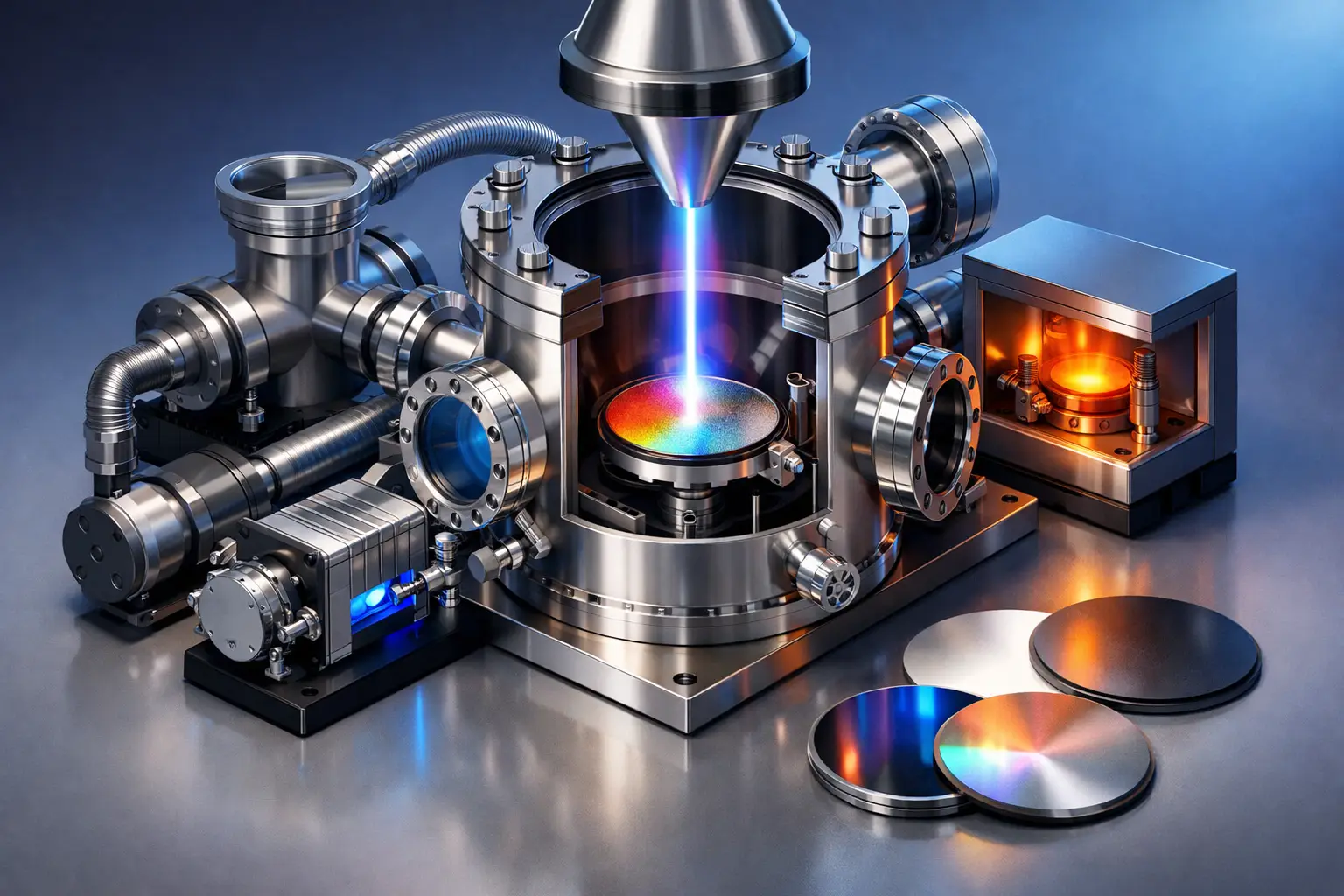
A coating that performs well in ambient production conditions can become a critical source of contamination once it enters a vacuum chamber. Under reduced pressure, trapped solvents, plasticisers, moisture and low-molecular compounds may desorb from the surface. For high-vacuum and ultra-high-vacuum applications, a vacuum compatible coating must therefore do more than protect a component: it must preserve chamber cleanliness, functional stability and process repeatability.
This changes the selection process fundamentally. The correct coating is not defined by a single material property such as hardness or chemical resistance. It is determined by the interaction between substrate, coating chemistry, layer architecture, deposition process, operating temperature, target pressure and permitted contamination budget.
What defines a vacuum compatible coating?
Vacuum compatibility describes the suitability of a material or coated assembly for operation in a defined vacuum environment without adversely affecting pressure, residual gas composition, particle load or adjacent processes. The required level depends on the application. A coating used in a technical vacuum process may face very different limits from one installed near an optical system, a semiconductor process chamber, an analytical instrument or a space-qualified assembly.
The first criterion is outgassing. Materials release absorbed water and volatile constituents when pressure falls. This effect can extend pump-down times, increase the gas load and deposit contaminants on sensitive surfaces. The relevant question is not simply whether a material outgasses, because every material does to some degree. The question is whether its outgassing behaviour remains within the defined process window after specified cleaning, curing and conditioning steps.
Particle generation is equally significant. Coatings exposed to mechanical contact, thermal cycling or plasma can crack, abrade or delaminate if adhesion and layer stress have not been engineered for the duty cycle. In vacuum technology, even very small particles can impair yields, compromise optical surfaces or affect moving precision components.
A suitable system must also retain its intended function. Depending on the component, that may mean electrical insulation, controlled conductivity, low friction, corrosion resistance, diffusion barrier performance, chemical protection or biocompatibility. Vacuum compatibility without functional reliability is not an engineering solution.
Why generic coating specifications are insufficient
Data sheets are useful starting points, but they rarely replace application-specific assessment. Values for temperature resistance, thickness or dielectric strength are normally measured under defined laboratory conditions. They do not automatically predict behaviour after vacuum bake-out, repeated venting cycles, plasma exposure or contact with process media.
Consider a polymeric protective layer on an electronic assembly. It may provide excellent conformal coverage around sharp edges and complex geometries. Yet its suitability for high vacuum depends on polymer grade, film thickness, deposition purity, residual monomers, pre-treatment, cleaning history and maximum bake-out temperature. A metallic or ceramic thin film may show lower outgassing, but could introduce conductivity, stress or coverage limitations that are unacceptable for the same assembly.
This is why coating selection must begin with the application boundary conditions rather than with a preferred technology. A technically credible specification defines the pressure range, base-pressure target, thermal profile, exposure time, allowable residual gases, mechanical loads, substrate material and downstream process sensitivity. It also identifies whether the component is located inside the vacuum volume, close to the process zone or only exposed during intermittent evacuation.
Selecting the right coating technology
Parylene coatings are relevant where highly conformal, pinhole-minimised insulation and barrier protection are required on intricate geometries. Deposited from the vapour phase, Parylene can coat edges, cavities and fine structures that are difficult to protect with liquid-applied systems. For vacuum use, however, material selection and post-deposition conditioning must be matched precisely to the required pressure level, bake-out regime and contamination limits.
PVD coatings offer a different performance profile. Thin metallic, nitride, oxide or carbon-based layers can provide wear resistance, defined friction behaviour, conductivity or protective surface functionality. Their advantages are especially relevant for mechanically loaded components, precision tools, optical elements and technical surfaces where thin, adherent films are required. The limitations lie in line-of-sight effects, substrate geometry and the need to manage intrinsic stress in the film.
CVD and plasma-assisted processes expand the available design space. They can create dense barrier layers, alter surface energy, improve adhesion or functionalise a surface at a highly controlled scale. Hybrid layer systems are often appropriate where no single material can satisfy all requirements, for example when an adhesion-promoting interlayer, an electrically insulating layer and a low-friction top layer must work together.
The best technology is therefore conditional. A high-purity ceramic or metallic film may be preferable for elevated-temperature vacuum systems. A tailored polymer coating can be the more effective choice for sensitive electronics or medical components with complex three-dimensional geometry. What matters is validated performance in the actual application environment.
The substrate and pre-treatment determine long-term stability
Many coating failures attributed to the layer itself originate at the interface. Stainless steel, aluminium, titanium, glass, ceramics and engineering polymers each present different surface chemistry, roughness, thermal expansion and contamination risks. Machining residues, release agents, fingerprints, oxide layers and cleaning-media residues can all reduce adhesion or increase the volatile load.
A controlled pre-treatment strategy is therefore part of the coating system. This may include precision cleaning, plasma activation, ion etching, controlled roughening or an engineered adhesion layer. The aim is not merely to make the surface appear clean. It is to establish a stable, reproducible interface that withstands evacuation, temperature change and operational loads.
Masking also requires careful design. In vacuum assemblies, an uncoated contact face, sealing geometry or optical aperture may be as important as the protected area. Poorly designed masking can leave edge defects, create particle traps or make removal difficult. The coating process must account for these functional zones from the outset.
Validation should reflect the real vacuum duty cycle
A vacuum compatible coating should be qualified through a test plan that mirrors the intended use. Pump-down and bake-out testing reveal different issues from atmospheric ageing. Thermal cycling can expose adhesion weaknesses, while plasma or chemical exposure may alter surface composition and layer thickness over time.
Useful validation typically combines material-level and component-level assessment. Residual gas analysis can identify evolved species during evacuation. Gravimetric or mass-spectrometric methods may support outgassing assessment where required. Adhesion testing, optical inspection, thickness measurement and surface analysis help verify film integrity before and after environmental exposure.
For critical assemblies, it is sensible to evaluate the coated component in a representative chamber configuration. This captures interactions that isolated coupon tests cannot show, including shadowed surfaces, assembly-related contamination, heat transfer paths and the effect of neighbouring materials. The necessary test depth depends on risk, but regulated and yield-sensitive applications benefit from traceable acceptance criteria rather than informal visual approval.
Designing for production, not only for qualification
A successful laboratory result is only the first stage. Industrial use requires a process that can be repeated across batches, geometries and production volumes. This includes controlled incoming inspection, defined cleaning windows, fixture design, loading patterns, process monitoring and final inspection criteria.
For organisations bringing coating in-house, the coating plant must be designed around the component and quality requirements. Chamber size alone is not a meaningful specification. Pumping configuration, vapour distribution, plasma source design, temperature control, substrate handling, masking concept and automation level all influence reproducibility. Maintenance planning and contamination control must be considered early, particularly where one coating system serves several product families.
NTTF Coatings approaches these projects as an integrated engineering task: from feasibility assessment and layer development through to industrial coating processes and customer-specific equipment design. This connection between material science and plant engineering is decisive when a coating must function reliably beyond a single test series.
Questions that should be resolved before specification
Before approving a coating, technical teams should establish the target pressure range and permissible pump-down time, maximum and minimum operating temperatures, required bake-out conditions, exposure to plasma or process gases, and the surfaces that must remain uncoated. They should also define whether the primary risk is outgassing, particles, electrical failure, corrosion, wear or a combination of these factors.
Equally, clarify the required evidence. Some projects need a practical process qualification with documented cleaning and coating parameters. Others require material traceability, batch records, analytical data and a formal change-control process. Establishing this level of proof early prevents costly redesign when a component moves from prototype to series production.
The most reliable route is to treat vacuum compatibility as a system requirement, not as a label attached to a material. When coating chemistry, interface preparation, process control and validation are engineered together, the coated component becomes a controlled part of the vacuum system rather than an avoidable source of uncertainty.
