
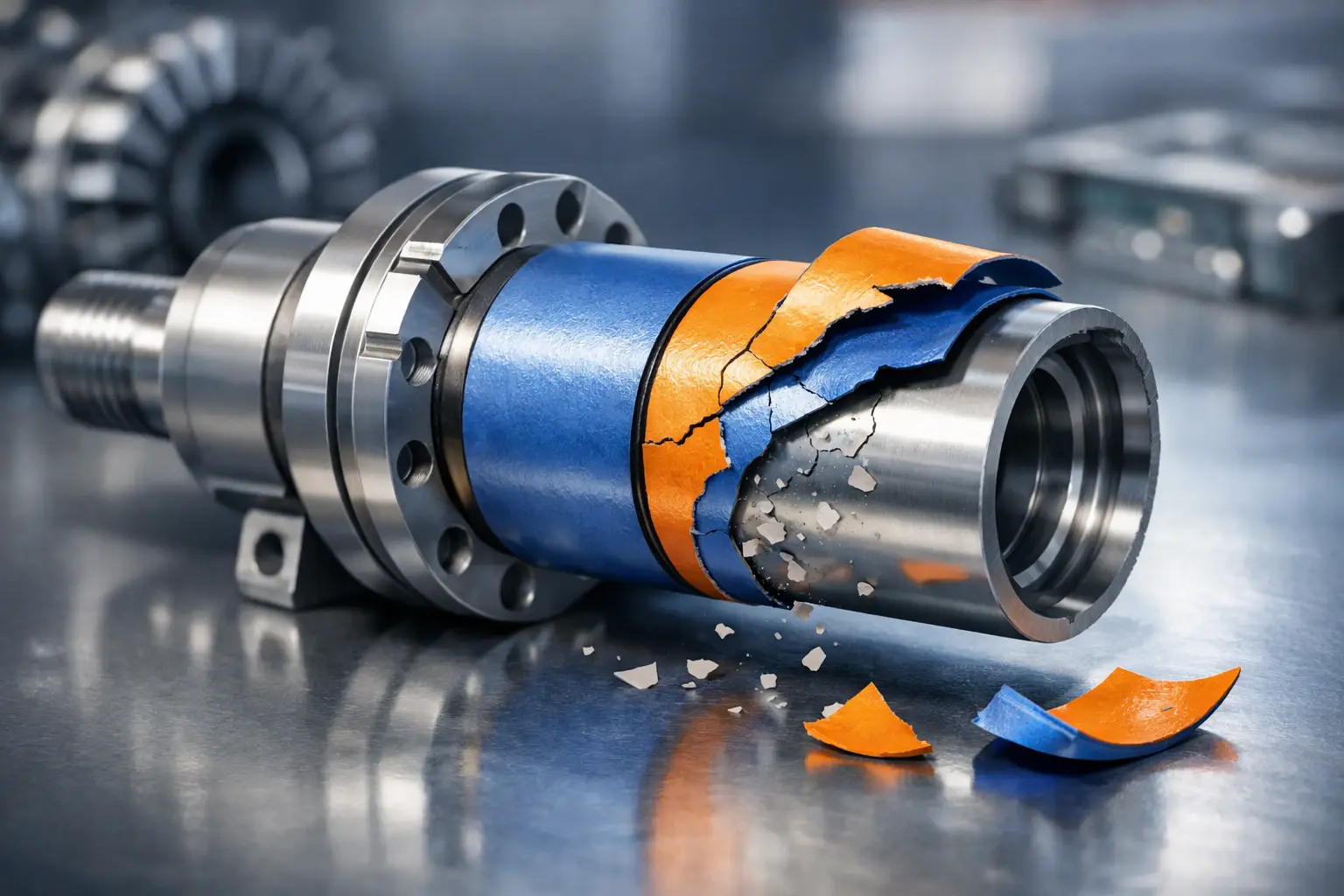
A coating can pass visual inspection at the end of a production line and still fail months later at a single edge, bore or contact point. In regulated and high-reliability applications, that local failure can compromise corrosion protection, electrical insulation, biocompatibility or functional performance. So, why do coatings delaminate? The short answer is that the forces separating the coating exceed the strength of the interface holding it to the substrate. The engineering task is to determine why that interface was weak, stressed or exposed.
Delamination is rarely caused by one isolated variable. It usually results from an interaction between substrate condition, surface preparation, coating chemistry, layer architecture, process parameters and the component’s real service environment. A reliable solution therefore starts with failure analysis, not with simply selecting a thicker coating.
Why Do Coatings Delaminate at the Interface?
Delamination is the loss of adhesion between a coating and its substrate, or between individual layers in a multilayer system. It may appear as peeling, blistering, flaking, cracking followed by lift-off, or a loss of coating around edges and geometrically complex areas. The visible defect is the final stage of a process that often began before coating application.
At the interface, adhesion can arise through mechanical interlocking, chemical bonding, polar interactions or combinations of these mechanisms. The relative importance depends on the substrate and deposition method. A plasma-activated polymer surface, for example, behaves very differently from stainless steel, aluminium, titanium, glass or a plated electronic assembly.
A coating adheres only when the deposited material can wet, contact and interact with the prepared surface consistently. If contamination, weak boundary layers or insufficient activation interrupt that contact, the apparent adhesion may initially be acceptable but remain vulnerable to humidity, thermal cycling, sterilisation, vibration or chemical exposure.
Contamination and weak boundary layers
Oils, fingerprints, machining residues, polishing compounds, release agents, oxide layers and particulate contamination are common causes of adhesion failure. Even very low levels of organic residue can create a barrier between substrate and coating. The coating is then bonded to contamination rather than to the engineered surface beneath it.
Weak boundary layers are more difficult to identify. A substrate may be clean in a conventional sense but carry a loosely attached oxide, an unstable conversion layer, degraded polymer chains or absorbed moisture. If that layer fails cohesively, the coating may detach with material from the surface still attached to its reverse side.
Cleaning must therefore be matched to the material and subsequent coating process. Solvent cleaning alone may remove gross contamination but not sufficiently modify surface energy or remove chemically bound residues. Depending on the application, aqueous cleaning, ultrasonic treatment, controlled abrasion, plasma cleaning or plasma activation may be required. Each method has limits: aggressive preparation can also damage delicate components, alter dimensions or introduce new residues.
Inadequate surface energy and wetting
Low-surface-energy polymers are particularly challenging because deposited layers may not establish durable interfacial contact. Fluoropolymers, polyolefins and some moulded engineering plastics often require activation before coating. Plasma processes can increase surface energy and create functional groups, improving the conditions for adhesion.
The timing between activation and coating matters. Many activated surfaces undergo hydrophobic recovery or collect airborne contamination rapidly. A process that performs well in laboratory trials may become inconsistent in production if handling times, storage conditions and transfer routes are not controlled. For high-value components, the preparation-to-deposition sequence should be treated as one validated process window.
Residual Stress Can Overcome Good Adhesion
A chemically clean interface is necessary, but it is not sufficient. Coatings also delaminate when stresses within the layer system exceed its adhesive or cohesive strength. These stresses may be generated during deposition, curing or subsequent use.
Thermal expansion mismatch is a frequent driver. When a coated component is heated or cooled, the substrate and coating expand at different rates. A thin, stiff film on a polymer substrate may experience repeated strain during temperature cycling. A coating on metal can face similar challenges where the component operates across a wide temperature range or is subjected to rapid heating and cooling.
Film thickness changes the balance. Increasing thickness can improve barrier performance and wear life, but it can also increase stored stress and make edge lift-off more likely. The appropriate thickness is therefore application-specific, particularly for PVD, CVD and hybrid thin-film systems where functional performance is closely linked to microstructure and stress state.
Curing can introduce additional stress. Solvent loss, crosslinking shrinkage and excessive cure temperatures may pull a coating away from the substrate. Conversely, under-curing can leave a film mechanically weak or chemically vulnerable. The correct cure profile must account for coating formulation, layer thickness, substrate sensitivity and the component’s intended operating environment.
Geometry concentrates stress
Sharp edges, burrs, deep recesses, blind holes and abrupt transitions can concentrate mechanical stress and disrupt uniform coating coverage. A defect at an edge is not always evidence of poor bulk adhesion. It may indicate that local film thickness, surface preparation or field distribution during deposition was inadequate for that geometry.
Design-for-coating principles can reduce this risk. Where possible, edges should be radiused, burrs removed and inaccessible areas considered early in component design. If geometry cannot change, the process must be developed around it through appropriate fixturing, masking, plasma treatment and deposition strategy.
Environmental Exposure Turns Small Defects Into Failures
Many coating systems do not fail immediately after application. They fail when water, ions, cleaning media, process chemicals or corrosive gases enter through a pinhole, scratch, edge or poorly covered transition. Once moisture reaches the interface, it can weaken adhesion and propagate laterally beneath the coating.
This is why blistering is often associated with humidity or immersion. Water can diffuse through certain polymers, accumulate at the interface and promote corrosion or osmotic effects. On metallic substrates, corrosion products may occupy a greater volume than the original metal, creating sufficient pressure to lift the coating further.
Electrical assemblies present another set of conditions. Ionic residues from manufacturing, condensation, bias voltage and temperature cycling can drive electrochemical migration or corrosion beneath insulating coatings. A conformal coating must therefore be evaluated not only for nominal dielectric performance, but also for coverage, adhesion, cleanliness and long-term environmental resistance.
In medical technology, sterilisation cycles, disinfectants, body fluids and repeated mechanical loading require similarly careful assessment. Biocompatibility alone does not guarantee a stable interface. The coating-substrate combination must retain its integrity throughout the validated use case.
Process Variation Is Often the Hidden Cause
When delamination appears intermittently, the root cause is frequently process variation rather than the coating material itself. Variation can enter through incoming material batches, machining lubricants, cleaning bath condition, operator handling, component storage, fixture design, chamber loading, deposition rate, vacuum quality or cure conditions.
A development run may use carefully handled samples with a short transfer time from cleaning to deposition. Serial production may introduce waiting periods, different suppliers, complex part orientations and larger batch sizes. Unless those factors are defined and monitored, adhesion performance can drift.
For this reason, reproducibility requires more than a nominal process specification. Critical parameters should be identified, toleranced and documented. For demanding applications, this can include substrate roughness and chemistry, cleanliness acceptance criteria, plasma power and exposure time, chamber pressure, deposition temperature, layer thickness, cure profile and traceability of each production batch.
Diagnosing Delamination Before Selecting a Remedy
The right corrective action depends on where the failure occurs and what the exposed surfaces reveal. Adhesive failure occurs at the coating-substrate interface. Cohesive failure occurs within the coating itself or within an intermediate layer. These mechanisms demand different responses.
Visual examination is a useful first step, but it should be supported by targeted analysis. Cross-sections can reveal layer thickness, voids and interfacial discontinuities. Microscopy can identify crack paths and edge defects. Surface analysis may expose contamination, oxidation or incompatible material residues. Environmental and thermal testing can reproduce the failure mode under controlled conditions.
Adhesion tests also need careful interpretation. A test method should reflect the intended component and service conditions. A coating may achieve acceptable initial pull-off or tape-test performance yet fail after damp heat, thermal shock, chemical immersion or cyclic loading. The most meaningful qualification programme is therefore based on realistic failure mechanisms, not a single generic test.
Preventing Delamination Through Coating-System Design
The most durable coating is designed as a system: substrate, preparation route, interface, coating architecture, deposition process and application environment. This is particularly relevant when requirements combine corrosion resistance, electrical insulation, low friction, barrier performance or biocompatibility.
For difficult substrates, plasma activation or an adhesion-promoting interlayer can create a more stable interface. For complex geometries, conformal processes such as Parylene deposition can provide highly uniform coverage, although the substrate preparation and masking concept remain decisive. For high-wear or high-temperature components, PVD, CVD or hybrid architectures may offer the necessary mechanical performance, provided residual stresses and interface compatibility are engineered appropriately.
At NTTF Coatings, the practical objective is not simply to apply a coating that adheres in an initial test. It is to develop a controlled process that remains stable across the intended component geometry, production volume and operating profile. That may require coating trials, materials analysis, process optimisation and, where appropriate, a custom-designed coating system integrated into the customer’s production environment.
A delaminating coating is a diagnostic signal. It shows that the interface, the stress state or the service conditions have not yet been aligned. When those factors are evaluated together, adhesion becomes a measurable, reproducible engineering outcome rather than an assumption made at the end of the line.
