
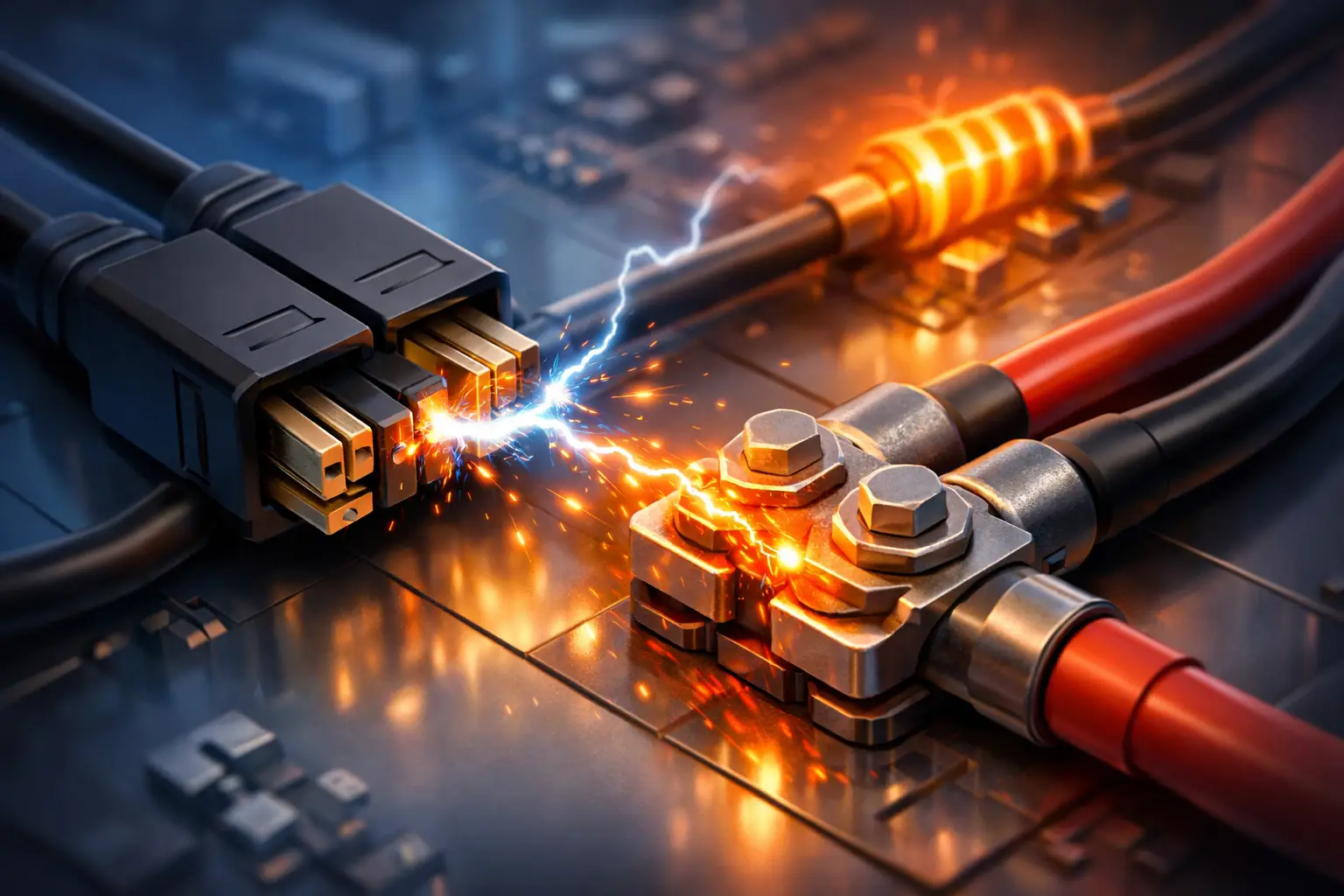
A connector failure rarely begins with a dramatic electrical event. More often, it starts at the interface between two contacts: a thin oxide layer, a trace of moisture, microscopic movement caused by vibration, or contamination introduced during assembly. Electrical connector reliability is therefore not determined by the connector geometry alone. It is a system property shaped by material selection, contact force, surface condition, environmental exposure and manufacturing control.
For development and production teams in medical technology, automotive electronics, aerospace, defence and industrial equipment, the consequence is clear: a connector must be evaluated over its actual service life, not merely by its initial contact resistance. A component that performs correctly after assembly may still lose functional margin after thermal cycling, humidity exposure or thousands of vibration cycles.
What determines electrical connector reliability?
The electrical function of a connector depends on a stable, low-resistance contact zone. Although the apparent contact area may be relatively large, current transfer takes place through numerous microscopic asperities where the two surfaces meet. These contact points must remain sufficiently conductive despite mechanical loading and chemical change at the surface.
Contact force is central to this behaviour. Too little force reduces the number and stability of conductive contact points. Too much force can cause wear, deformation or damage to a thin functional coating. The optimum is application-specific and must account for mating cycles, vibration spectrum, conductor size, temperature and the mechanical behaviour of the housing.
Base materials also matter. Copper alloys are commonly selected for their electrical conductivity, while stainless steels or nickel-containing alloys may be required where mechanical strength or temperature resistance is higher. Yet the base material alone does not define the interface. Surface finishes control oxidation behaviour, friction, wear and solderability, making them a decisive part of the connector design.
Corrosion is an electrical failure mechanism
Corrosion products are often poorly conductive. In humid, saline or chemically active environments, even a small amount of corrosion at the contact interface can raise resistance or create intermittent signals. This is especially critical in low-voltage and low-current circuits, where there may be insufficient energy to disrupt an insulating film during operation.
Galvanic effects add another layer of risk. If dissimilar materials are combined and an electrolyte is present, the less noble material may corrode preferentially. Connector systems should therefore be assessed as material pairings rather than as individual parts. Pin, socket, plating stack, cable termination and surrounding housing can all influence the electrochemical environment.
Protective surface engineering reduces this exposure, but the right solution depends on the duty cycle. A connector permanently sealed within an electronics enclosure faces different demands from a plug repeatedly mated in a humid industrial setting. A coating that provides excellent barrier protection may be unsuitable on the primary mating surface if it compromises the required electrical contact mechanism. Selective protection and precisely defined masking are often more effective than treating every surface identically.
Fretting corrosion combines motion and chemistry
Vibration does not need to visibly loosen a connector to cause failure. Small relative movements at the contact interface – often only a few micrometres – can wear away protective films and generate metallic debris. In the presence of oxygen and humidity, this debris oxidises. The result is fretting corrosion: an increase in contact resistance that can be progressive and difficult to diagnose.
This failure mode is common in vehicles, rail systems, industrial drives and aerospace assemblies. Thermal expansion can create similar micro-movements even where external vibration is limited. Connector design must therefore consider clamping, strain relief, housing stiffness and the coefficient of friction at adjacent interfaces, not only the nominal retention force.
Appropriate thin-film systems can support wear resistance and reduce environmental attack on non-contact regions. Plasma activation may also improve adhesion where subsequent protective layers, potting compounds or overmoulded elements are required. The value lies in designing the complete interface, including where the coating must stop.
Surface protection for reliable connector systems
Surface treatment should begin with a functional question: which area needs conductivity, which needs insulation, and which needs a barrier against moisture or media? Treating the connector as a single uniform surface overlooks these different requirements.
Noble-metal finishes are widely used for low-level signal contacts because they resist oxidation and maintain stable electrical behaviour. Their use involves economic and technical trade-offs. Thickness, underlayer quality, porosity, wear exposure and the number of mating cycles influence whether the finish delivers lasting value. A nominally noble surface can still fail if mechanical wear exposes a reactive substrate or if contamination accumulates in the contact zone.
For assemblies that need protection beyond the mating interface, conformal polymer coatings can be highly effective. Parylene, deposited from the vapour phase, forms a thin and highly conformal barrier layer around complex geometries, edges and crevices. It can protect electronic subassemblies, cable terminations and connector backshell regions against humidity, condensate, chemicals and particulate contamination.
Its conformality is a particular advantage where liquid coatings struggle to cover narrow gaps consistently. At the same time, Parylene must be applied with clearly defined functional boundaries. Contacts, mating zones, solder pads or grounding points may need masking or subsequent processing to preserve their required electrical function. This is not a limitation of the technology; it is a design requirement that should be addressed early in development.
Process control is part of connector performance
A high-performing coating cannot compensate for uncontrolled preparation. Oils, fingerprints, mould-release residues and oxide layers can impair adhesion, alter contact resistance or create weak points in a protective barrier. Cleaning, activation and handling conditions must therefore be specified as part of the process chain.
Plasma processes are particularly valuable for removing organic residues and activating surfaces before coating, bonding or overmoulding. The process window must be matched to the substrate and component geometry. Excessive treatment can alter sensitive polymer surfaces, whereas insufficient treatment may leave contamination in recessed areas. Reproducibility depends on defined parameters, suitable fixturing and verification methods rather than on visual inspection alone.
For production transfer, the same discipline applies to masking and loading. Coating thickness, edge coverage, shadowing effects and batch-to-batch consistency are influenced by component orientation and fixture design. In regulated sectors, traceable process data and validated parameters are essential because connector performance is often safety-relevant, even if the connector itself appears to be a small part of the assembly.
Qualification should reflect the real duty cycle
Standard tests provide an essential baseline, but a test plan should also represent the conditions that create risk in the final application. A laboratory evaluation might combine thermal cycling, damp heat, salt mist where relevant, vibration, mechanical mating cycles and electrical resistance monitoring. The correct sequence matters. Environmental exposure before vibration may reveal a different failure mechanism from vibration before humidity.
For medical devices, cleaning agents, sterilisation routes and biocompatibility requirements can influence material and coating selection. For automotive and aerospace applications, rapid temperature changes, vibration and fluid exposure may dominate. In industrial machinery, long maintenance intervals and contamination by oils or process media can be more significant than extreme temperature. Electrical connector reliability is always application-dependent, which is why generic coating specifications frequently leave performance potential unrealised.
From failure analysis to a scalable solution
When a connector issue appears in the field, the productive question is not simply which coating should be added. The investigation should establish where resistance changes occur, whether failure is permanent or intermittent, which materials are exposed, and how the component is actually loaded. Cross-sections, surface analysis, contact-resistance data and environmental history can distinguish corrosion, wear, contamination, insufficient contact force and assembly-related damage.
That evidence forms the basis for a targeted solution. It may involve a modified plating stack, selective Parylene protection, plasma pre-treatment, a redesigned fixture, improved masking or changes to connector placement within the final assembly. For larger volumes, the coating process must also be engineered for cycle time, handling, traceability and integration into the customer’s production environment.
NTTF Coatings develops surface processes and customised coating systems around these practical constraints. The objective is not a standard coating applied to a standard problem, but a reproducible process that protects the required areas without impairing the electrical interfaces that must remain accessible.
Reliable connectors are created long before final electrical testing. When contact physics, material compatibility, environmental protection and production conditions are considered together, surface engineering becomes a measurable contribution to service life rather than an afterthought following failure.
