
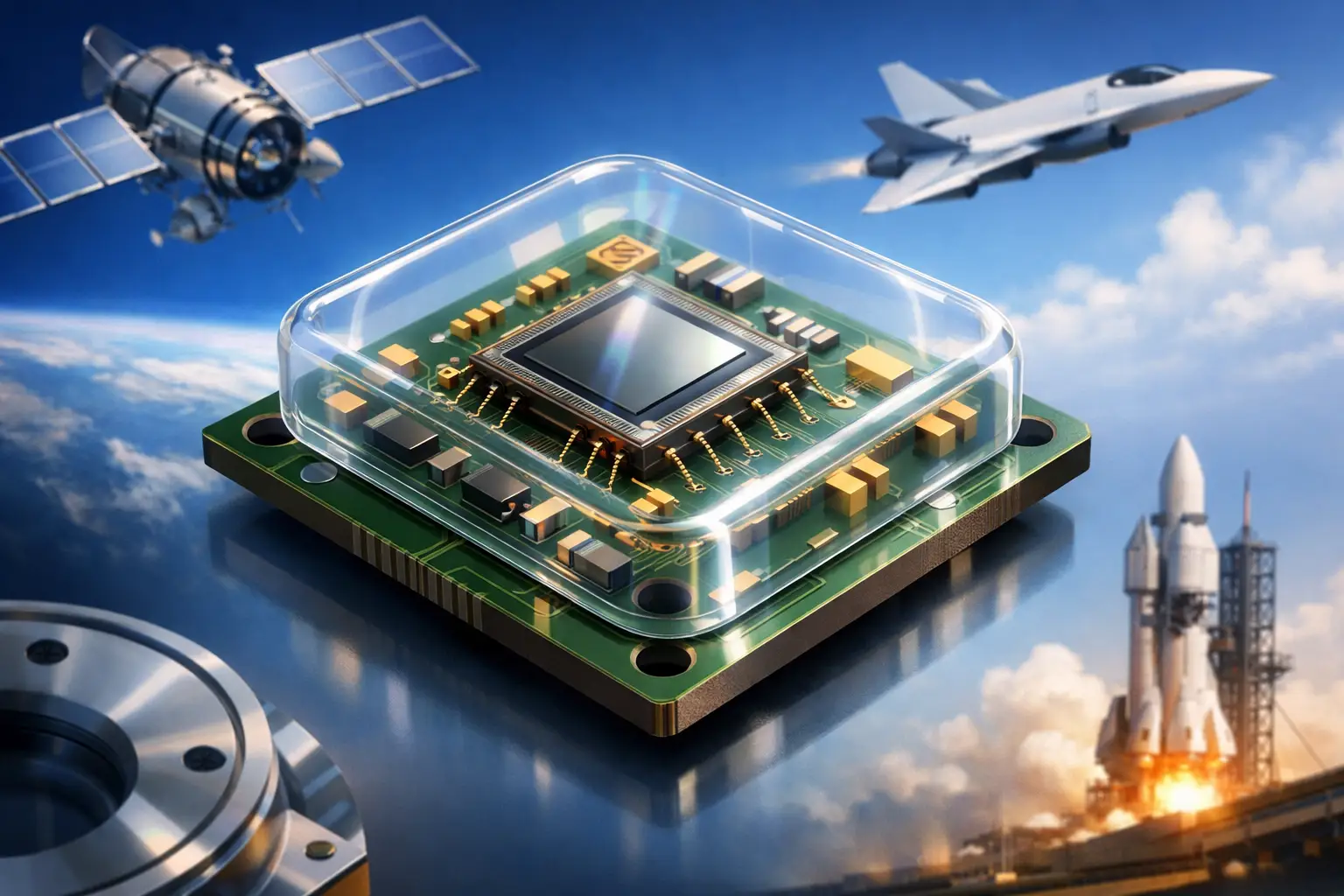
A Parylene coated aerospace sensor example is rarely defined by the coating alone. It is defined by the failure mechanism the coating must prevent: moisture-driven leakage currents, corrosion at dissimilar-metal interfaces, insulation breakdown under contamination, or signal drift after repeated thermal cycling. For aerospace developers, the relevant question is therefore not whether Parylene can be applied, but how a precisely specified film contributes to sensor stability throughout the mission profile.
A Parylene Coated Aerospace Sensor Example in Practice
Consider a pressure and temperature sensor module installed in an aircraft environmental control system. The module contains a ceramic sensing element, wire-bonded signal conditioning electronics, solder joints, a flex circuit and connector contacts within a compact housing. During service, it encounters humidity, condensation risk during ground cycles, vibration, hydraulic-fluid vapours and substantial temperature variation.
The electronics require an electrically insulating barrier that follows every exposed geometry without adding significant mass or occupying the limited installation volume. Conventional liquid-applied coatings can protect accessible surfaces effectively, but their thickness distribution at sharp edges, beneath components and around wire bonds depends strongly on viscosity, surface tension and drainage. These are precisely the regions in which an aerospace electronics assembly may be most vulnerable.
A vapour-deposited Parylene film addresses this geometry differently. The coating is formed by polymerisation from the gas phase, producing a conformal layer across complex three-dimensional surfaces. Subject to suitable masking and process design, the film can cover solder joints, lead frames, board edges, bond wires and fine-pitch structures with highly uniform thickness. The result is not merely a covered assembly, but a controlled dielectric and environmental barrier integrated into the sensor design.
For this representative module, Parylene C may be selected where moisture and chemical barrier performance are decisive. Parylene N can be appropriate when dielectric properties and penetration into fine geometries are prioritised. Where elevated-temperature capability and resistance to demanding aerospace fluids are central to the requirement, Parylene HT may be assessed. Material selection must follow test data for the specific application rather than a generic assumption that one Parylene grade suits every flight environment.
Why the Coating Changes Sensor Reliability
Sensor performance can deteriorate long before a complete electronic failure occurs. A small increase in leakage current can alter a low-level measurement. Ionic contamination combined with humidity may create conductive paths between adjacent conductors. Corrosion products at contacts can increase resistance or introduce intermittent signals. In a pressure measurement chain, even a minor electrical instability can become a calibration, maintenance or safety concern.
Parylene provides a very thin, continuous barrier that can reduce exposure to moisture and contaminants while preserving the functional dimensions of miniature assemblies. Its dielectric properties are particularly valuable where insulation distances are limited. Because the film adds little mass, it is also attractive for components where mass budgets and dynamic behaviour matter.
However, a conformal coating is not a substitute for sound electronics design. It cannot correct inadequate creepage distances, poorly controlled residues, incompatible adhesives or unstable connector systems. It also does not eliminate the need to protect areas intended for electrical connection, grounding, bonding or heat transfer. In the example sensor module, connector mating surfaces and designated grounding points would be masked, while the sensitive electronics and exposed soldered regions would be coated.
The greatest benefit is achieved when coating requirements are considered early. If the process is only introduced after qualification failures occur, the design may contain inaccessible regions, unsuitable mask boundaries or materials that outgas during deposition. Early co-engineering turns Parylene from a remedial layer into a defined reliability measure.
Process Control Is Part of the Component Design
Aerospace qualification depends on repeatability, traceability and a clear understanding of process windows. Coating thickness is only one parameter. Surface preparation, handling, cleaning, masking, fixturing, chamber loading and post-coating inspection all influence the finished component.
Before deposition, residues from fluxes, machining oils, release agents and handling must be assessed. A Parylene film deposited over contamination may encapsulate the problem rather than remove it. Depending on the substrate and contamination profile, a defined cleaning sequence and plasma activation can improve surface condition and adhesion behaviour. The correct approach depends on the materials stack: polymers, ceramics, metals, adhesives and elastomers can respond very differently to pretreatment.
Masking must also be engineered rather than improvised. The boundary between coated and uncoated surfaces affects connector function, sensor ports, grounding concepts and assembly tolerances. In high-volume production, purpose-designed masking tooling improves positional consistency and reduces handling damage. For smaller qualification batches, the same principles apply, even if the fixtures are tailored to a prototype geometry.
Thickness selection requires similar discipline. A thicker film may improve barrier duration in some environments, yet it can alter thermal paths, add stress at sharp edges or make rework more difficult. A thinner film may preserve dimensional tolerances and flexibility, but must still meet dielectric and environmental requirements. The optimum thickness is therefore application-specific, defined through environmental testing and electrical verification.
The Trade-Offs Engineers Need to Evaluate
Parylene is highly capable, but not universal. A well-founded aerospace specification recognises its limits alongside its strengths.
First, exposure conditions must be defined precisely. “Aerospace environment” is not a single condition. An avionics sensor in a controlled cabin, a nacelle-mounted monitoring system, a spaceborne instrument and an unmanned platform each face different temperature ranges, pressure conditions, radiation levels, fluids and service durations. Radiation resistance, for example, should be verified against the anticipated dose and mission duration rather than inferred from general material data.
Secondly, thermal management may be critical. Parylene is a polymeric dielectric, not a heat sink. On densely packed electronics with significant power dissipation, coated surfaces and interfaces should be evaluated within the complete thermal design. Areas used for conductive heat transfer may require masking or an alternative protective concept.
Thirdly, mechanical interfaces deserve attention. Repeated flexing, abrasion, sharp-edge contact or component movement can challenge any thin film. Where a sensor assembly includes moving elements, cable exits or mechanically loaded interfaces, the coating boundary and substrate support must be designed accordingly. A coating can protect a stable structure very effectively, but it should not be expected to bridge poorly controlled mechanical movement indefinitely.
Finally, inspection and repair strategy matter. Parylene is highly conformal, which is valuable in service but can complicate access to test pads or rework locations. Defining protected test areas, removable masks and repair procedures before series production prevents unnecessary disruption later.
Qualification Should Reflect the Actual Mission Profile
A meaningful qualification plan for the representative sensor module would combine electrical measurements with environmental exposure. Baseline insulation resistance, leakage current, sensor accuracy and signal noise should be recorded before testing. The coated module can then be assessed through thermal cycling, humidity exposure, vibration, fluid exposure and, where relevant, low-pressure or altitude simulation.
Measurements should be repeated during and after exposure, not only at the end of a test sequence. This makes it easier to identify whether a change is temporary, progressive or linked to a particular stress condition. Visual inspection at masked boundaries, edges, solder joints and connectors helps correlate any electrical change with a physical mechanism.
For assemblies moving towards production, process qualification should accompany component testing. Coupon panels, witness samples, thickness verification and defined acceptance criteria provide evidence that the deposited film remains within the approved process window. Traceable batch documentation supports quality management and makes deviations easier to investigate.
NTTF Coatings GmbH approaches such projects as a combination of materials engineering, application-specific process development and scalable equipment design. This matters when a successful prototype must transition into repeatable industrial coating, whether through qualified contract coating or a customer-specific in-house Parylene system.
From Prototype Protection to a Controlled Production Process
The most useful Parylene coating programme begins with the sensor’s functional risks and production reality. Engineers should provide the materials list, operating environment, geometry, critical surfaces, electrical requirements, planned test methods and anticipated annual volume. This information enables a coating concept that accounts for masking, pretreatment, thickness, inspection and logistics from the outset.
A representative Parylene coated aerospace sensor example demonstrates a broader engineering principle: protection is most valuable when it is designed into the component, validated against realistic stresses and reproduced under controlled conditions. When the film, substrate, geometry and process are treated as one system, a thin coating can make a decisive contribution to long-term measurement integrity where failure is not an acceptable maintenance strategy.
