
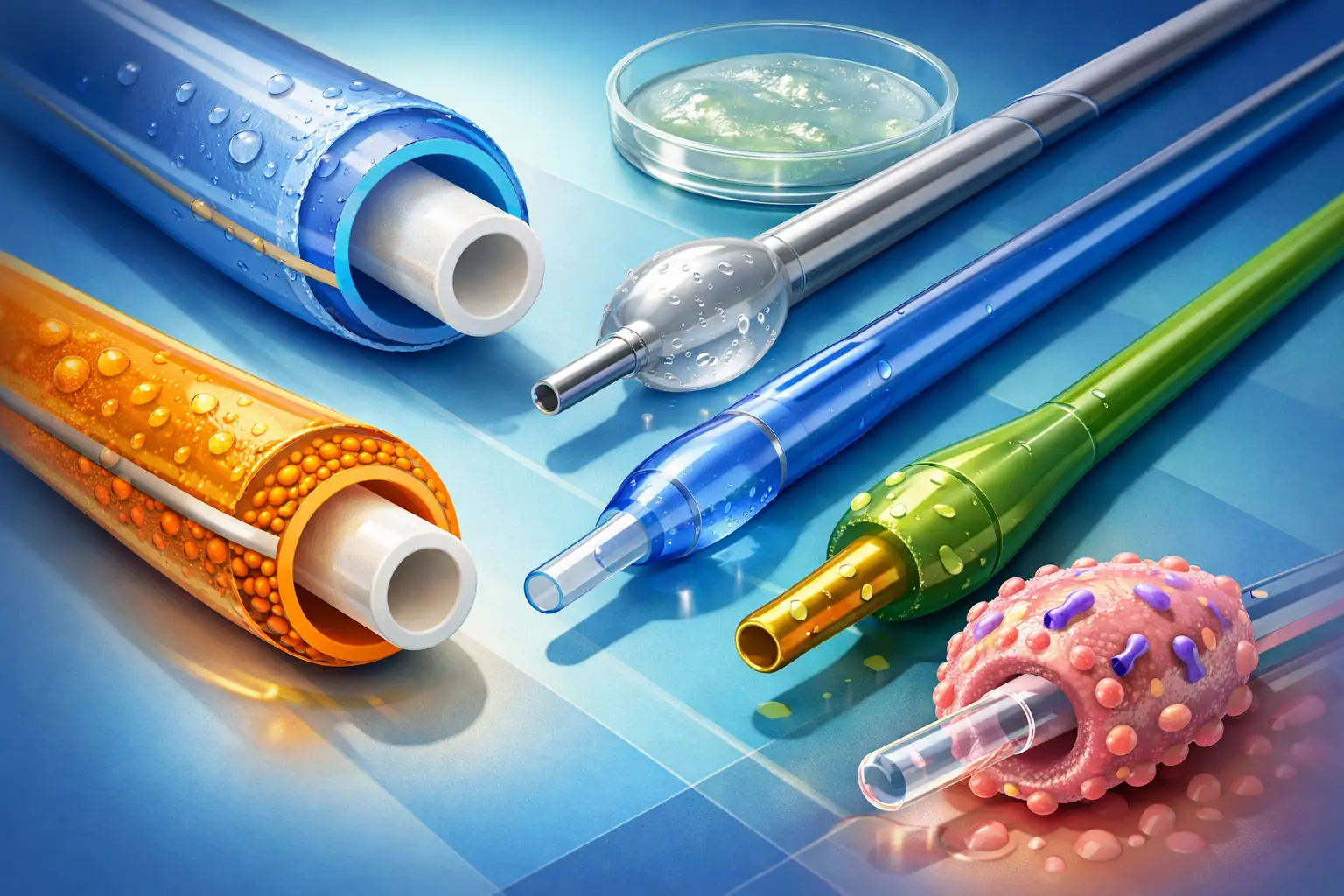
A catheter that performs well in bench testing can still fail its real-world brief once insertion forces rise, dwell times extend, or drug compatibility becomes more demanding. That is why selecting the best coatings for catheters is rarely a matter of choosing the lowest-friction surface alone. For medical device manufacturers, the coating must work as part of the full system – substrate, geometry, sterilisation route, regulatory pathway and production scale included.
In practice, catheter coatings are expected to solve several problems at once. They may need to reduce insertion trauma, improve lubricity, act as a moisture or gas barrier, support biocompatibility, or protect sensitive functional layers beneath. Those targets do not always align. A coating that delivers excellent wet lubricity may offer limited long-term barrier performance, while an ultra-thin conformal barrier layer may not meaningfully reduce friction on its own. The right choice depends on the clinical use case and the manufacturing constraints behind it.
What defines the best coatings for catheters?
The answer depends first on function. Intermittent urinary catheters, central venous catheters, electrophysiology catheters and neurovascular delivery systems do not place the same demands on a surface. Some applications prioritise low insertion force during a short procedure. Others require dimensional stability, chemical resistance and reliable performance after prolonged exposure to bodily fluids.
For technical decision-makers, the evaluation usually comes down to six criteria: lubricity, coating adhesion, biocompatibility, barrier effect, durability under flexing, and process reproducibility. Cost matters, but in regulated medical applications it is usually secondary to validation effort and long-term reliability. A coating that performs well in a sample run but shows variability across complex geometries can become expensive very quickly.
Substrate compatibility also narrows the field. Catheters are commonly based on polymers such as Pebax, polyurethane, silicone, PTFE and nylon, often in multilayer constructions. Each substrate presents different surface energies and different responses to plasma activation, chemical primers or vacuum-based deposition. The coating process must therefore be developed with the full catheter architecture in mind, not treated as an afterthought.
Hydrophilic coatings for catheters
Hydrophilic systems are often the first option considered when lubricity is the primary requirement. Once activated by water, these coatings create a low-friction surface that can significantly reduce insertion forces. In applications where atraumatic navigation is central, that advantage is hard to ignore.
Their strength is clear: excellent wet lubricity and improved handling in use. In many catheter classes, this directly supports clinical performance and user comfort. However, hydrophilic coatings are not universally the best answer. Their performance depends on hydration state, and durability can become a limiting factor if abrasion resistance or extended dwell stability is critical.
Manufacturing complexity should also be assessed carefully. Hydrophilic layers may require tightly controlled surface preparation, primer chemistry and curing conditions to achieve consistent adhesion. On demanding geometries, edge coverage and coating uniformity can be difficult to maintain. For regulated products, that means validation must cover not only initial lubricity but also ageing, packaging interaction and post-sterilisation behaviour.
Parylene as a functional catheter coating
Parylene occupies a different position. It is not primarily chosen as a lubricious topcoat, but as a highly uniform, pinhole-free conformal coating deposited from the vapour phase. For catheter manufacturers, that opens a distinct set of advantages: ultra-thin barrier protection, high surface conformity, low added mass and excellent control over film thickness.
Where moisture protection, chemical resistance or dielectric insulation matter, Parylene can be highly effective. It is especially relevant for advanced catheter systems that integrate sensors, conductors or delicate functional elements. Because deposition occurs at low temperature and with exceptional throwing power, complex geometries and internal features can often be coated more uniformly than with many liquid-applied systems.
That said, Parylene is not a universal friction solution. On its own, it may reduce surface interaction in some configurations, but it is not a substitute for a dedicated hydrophilic lubricious layer where extremely low wet friction is required. Its real value lies in precision barrier performance, biocompatibility and dimensional fidelity. In some catheter architectures, the strongest approach is a multilayer strategy in which Parylene protects the device structure while another functional layer addresses lubricity.
For manufacturers considering scale-up, process stability matters just as much as material properties. Parylene offers a high degree of reproducibility when the process window, masking concept and substrate preparation are engineered correctly. That is particularly relevant where traceability and repeatable coating performance are part of the device’s regulatory case.
PTFE and fluoropolymer options
PTFE and related fluoropolymer coatings are often associated with low surface energy and good chemical resistance. In catheter applications, they can contribute to reduced friction and improved cleanability, depending on the exact formulation and deposition route.
Their advantage lies in inertness and relatively stable tribological behaviour. For some guide catheters or introducer-related components, fluoropolymer surfaces can be useful where dry-slip characteristics matter more than water-activated lubricity. They can also perform well in chemically demanding environments.
The trade-off is that achieving durable adhesion on polymer catheter substrates can be challenging. Fluoropolymers are not automatically suited to every flexible medical device assembly, and their deposition can involve process limitations with respect to thin-wall components or highly flexible sections. In addition, if the requirement includes a highly conformal barrier layer over intricate features, fluoropolymer systems may be less attractive than vapour-deposited alternatives.
Silicone and antimicrobial coatings
Silicone-based coatings are used where softness, flexibility and a degree of lubricity are required. They can be effective in certain long-dwell or comfort-driven applications, particularly where surface feel and flexibility have high relevance. However, their lower barrier performance and potential interaction with subsequent bonding or assembly steps must be evaluated early.
Antimicrobial coatings are often discussed in parallel, especially for indwelling catheters. Here, caution is warranted. While antimicrobial strategies can be valuable in specific indications, they introduce additional regulatory complexity and require very clear evidence of sustained efficacy, release behaviour and patient safety. From an engineering standpoint, they should be specified only when the clinical and regulatory rationale is robust.
How to choose the best catheter coating for the application
A sensible selection process starts with the primary failure mode. If the central problem is insertion force, a hydrophilic system will often be the leading candidate. If the device contains electronics or moisture-sensitive elements, Parylene may become the key enabling layer. If chemical inertness and low surface energy dominate, a fluoropolymer route may deserve consideration.
The next question is whether one layer can realistically do the whole job. In many modern devices, the answer is no. Catheters are becoming more functional, more miniaturised and more tightly regulated. That pushes coating design towards tailored layer stacks rather than single-material decisions. A barrier layer, adhesion-promoting interface and lubricious top layer may each serve a distinct technical purpose.
Process integration then becomes decisive. A coating that performs impressively in the laboratory but cannot be applied reproducibly to long, narrow, flexible substrates is not the best coating in any industrial sense. Fixturing, masking, batch-to-batch consistency, inspection strategy and sterilisation compatibility all influence the final decision. This is where development expertise and application-specific process design make a measurable difference.
Best coatings for catheters in regulated production
For regulated medical manufacturing, coating selection is inseparable from validation strategy. Material data alone is not enough. Manufacturers need evidence that the coating remains stable after sterilisation, during storage, and under the mechanical loads of use. They also need confidence that critical properties such as thickness, adhesion and surface function can be controlled within specification.
This is particularly relevant for thin-film technologies. Their value lies in precision on a very small scale, but that precision must be repeatable in production. Plasma pre-treatment, vacuum deposition, hybrid layer design and customised coating equipment can all improve consistency – provided they are configured around the actual product, not a generic process template. Companies such as NTTF Coatings typically work at this interface, where coating chemistry, equipment engineering and application requirements need to align.
The strongest projects usually begin with a clear hierarchy of requirements. What is essential, what is desirable, and what is simply inherited from an earlier design? Once that is defined, coating selection becomes more rigorous and more economical. It also reduces the risk of forcing one material to solve a problem that is better addressed through a combined process approach.
For catheter developers, the best coating is therefore not the one with the strongest headline property. It is the one that delivers the required surface function, survives the manufacturing and regulatory pathway, and continues to perform when the device leaves the test rig and enters clinical use. That decision is rarely generic, but it is very often where product performance is won or lost.
