
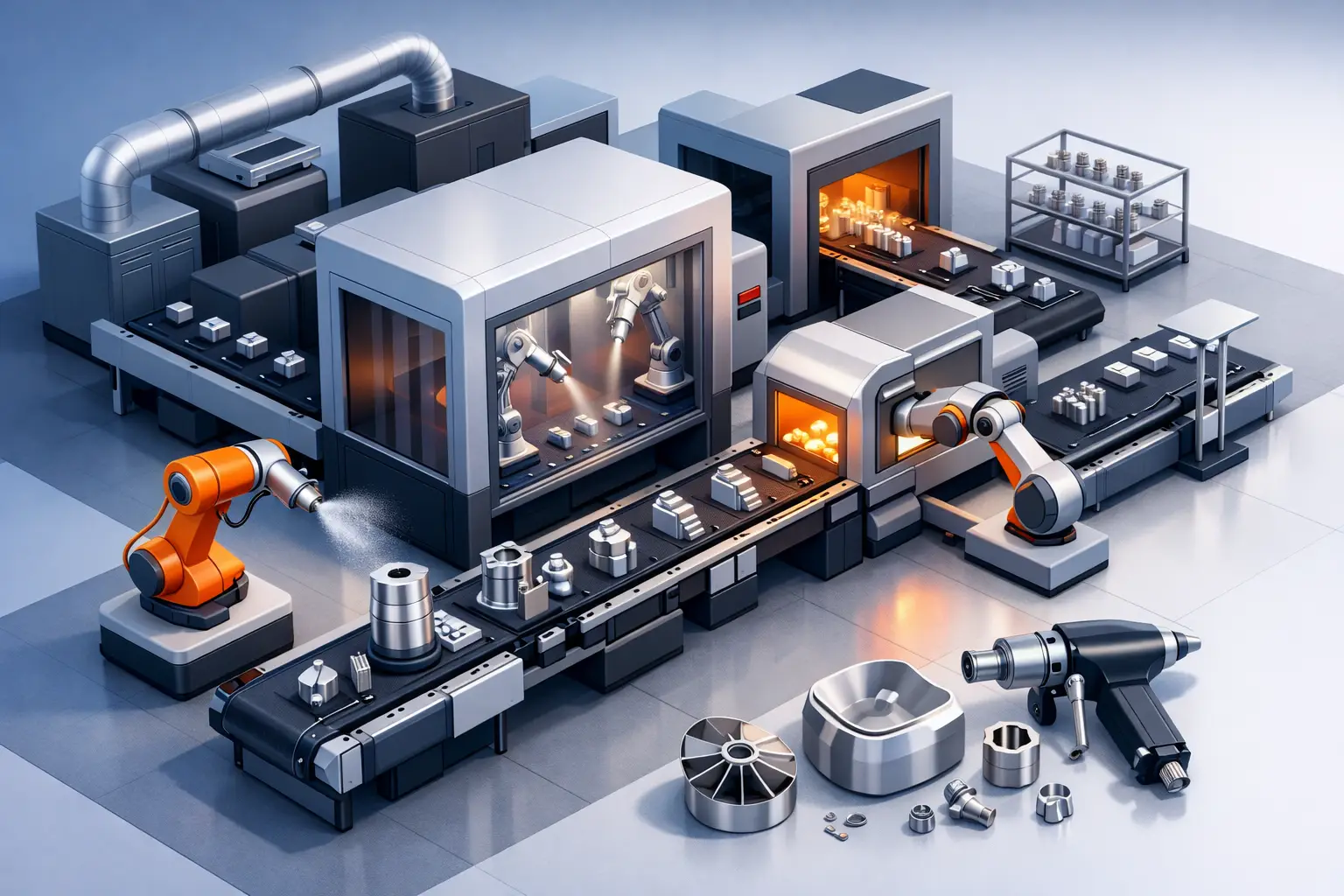
A custom coating line example becomes meaningful when the component, not the equipment catalogue, defines the project. Consider a manufacturer of compact electronic and electromechanical assemblies that must operate reliably under humidity, condensation, salt exposure and thermal cycling. The assemblies contain sensitive solder joints, narrow gaps, mixed materials and contact areas that cannot be impaired by coating build-up. A standard process may cover the obvious surfaces, yet still leave uncertainty around penetration, adhesion, masking quality and batch-to-batch reproducibility.
The appropriate solution is not simply a larger deposition chamber. It is a controlled production system in which cleaning, preparation, loading, coating, inspection and documentation are engineered around the actual part geometry and its functional requirements. This is where a custom coating line changes from a capital purchase into a manufacturing capability.
The application defines the custom coating line example
In this example, the target is a thin, conformal protective layer that reaches recessed geometries without adding significant mass or altering dimensions. Parylene is often a strong candidate because the vapour-phase process can form highly uniform coatings on complex three-dimensional structures. Depending on the application, plasma activation may be introduced before deposition to improve surface energy and adhesion. Where additional barrier, wear or electrical functions are required, a hybrid process architecture can combine technologies rather than forcing one coating to solve every problem.
The engineering brief begins with measurable questions. Which surfaces require protection? Which contact zones must remain coating-free? What film thickness is necessary to meet the environmental requirement without compromising tolerance chains? Which substrates, adhesives, inks or potting compounds are present? Is the line intended for prototype transfer, medium-volume manufacture or continuous industrial operation?
These questions determine the line concept. A device with a few critical sealing faces calls for a different masking strategy from a densely populated electronic assembly. Likewise, a medical component may require a process window shaped by biocompatibility, extractables considerations and documented traceability, while an aerospace component may place greater emphasis on thermal stability, corrosion resistance and defined inspection evidence.
From component analysis to process architecture
A reliable line starts upstream of the deposition chamber. Surface condition has a direct effect on coating performance. Residues from machining, mould release agents, flux, fingerprints and absorbed moisture can reduce adhesion or produce local defects. For this reason, a custom system may include defined incoming inspection, aqueous or solvent-based cleaning, controlled drying and plasma pre-treatment.
Plasma treatment is not a universal requirement, nor is it a substitute for cleaning. Its value lies in targeted surface activation and, in some cases, removal of fine organic contamination. The appropriate gas chemistry, power, pressure and treatment duration depend on the substrate and the intended coating. Excessive treatment can be as problematic as insufficient treatment, particularly for sensitive polymers or materials with tightly controlled surface properties.
After preparation, part handling becomes a central design decision. Racks, carriers and fixtures must hold components securely while exposing relevant surfaces to the process. They must also be practical for operators, repeatable in position and compatible with the thermal and vacuum conditions involved. For high-value components, mistake-proof loading can be more valuable than a marginal gain in rack density. For larger volumes, the balance may shift towards automated handling, barcode-controlled batch assignment and fixture designs that reduce cycle time.
Masking is part of the coating system
Masking is often treated as a manual side task. In demanding applications, it is a process module in its own right. Connectors, optical windows, bonding pads, sliding interfaces and defined grounding points may need protection from deposition. The line should therefore provide a controlled route from masking application through verification and removal.
A suitable approach may use reusable mechanical masks, dedicated plugs, selective tapes or component-specific covers. The choice depends on feature geometry, required edge definition, cleaning compatibility and production quantity. Reusable masks can reduce consumable cost and improve repeatability, but they require maintenance and validation. Disposable solutions may offer flexibility during development, although their use can introduce greater operator dependence at volume.
Deposition capacity is not the same as production capacity
A chamber volume alone says little about useful output. In a Parylene process, production capacity is governed by the entire cycle: loading, evacuation, deposition, venting, unloading, inspection and any required cleaning or maintenance. Coating thickness, surface area, part orientation and process recipe all influence throughput.
For the electronic assembly example, the engineering team may determine that two smaller chambers provide more operational resilience than one large chamber. This arrangement allows recipe separation, reduces the impact of planned maintenance and supports parallel production of different component families. Conversely, one larger chamber may be commercially preferable where parts are physically large, recipes are stable and loading efficiency is high. Neither option is inherently superior. The correct choice follows from forecast demand, acceptable lead time, product mix and the consequences of unplanned downtime.
The deposition system should be specified with clear controls over vacuum performance, precursor handling, thermal management and recipe execution. Sensors and data capture are not decorative additions. They create the evidence needed to compare batches, investigate deviations and maintain a stable process over time. For regulated environments, the detail and retention of that evidence should be defined early, rather than added after the equipment design is fixed.
Quality assurance is built into the material flow
In this custom coating line example, quality control is distributed across the process rather than concentrated at final inspection. Incoming parts are checked for condition and identity. Fixtures are verified before loading. Process parameters are recorded during deposition. Coated parts undergo visual inspection, and representative samples may be assessed for thickness, coverage, adhesion or electrical performance according to the product specification.
The right test methods depend on the failure mode being controlled. A conformal protective layer may require thickness mapping on witness coupons, microscopic examination of critical features and environmental exposure testing during qualification. Where insulation performance is central, electrical tests can provide more useful evidence than visual appearance alone. For mechanically stressed parts, abrasion, friction or bending evaluations may be required.
Traceability should connect the part or batch to material lots, masking configuration, fixture identity, approved recipe, operator actions and inspection outcomes. This level of control supports root-cause analysis when a field issue arises, but it also shortens routine decision-making. A production manager can see whether variation is linked to substrate condition, a change in consumables or a specific process stage rather than relying on assumption.
Automation should address the real constraint
Automation can improve repeatability, but only when applied to the actual source of variation or delay. If masking placement is the dominant quality risk, vision-assisted assembly or dedicated fixtures may justify investment. If chamber utilisation is poor because operators wait for manual approvals, digital batch release and scheduling may deliver a greater benefit. Fully automated transfer systems are valuable in high-volume, stable programmes, yet can create unnecessary complexity for low-volume product families with frequent engineering changes.
A well-designed line therefore retains deliberate flexibility. Recipe management should allow authorised changes while protecting validated parameters. Modular stations can support future capacity increases or additional pre-treatment steps. Spare parts strategy, maintenance access and operator training need the same attention as coating performance. The most advanced chamber cannot compensate for a line that is difficult to service or vulnerable to routine handling errors.
Scaling from development to serial manufacture
The critical transition is not the first coated sample. It is the point at which a promising coating becomes a repeatable industrial process. Development work should establish a process window, not merely a single successful recipe. That means testing realistic variation in substrate batches, part loading, component geometry and environmental conditions.
Pilot production is the appropriate place to prove fixture durability, masking cycle time, inspection workload and yield. It can also reveal practical issues that are rarely visible in laboratory trials, such as trapped handling residues, inconvenient rack loading or insufficient separation between component variants. Design changes at this stage are usually far less costly than changes after serial launch.
For NTTF Coatings GmbH, the value of a tailored line lies in linking coating expertise with plant engineering from the outset. The coating material, process parameters, component handling and quality concept must work as one controlled system. Treating these elements as separate procurement packages often creates gaps precisely where demanding applications cannot tolerate them.
The most useful next step is to bring representative components, performance requirements and realistic production forecasts into an early feasibility discussion. A coating line should be designed around the failures a product cannot afford, the evidence its market requires and the manufacturing conditions it will face for years to come.
