
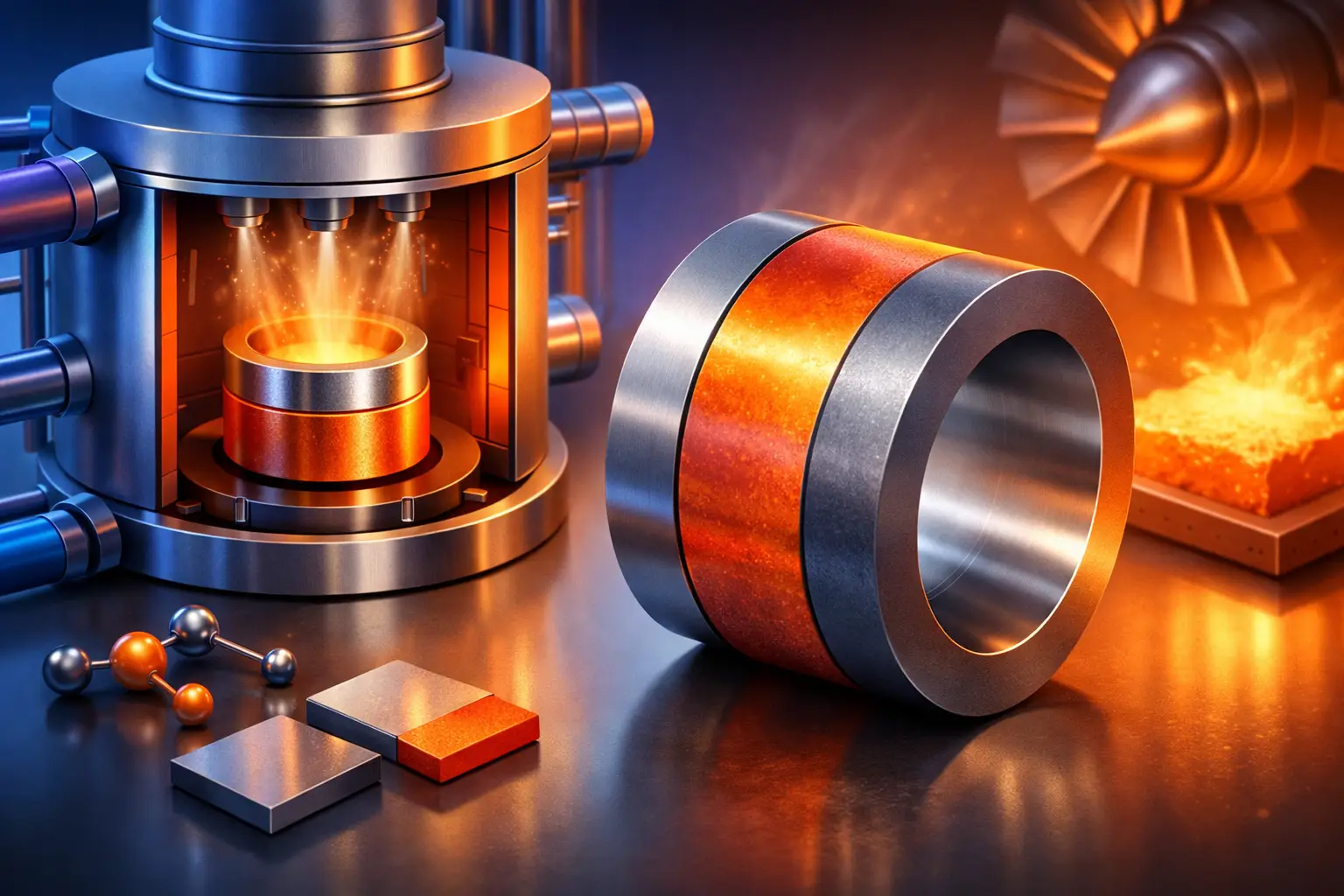
When a component fails at 800°C, the root cause is rarely temperature alone. In most industrial settings, failure comes from a combination of heat, oxidation, corrosive media, thermal cycling and mechanical load. That is precisely where CVD coating for high-temperature applications becomes relevant – not as a generic surface finish, but as a targeted engineering tool for extending service life under conditions that conventional coatings cannot reliably withstand.
For technical decision-makers, the key question is not whether CVD can deposit a hard or chemically stable layer. It can. The more relevant question is whether the coating system, substrate material and process window are matched closely enough to the real operating profile. In high-temperature use, that distinction determines whether a coated part lasts significantly longer or merely fails in a different way.
Why CVD coating for high-temperature applications stands out
Chemical vapour deposition is particularly suited to demanding thermal environments because it forms dense, strongly adhering layers through chemical reactions at the substrate surface. Unlike some lower-temperature deposition methods, CVD processes can create coatings with excellent conformity, high purity and very good stability at elevated temperatures.
That matters in components with complex geometries, internal features or critical edges. In furnace hardware, tooling, sealing elements, semiconductor process parts or high-load machine components, a coating must not only survive temperature. It must remain dimensionally functional, chemically effective and mechanically intact across the whole part.
Common CVD coating materials for high-temperature service include carbides, nitrides and oxide-forming systems selected for hardness, diffusion resistance, oxidation behaviour or tribological performance. Which system is suitable depends heavily on the failure mechanism. If abrasive wear dominates, one solution may fit. If hot corrosion, metal dusting or interdiffusion is driving degradation, the material choice changes.
What high-temperature performance really depends on
In practice, thermal resistance is only one parameter among several. A technically sound specification for CVD coating for high-temperature applications has to consider the full interaction between coating, substrate and atmosphere.
Oxidation and corrosive attack
At elevated temperatures, many metallic components degrade not because they soften, but because oxygen, sulphur-bearing gases, halides or reactive process media attack the surface. A well-designed CVD layer acts as a barrier and stabilises the interface. The effectiveness of that barrier depends on coating density, defect population and chemical compatibility with the process environment.
A coating that performs well in dry air may be unsuitable in water vapour, hydrogen-containing atmospheres or aggressive chemical process chambers. This is why laboratory values alone are not enough. Application-specific validation is essential.
Adhesion under thermal cycling
A coating may show excellent hardness and chemical resistance, yet still fail if the coefficient of thermal expansion is poorly matched to the substrate. Repeated heating and cooling generate stress. Over time, that stress can lead to cracking, spallation or edge delamination.
This is one of the main reasons high-temperature coating projects should not be approached as catalogue selections. Layer architecture, deposition temperature, substrate preparation and post-process handling all influence long-term adhesion. The best results usually come from systems engineered around the part rather than chosen from a standard menu.
Diffusion and microstructural stability
In many industries, high-temperature degradation begins below the surface. Elements migrate, interfaces react and the substrate microstructure changes over time. CVD coatings can be designed to reduce diffusion, stabilise contact surfaces and protect against detrimental interfacial reactions.
This is especially relevant in tooling, aerospace components, power generation hardware and specialised process equipment where dimensional stability and repeatable performance are critical. A thin layer can have an outsized effect when it limits atom transport at precisely the right interface.
Where CVD delivers measurable industrial value
The industrial value of CVD is clearest in applications where uncoated parts fail predictably and expensively. In these cases, the coating is not a cosmetic upgrade. It changes maintenance intervals, process stability and total part economics.
In heat treatment and furnace technology, CVD coatings can reduce oxidation, sticking and wear on fixtures, supports and handling components. In metal forming and machining, they improve hot hardness and reduce tribological stress on tools exposed to high contact temperatures. In semiconductor and electronics production, they help protect process-critical components against chemically aggressive, thermally demanding environments where contamination control is equally important.
Automotive, aeronautical and defence-related applications often place further demands on reproducibility and qualification. Here, coating performance must be stable not only in one test specimen, but across batches, geometries and production lots. That shifts the discussion from coating chemistry alone to process capability.
Limits and trade-offs in CVD coating for high-temperature applications
CVD is highly capable, but it is not universally the right answer. The process itself often runs at elevated temperatures, which can restrict substrate choice. If the base material is heat-sensitive, dimensionally critical or prone to metallurgical change during deposition, alternative coating routes may need to be considered.
Cost is another factor, although it should be assessed correctly. A CVD coating can be more complex than a simpler surface treatment, but in demanding applications the relevant comparison is not coating price per part. It is cost per operating hour, cost per cycle or cost per accepted unit produced. Where downtime, scrap or premature wear are expensive, a higher-performance layer often proves economically sound.
There is also the question of coating thickness. Thicker is not automatically better. In some systems, excessive thickness increases internal stress or affects tolerances. In precision components, the useful coating window may be narrow and must be controlled tightly.
Process development matters more than generic specification
For high-temperature use, successful coating projects usually begin with a failure analysis rather than a material shortlist. What exactly is happening at the surface? Is the dominant mechanism abrasive wear, oxidation, corrosion, galling, diffusion, thermal fatigue or a combination of several effects? Without that clarity, even a technically advanced coating can miss the actual problem.
This is why serious implementation requires process development at application level. The substrate material, roughness, geometry, thermal history and expected media exposure all influence the final result. So do masking concepts, fixturing, batch loading and quality assurance methods.
An experienced development partner will typically evaluate not only the coating material, but also the deposition route, pretreatment strategy and industrial scalability. That is particularly important when a process is intended to move from prototype or pilot stage into serial production. Reproducibility at laboratory level is useful. Reproducibility in a validated production environment is what creates long-term value.
For companies aiming to integrate coating technology into their own operations, the process window becomes even more important. In-house implementation requires more than equipment delivery. It requires system design, media handling, process control, qualification support and a realistic understanding of maintenance and throughput. This is where an engineering-led provider such as NTTF Coatings can create a measurable advantage by combining coating expertise with application-specific plant design.
How to evaluate suitability for your component
A sensible assessment starts with the service profile. Temperature range matters, but so do dwell time, ramp rates, atmosphere, contact conditions and acceptable wear limits. A component exposed briefly to 1,000°C behaves differently from one operating continuously at 650°C in a corrosive atmosphere.
The second step is substrate assessment. Base material composition, heat treatment condition and dimensional sensitivity influence which CVD process can be used safely. If the substrate cannot tolerate the deposition temperature, the coating concept must be adjusted early rather than after testing begins.
The third step is validation. Useful testing should replicate the actual combination of thermal, chemical and mechanical loads as closely as practical. Simplified coupon tests can help screen candidates, but final approval should reflect the real component geometry and process environment. Otherwise, the gap between lab success and field performance remains too large.
The strategic role of CVD in high-temperature design
For many manufacturers, coatings are still considered late in the development cycle, often after repeated field failures. That approach leaves performance potential on the table. When surface engineering is included earlier, CVD can become part of the design strategy rather than a repair measure.
This changes how components are specified. Designers can work with base materials optimised for structural needs while using the coating to deliver surface functionality such as wear resistance, chemical stability or diffusion control. In demanding sectors, that separation of functions often leads to better overall system performance and more economical part design.
The practical value of CVD coating for high-temperature applications lies exactly there – in creating a controlled, application-specific surface that remains functional where heat, chemistry and load would otherwise shorten component life. The right coating does not simply protect a part. It gives engineers more room to design for reliability, process stability and productive operating time.
