
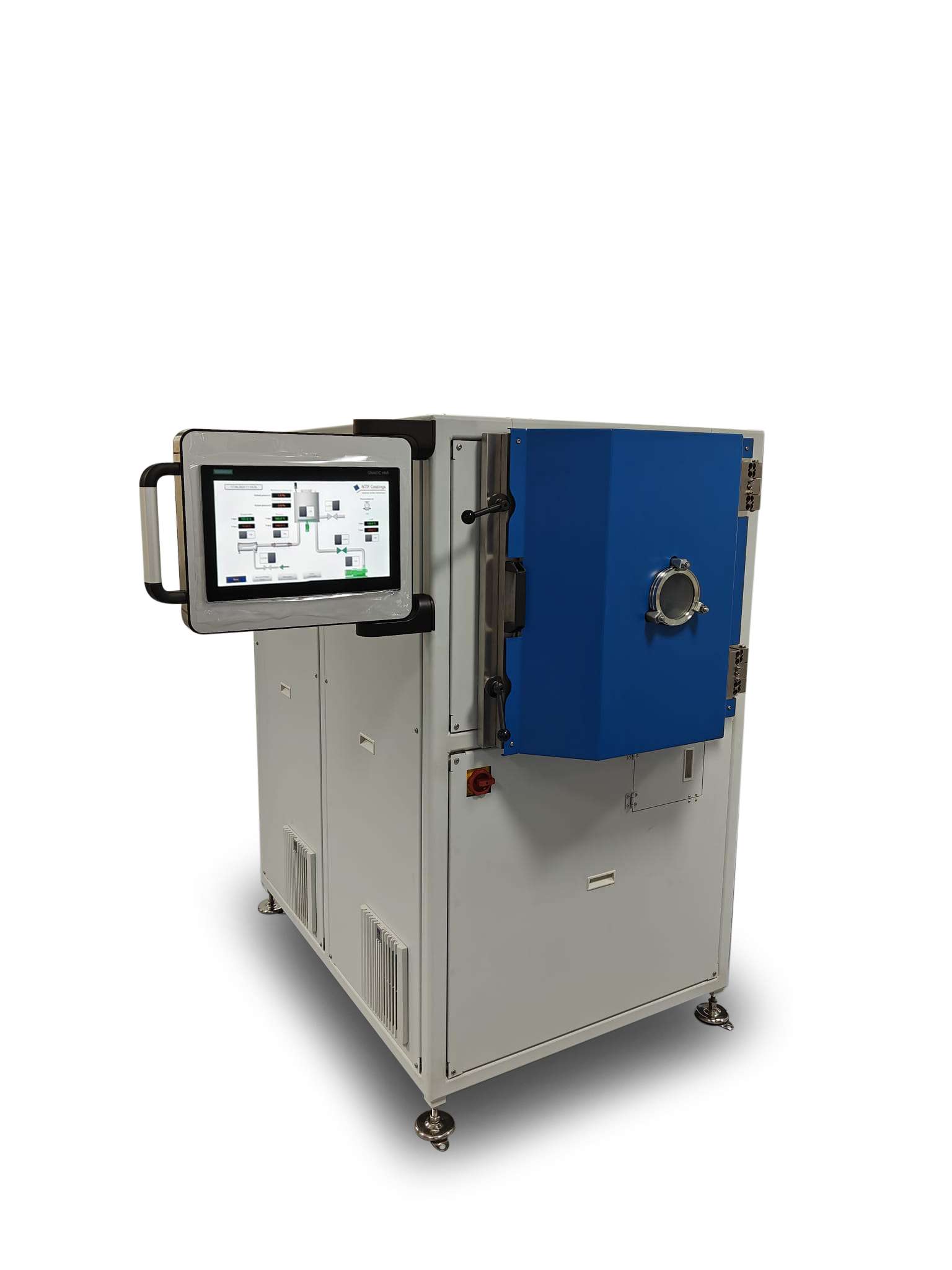
When a coating process fails in production, the problem is rarely the polymer alone. More often, the weakness sits in the interface between material, component geometry, throughput target and plant design. That is exactly why custom parylene coating equipment matters. In regulated and technically demanding industries, a standard chamber with generic process settings is often too blunt an instrument for the job.
Parylene is valued because it forms highly uniform, pinhole-free and conformal thin films, even on complex geometries. Yet those advantages only translate into reliable industrial results when the deposition system is matched to the actual part spectrum, cleanliness concept, process window and downstream quality requirements. For technical decision-makers, the real question is not whether parylene works. It is whether the equipment architecture can produce the required layer quality repeatedly, economically and under controlled conditions.
Why custom parylene coating equipment is often the better choice
Off-the-shelf systems can be suitable for straightforward applications with stable part dimensions, modest throughput and low regulatory pressure. The picture changes quickly when components become more complex, cleanliness requirements rise or process reproducibility becomes audit-relevant. In those cases, custom parylene coating equipment is less a luxury than a practical necessity.
A tailored system allows the process to be designed around the component rather than forcing the component into the limits of a standard machine. That affects several critical parameters at once. Chamber size must suit the loading strategy. Vapour flow and deposition behaviour must remain stable across the usable volume. Fixturing has to support even coating without creating shadowing or handling damage. At the same time, the system must fit the customer’s production logic, whether that means batch traceability, cleanroom integration, recipe control or compatibility with upstream plasma activation.
For medical technology, this may centre on biocompatibility, validation and gentle treatment of intricate substrates. In electronics, dielectric performance, insulation reliability and coating penetration into narrow structures are often decisive. In mechanical and automotive applications, wear protection, chemical resistance and process economy usually carry more weight. The equipment design should reflect those priorities from the outset.
What has to be engineered into the system
A parylene process may look simple from the outside – precursor in, coating out – but the equipment behind it is a tightly coupled process chain. Weakness in one module tends to show up later as coating variation, contamination, inefficiency or maintenance burden.
Chamber design and usable process volume
The deposition chamber is more than a container. Its geometry influences gas distribution, loading density and the consistency of film growth across all parts in the batch. A chamber that is too large may reduce efficiency and extend cycle times. One that is too compact may limit fixture design or create local process differences. Custom engineering helps align chamber dimensions with actual component size, planned batch structure and future capacity.
Vapourisation and pyrolysis control
Parylene deposition depends on tightly controlled conversion stages. The dimer must vapourise consistently, and the pyrolysis unit must cleave it into the reactive monomer without undesirable side reactions. Temperature control, thermal stability and line design all influence the quality of the deposited film. If these modules are not matched to the required coating rate and material grade, the process window narrows and reproducibility suffers.
Vacuum system and pressure stability
Stable vacuum conditions are essential for repeatable deposition. Pump configuration, pressure control strategy and condensate management must be designed around both the process chemistry and the production rhythm. In a development environment, flexibility may be the priority. In series production, uptime, cleaning intervals and predictable cycle performance become more important. The right answer depends on the use case.
Fixturing and part handling
Many coating challenges are mechanical before they become chemical. Delicate parts, high-density loading, narrow cavities or mixed substrates require fixture concepts that protect components while exposing critical surfaces correctly. Custom racks and holders are often what make a process scalable. They also affect throughput, handling time and the risk of particle generation.
Integrating the process, not just buying a machine
The strongest argument for custom parylene coating equipment is not only coating quality. It is process integration. A deposition system that performs well in isolation can still become a bottleneck if it does not fit the surrounding production environment.
That starts with logistics. How are parts cleaned, loaded and tracked? Does the line need manual flexibility or automated repeatability? Is there a requirement for data logging, user management or recipe security? For manufacturers in regulated sectors, these questions are not administrative details. They are part of the technical solution.
A custom system can also be configured as part of a broader surface treatment chain. Plasma pre-treatment may be required to improve adhesion on difficult substrates. Masking concepts may need to be built into the workflow. Post-process inspection, thickness verification and release documentation must often be considered from the beginning. If these elements are added later as workarounds, the process tends to become slower and less stable.
Where standard systems reach their limits
Standardised machines are typically designed around average use cases. That makes them faster to specify, but also more likely to create compromises. The difficulty is that parylene applications are rarely average.
A device housing with open external surfaces behaves very differently from a densely packed electronic assembly, a catheter component or a mechanical seal with hidden features. Substrate materials vary in thermal sensitivity, outgassing behaviour and adhesion response. Production goals range from prototype support to validated high-volume manufacturing. One machine concept cannot serve all these scenarios equally well.
The usual trade-off is between flexibility and optimisation. A generic plant may accommodate many part types, but often with lower efficiency, less precise loading concepts and wider process tolerances. A custom-built system narrows the design around the real requirement profile. That can improve quality consistency, reduce scrap and shorten cycle-related losses, although it may demand more detailed planning at project start.
Custom parylene coating equipment for regulated sectors
In regulated environments, equipment design has consequences beyond production output. It affects documentation, qualification and long-term change control. Medical technology is a clear example. If the coating contributes to product safety or function, the plant must support a process that is demonstrably stable, traceable and reproducible.
That influences software architecture, sensor selection, calibration strategy and maintenance design. Cleanability and contamination control may be just as important as deposition performance. Access rights, batch records and parameter monitoring are often required at a level that standard systems do not fully support without modification.
The same principle applies in aeronautics, defence-related applications and high-reliability electronics. Here, a coating process must not merely work under laboratory conditions. It must stand up to qualification demands, long production campaigns and recurring audits.
Economic value comes from fit, not only from capacity
A common purchasing mistake is to compare systems primarily by chamber size or nominal throughput. Those metrics matter, but they do not tell the whole story. The true economic value of custom parylene coating equipment lies in how well the system fits the product mix and operating model.
A better-matched system can reduce coating variation, handling effort and cleaning downtime. It can support denser but still controlled loading. It can improve recipe transfer from development to production. It may also simplify operator training because the process flow is built around the actual manufacturing sequence rather than adapted afterwards.
Of course, customisation has its own considerations. Engineering effort is higher, specification work is more demanding and project timelines can be longer than for catalogue equipment. But for companies with demanding parts, strict quality targets or a strategic need to bring coating competence in-house, that upfront effort is often what prevents expensive limitations later.
How to assess the right system concept
The starting point should always be the component and its required function. Coating thickness, dielectric behaviour, barrier properties, friction response, biocompatibility and adhesion targets all shape the process design. From there, the equipment concept can be derived with more clarity.
Useful questions include how broad the part portfolio will be, what annual volume is expected, how much recipe flexibility is needed and whether the line must integrate with existing automation or cleanroom infrastructure. It is also worth defining what success means operationally. For one manufacturer, the key metric may be traceable reproducibility. For another, it may be cycle time, maintenance accessibility or the ability to coat unusually complex geometries.
A capable engineering partner should be able to translate those requirements into a coherent plant design rather than offering a resized standard platform. That includes process development, fixture design, module selection and practical implementation planning. NTTF Coatings works in precisely this overlap between coating science, application-specific engineering and industrial plant construction.
The most effective coating equipment is rarely the most generic and rarely the most complex for its own sake. It is the system that fits the component, the quality requirement and the production reality closely enough to deliver repeatable performance without constant improvisation. That is where custom engineering stops being a special option and becomes sound industrial practice.
