
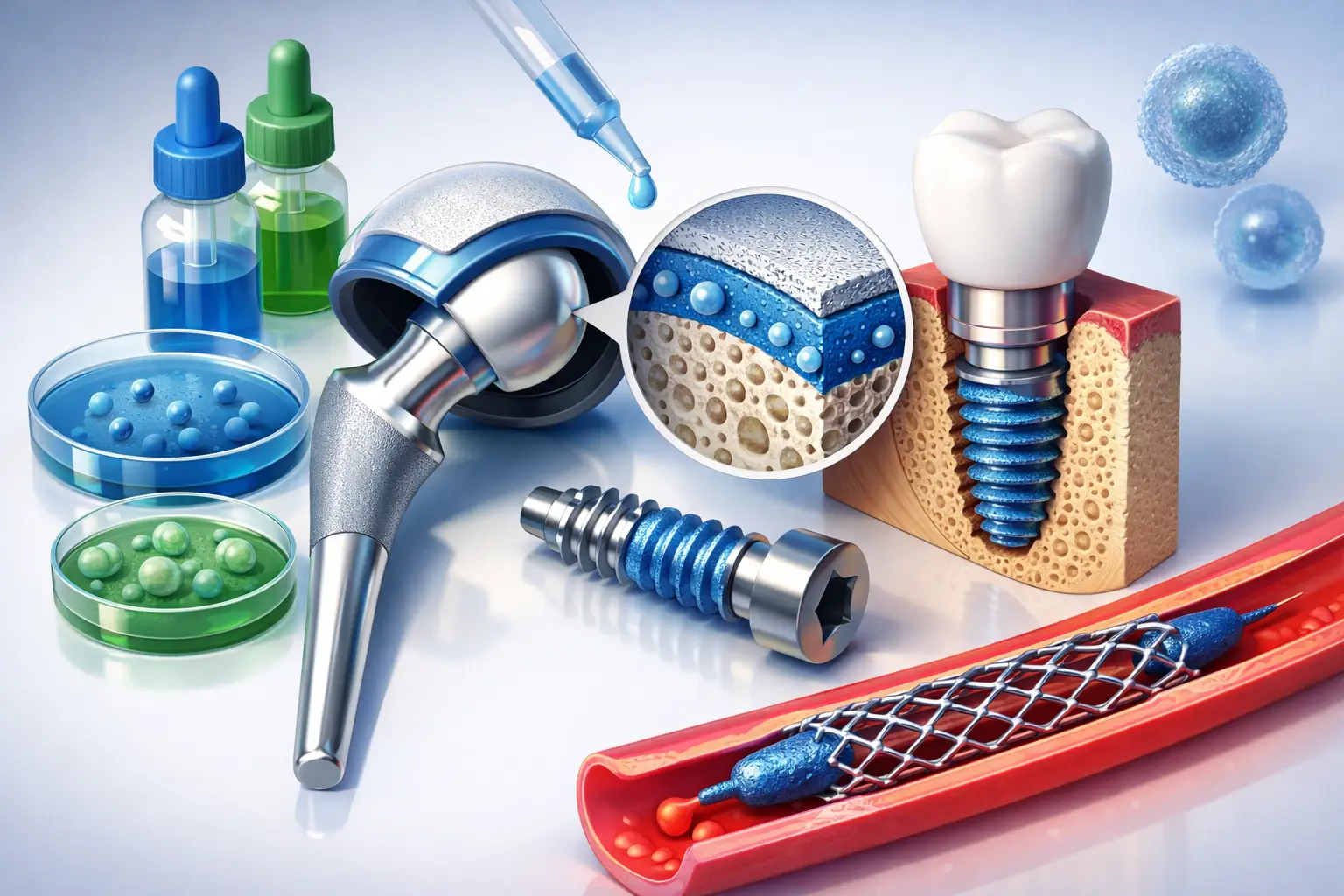
A biocompatible coating for implants is rarely chosen on a single property. In practice, developers must balance tissue compatibility, barrier performance, adhesion, sterilisation stability, geometry coverage and regulatory evidence – often within one component that has no tolerance for failure. That is why coating selection in medical technology is an engineering decision, not a catalogue exercise.
What a biocompatible coating for implants must achieve
For technical decision-makers, biocompatibility is the starting point, not the finish line. A coating may show favourable biological behaviour and still fail the application because it cracks under load, changes friction in an unwanted way or leaves weak points on complex geometries.
In implant systems, the coating sits at a critical interface between material and physiology. It can reduce direct interaction between the substrate and surrounding tissue, improve corrosion resistance, lower particle release and tailor surface energy. Depending on the indication, it may also support lubricity, electrical insulation or moisture barrier performance.
The challenge is that these requirements do not always align. A thicker layer may improve barrier protection but affect tolerances. A very hard coating may improve wear resistance but introduce stress at the interface. A chemically inert surface may be advantageous in one implant class and less suitable in another where specific biological interaction is required. Good coating design begins with these trade-offs.
Why substrate and implant function matter more than broad material claims
It is tempting to ask which coating is best for implants. The more useful question is which coating system is best for a specific implant, substrate and manufacturing route.
Titanium, stainless steel, nitinol, cobalt-chromium alloys and polymeric implant materials each behave differently during surface preparation, coating deposition and long-term use. Surface roughness, thermal sensitivity, oxide chemistry and coefficient of expansion all influence whether a layer adheres reliably and remains stable over time.
Function matters just as much. A cardiovascular component, an orthopaedic implant and an implantable electronic assembly place very different demands on the coating. One application may prioritise conformal coverage and dielectric behaviour. Another may need low friction and high wear resistance. A third may require a highly effective moisture and ion barrier for long-term protection of sensitive electronics.
This is why experienced development teams begin with the use case, not with the process name.
Relevant coating technologies for implant applications
No single technology covers every medical requirement. The right route depends on geometry, substrate, required film thickness and the target property profile.
Parylene for conformal, pinhole-free barrier layers
Parylene coatings are widely considered when implants require very uniform coverage, low permeability and high dielectric strength. Because deposition occurs from the gas phase, the coating can form an exceptionally conformal layer on complex three-dimensional components, including sharp edges, cavities and delicate structures.
For implantable electronics and miniaturised assemblies, that conformality is often decisive. A local weak point in the coating can become the point of failure in vivo. Parylene is therefore attractive where component integrity depends on continuous barrier performance across demanding geometries.
That said, Parylene is not a universal answer. Adhesion to the substrate must be engineered carefully through suitable pre-treatment and process control. Mechanical loading, flex behaviour and sterilisation conditions also need to be validated against the selected Parylene type and layer design.
Plasma processes for surface activation and functional adjustment
Plasma technologies are particularly useful when the surface itself must be modified before or alongside coating deposition. Plasma can clean, activate or functionalise the substrate and thereby improve adhesion, wettability or subsequent layer formation.
In implant manufacturing, this matters because contamination at microscopic scale can undermine an otherwise well-designed coating system. Plasma pre-treatment helps create a reproducible interface – especially important in regulated production where process stability must be demonstrated, not assumed.
Plasma-based steps are often most effective as part of an integrated coating architecture rather than a standalone solution.
PVD and CVD for hard, thin functional layers
Where wear resistance, hardness or specific chemical functionality are central, PVD and CVD processes can be relevant. These methods enable thin films with tightly controlled composition and structure. In suitable implant applications, they can improve tribological behaviour and provide targeted surface functionality.
However, suitability depends strongly on temperature sensitivity, line-of-sight limitations, internal geometry and the mechanical behaviour of the coated part. A technically impressive layer is of little value if it cannot be applied reproducibly to the actual component design.
Hybrid systems for multi-layer requirements
Implants often need more than one surface function. A hybrid system can combine, for example, adhesion-promoting pre-treatment, a hard functional base layer and a final conformal barrier coating. This is where application-specific development becomes particularly valuable.
Instead of forcing one technology to solve every problem, the better approach is to define which function should be delivered by which layer and how the total system behaves under realistic use conditions.
Key selection criteria beyond biocompatibility
The phrase biocompatible coating for implants sounds singular, but qualification is multi-dimensional. Technical teams should assess the full operating profile.
Adhesion is fundamental. If the coating detaches, every other performance claim becomes irrelevant. Surface preparation, substrate chemistry and process reproducibility are therefore as important as the coating chemistry itself.
Coverage of complex geometries is another frequent separator between promising laboratory results and viable production solutions. Implants are seldom simple flat coupons. They include cavities, porous areas, transitions and sensitive microfeatures. The deposition method must match the real part geometry.
Sterilisation resistance also deserves early attention. Autoclave, ethylene oxide, gamma and other methods can alter surface chemistry, mechanical properties or long-term stability. Testing only the as-coated state is not enough.
Then there is ageing behaviour. Medical components can remain in the body for years. Water uptake, ion diffusion, oxidation, stress relaxation and repeated mechanical loading must be considered in realistic test plans.
Finally, manufacturing economics matter. In B2B projects, a technically elegant coating that cannot be scaled with reproducible quality or integrated into existing production will struggle to justify adoption.
Development and validation in regulated environments
For implant applications, coating development is inseparable from documentation and validation. The question is not simply whether a coating works, but whether its performance can be proven consistently across batches, time and scale.
That changes how successful projects are run. Parameters such as pre-cleaning, plasma activation, chamber loading, deposition rate, thickness distribution and post-process inspection need to be defined and controlled. Small variations can affect biological response and long-term reliability.
A credible development partner will therefore look beyond sample coating. The more valuable contribution lies in translating a functional requirement into a stable process window and a qualification strategy. This includes selecting relevant test methods, defining acceptance criteria and understanding where tolerances are genuinely critical.
For companies that want to internalise coating capability, equipment design becomes part of the equation. Customised systems can be built around part geometry, throughput targets, traceability and cleanroom requirements. This is often the difference between a promising pilot and a repeatable industrial process.
Where application-specific engineering creates the real advantage
The market does not lack coating materials. What is often missing is the engineering depth to connect material, process and component function in a way that survives qualification and scale-up.
A biocompatible coating for implants should therefore be treated as a system decision. The substrate, the layer architecture, the pre-treatment route, the deposition technology and the inspection concept all influence the end result. Focusing too narrowly on a coating name can obscure the real causes of success or failure.
This is particularly true for companies developing new implant platforms or upgrading legacy designs. A coating may solve a corrosion issue while creating a tolerance problem. It may improve barrier performance while complicating downstream assembly. It may be ideal for outsourced batch processing but less suitable for future in-house integration. These dependencies need to be surfaced early.
For technically demanding medical projects, the stronger route is usually collaborative development with clear functional targets and realistic validation milestones. Providers such as NTTF Coatings work in exactly this space – combining coating expertise, process development and custom equipment engineering where standard solutions do not go far enough.
The most effective implant coatings are seldom the most generic. They are the ones specified with enough precision to fit the biology, the component and the production reality at the same time.
