
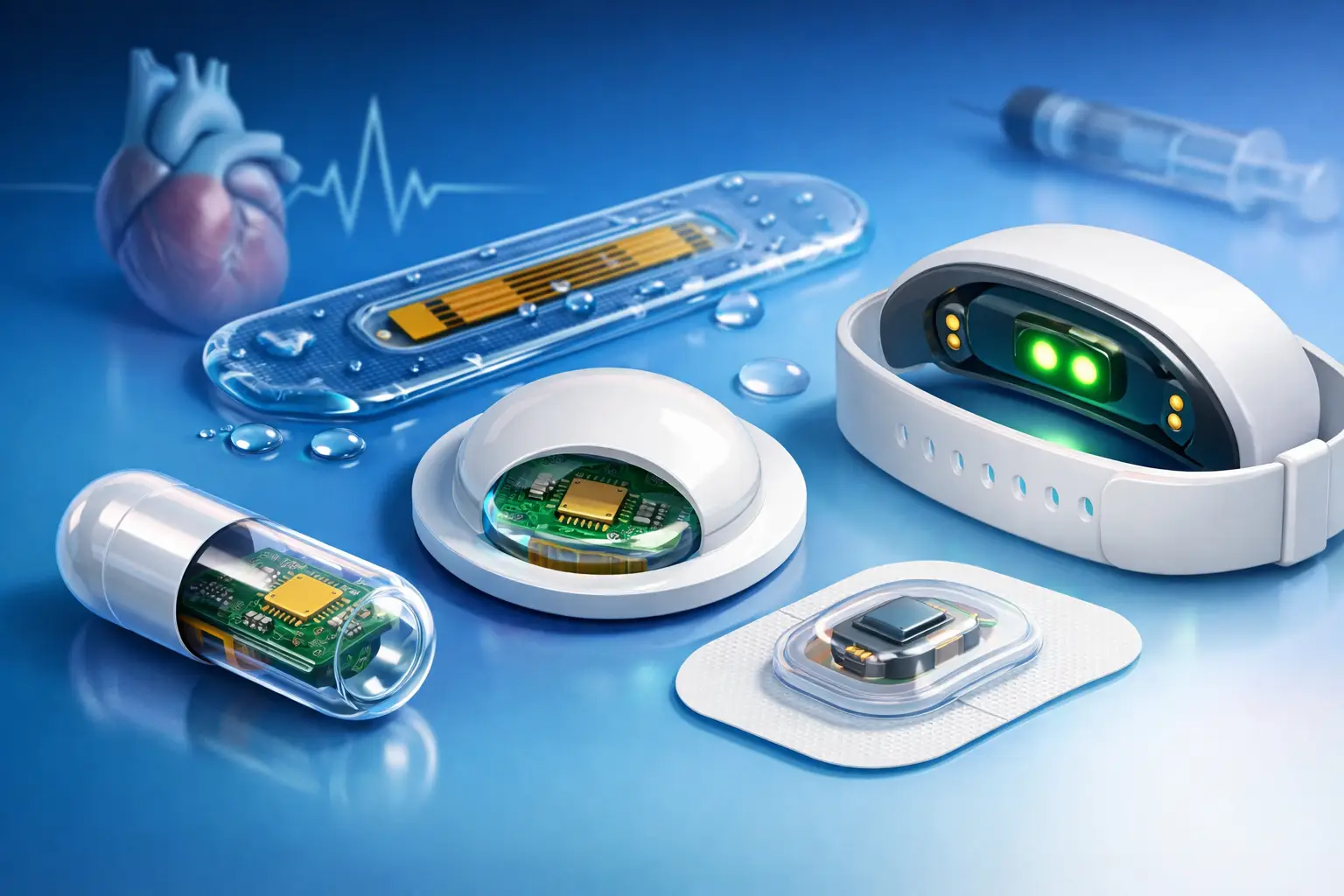
A sensor that performs precisely on the laboratory bench can fail quickly once it encounters saline solution, condensation, body fluids, sterilisation cycles or long-term implantation conditions. Medical sensor encapsulation is therefore not a finishing operation applied after development. It is a design-critical function that determines whether electrical performance, biocompatibility and product lifetime can be maintained under real operating conditions.
For manufacturers of diagnostic equipment, wearable systems, catheters, implantable electronics and surgical instruments, the challenge is rarely solved by simply applying more coating material. The encapsulation must protect vulnerable structures without impairing sensitivity, increasing component dimensions excessively or interfering with signal transmission. Achieving this balance requires an application-specific view of material, geometry, process window and regulatory evidence.
Why medical sensor encapsulation is technically demanding
Medical sensors combine sensitive elements with demanding environments. Electrodes, microelectronics, wire bonds, MEMS structures and flexible circuits may be exposed to ionic media that accelerate electrochemical corrosion. Even minimal moisture ingress can alter insulation resistance, create leakage currents or cause drift in low-level signals. In implantable applications, the time horizon may extend from months to many years.
At the same time, a protective layer must not compromise the sensor’s intended function. A pressure sensor needs defined mechanical coupling to its environment. A gas sensor requires controlled diffusion. Electrochemical electrodes may need an active surface to remain accessible, while neighbouring conductors require reliable insulation. The encapsulation concept must therefore distinguish precisely between functional areas and protection zones.
Biocompatibility adds another layer of complexity. Materials in direct or indirect contact with the patient must be assessed in relation to their intended use, contact duration and anatomical location. This includes not only the bulk material but also residues, adhesion promoters, pigments, cleaning agents and potential degradation products. A technically effective barrier is not automatically suitable for a medical application.
The functions of an encapsulation system
An effective system often performs several functions simultaneously. It limits moisture and ion ingress, electrically insulates conductive structures, reduces corrosion risk and provides a defined interface to tissue, fluid or the device housing. Depending on the application, it may also reduce friction, improve chemical resistance or support dielectric strength in compact electronic assemblies.
The required priorities differ considerably. For a reusable surgical instrument, resistance to repeated cleaning and sterilisation may dominate. For a disposable biosensor, manufacturing throughput, coating selectivity and cost per part can be decisive. An implantable neurostimulation component places particular emphasis on long-term barrier performance, adhesion stability and material compatibility with the surrounding biological environment.
This is why material selection should not start with a generic question such as which coating is best. The more useful question is which failure mode presents the greatest risk for this specific component. Corrosion at a bond pad, delamination at a polymer interface, dielectric breakdown, cracking under flexing and signal attenuation each demand different technical responses.
Parylene for conformal protection of complex geometries
Parylene coatings are frequently considered where thin, pinhole-minimised and highly conformal layers are required. Deposited from the vapour phase, Parylene can cover sharp edges, fine structures, internal surfaces and closely spaced electronic components with a comparatively uniform film thickness. This is a significant advantage over liquid coating processes, which can accumulate material at edges, bridge narrow gaps or leave shadowed areas insufficiently protected.
For medical sensor encapsulation, the key benefit is not simply thinness. It is the ability to apply a continuous protective layer to geometrically complex components while preserving small dimensions and low mass. This can be valuable for miniaturised sensors, flexible substrates, electronic modules and assemblies with wire bonds or soldered interconnects.
However, conformality alone does not guarantee long-term performance. Adhesion to the substrate is central. Surface contamination, absorbed moisture, residues from fluxes or mould-release agents and unfavourable surface energies can all reduce bond strength. Targeted pre-treatment, including plasma activation, can improve surface condition and support reproducible adhesion. The relevant process must be qualified for the actual material combination rather than inferred from generic data sheets.
Thickness also requires careful definition. A layer that is too thin may not provide the required barrier performance over the intended lifetime. A layer that is too thick can influence flexibility, thermal behaviour, sensor response or mechanical stress within the assembly. For electrically active structures, dielectric requirements and permissible capacitance changes must be assessed alongside environmental protection.
Selective coating requires defined masking strategy
Many sensors cannot be fully encapsulated. Optical windows, electrode interfaces, pressure diaphragms, fluidic ports or connector contacts may need to remain free from coating. Selective protection can be achieved through masking, local removal processes or design features that define functional exposure areas.
The choice depends on geometry, required edge definition, production volume and tolerances. Masking is not a secondary production detail. Mask transitions can become potential paths for fluid ingress or sites of stress concentration. The design of the component and the design of the coating process should therefore be developed together from an early stage.
Barrier performance depends on the complete assembly
A coating can have excellent intrinsic barrier characteristics and still fail at interfaces. Moisture does not only travel through a polymer film. It can enter at connector regions, under lifted edges, through cracks, along poorly bonded interfaces or through damage created during subsequent assembly. For that reason, encapsulation must be treated as a system consisting of substrate, surface preparation, coating, masking, post-processing and final device integration.
Part geometry is particularly influential. Sharp corners can concentrate stress. Moving sections can fatigue a coating over time. Different coefficients of thermal expansion between metal, ceramic, silicon and polymer substrates may create strain during temperature changes. The relevant test programme should reflect these conditions rather than rely solely on static immersion tests.
Useful qualification work commonly combines visual inspection, coating-thickness measurement, adhesion assessment, electrical isolation testing and environmental ageing. Depending on the product, this may include thermal cycling, humidity exposure, saline immersion, flex testing, sterilisation simulation and functional sensor measurements before and after ageing. The aim is to establish not merely that the coating is present, but that the encapsulated device continues to meet its specified performance limits.
From laboratory feasibility to controlled production
A successful prototype coating is an important milestone, but it is not yet an industrial process. Reproducibility depends on controlled loading, defined masking methods, material handling, chamber condition, process parameters and inspection criteria. These factors become increasingly relevant when production moves from small engineering batches to serial manufacture.
For regulated medical technology, traceability should be considered from the start. Lot-specific documentation, defined acceptance criteria and controlled process changes support later validation activities. The coating supplier or equipment partner needs to understand which characteristics are critical to quality and how those characteristics can be monitored in production.
There are two viable implementation routes. Contract coating is often appropriate when demand is variable, the product is in an early market phase or specialised process capability is required without internal capital investment. An in-house system may become advantageous when volumes, confidentiality requirements or supply-chain strategy justify integration into the manufacturer’s own production environment. The better route depends on projected demand, component variety, cleanroom requirements, validation effort and internal process expertise.
NTTF Coatings develops both application-specific coating processes and customised plant concepts, allowing encapsulation requirements to be considered across development, qualification and scale-up rather than as isolated production steps.
Questions that should be answered before selecting a process
A technically sound project begins with clear boundary conditions. What media will contact the sensor, and for how long? Which areas must remain functionally exposed? What electrical isolation, film thickness and dimensional tolerances are required? Will the device be sterilised, flexed or subjected to temperature cycling? Which materials, adhesives and residues are already present in the assembly?
Equally relevant is the definition of evidence. A coating decision should be linked to measurable acceptance criteria: leakage current, insulation resistance, sensor drift, adhesion after ageing, visual defect limits or functional response. This makes development decisions transparent and prevents late-stage surprises when a promising coating fails under application-relevant testing.
The most effective encapsulation concepts are established before the design is fixed. When sensor architecture, material selection and coating process are engineered together, protection becomes a controllable device property rather than a corrective measure applied after the first failure.
