
parylene coatings
A catheter shaft that feels fine in validation can still fail in use because moisture ingress changes its electrical behaviour, or because friction at a critical interface was underestimated. In medical technology, those failures rarely begin with dramatic design flaws. More often, they start at the surface. That is why parylene coating for medical devices is not a finishing detail, but a functional layer that can decide whether a component performs reliably over time.
Why parylene coating for medical devices is specified so often
Parylene is not applied like a conventional wet coating. It is deposited from the gas phase in a vacuum process and forms an ultra-thin, pinhole-minimised, highly conformal polymer layer. For medical devices with complex geometries, sharp edges, lumens, coils or sensitive electronic assemblies, that matters. The coating follows contours uniformly, including areas that are difficult to protect with liquid-based systems.
For design and manufacturing teams, the attraction is straightforward. Parylene can combine biocompatibility, dielectric insulation, chemical resistance and low friction in one coating system, while adding very little thickness. This is especially relevant where tolerances are tight and where a change of a few microns can already affect fit, movement or signal quality.
The practical benefit depends on the device architecture. On an implantable electronic assembly, the main value may be insulation and moisture barrier performance. On a guidewire or needle component, the emphasis may shift towards surface properties and chemical stability. On reusable instruments, the decisive factor may be resistance to cleaning media and repeated sterilisation cycles. Parylene is versatile, but not universal. The correct specification always starts with the actual load case.
What parylene does at component level
In medical applications, surface engineering is rarely about one isolated property. Most components must meet several requirements at once, often under regulatory scrutiny and over a defined service life. Parylene is useful because it can improve multiple performance parameters without forcing a complete redesign of the base material.
A well-designed parylene layer can reduce the exposure of the substrate to moisture, ions and aggressive process media. That helps stabilise sensitive electronics and protects metallic surfaces against corrosion-related degradation. At the same time, the coating acts as an electrical insulator with excellent dielectric properties, which is a key reason why it is widely considered for sensors, microelectronics and active medical assemblies.
Biocompatibility is another central argument. For patient-contacting devices, the surface must be assessed not only for function, but also for biological interaction. Parylene grades commonly used in medical technology are well established in this area. Even so, the coating itself is only one part of the assessment. Adhesion promoters, masking concepts, substrate preparation and the overall product design also influence the final qualification pathway.
Mechanical behaviour deserves equal attention. Because parylene films are thin and conformal, they usually preserve fine structures well. However, thin does not mean indestructible. If a component is exposed to repeated abrasion, sharp-point loading or aggressive flexing, the coating system must be matched carefully to the use scenario. In some cases, parylene is ideal on its own. In others, a hybrid approach with additional surface treatment is the better engineering decision.
Which medical devices benefit most
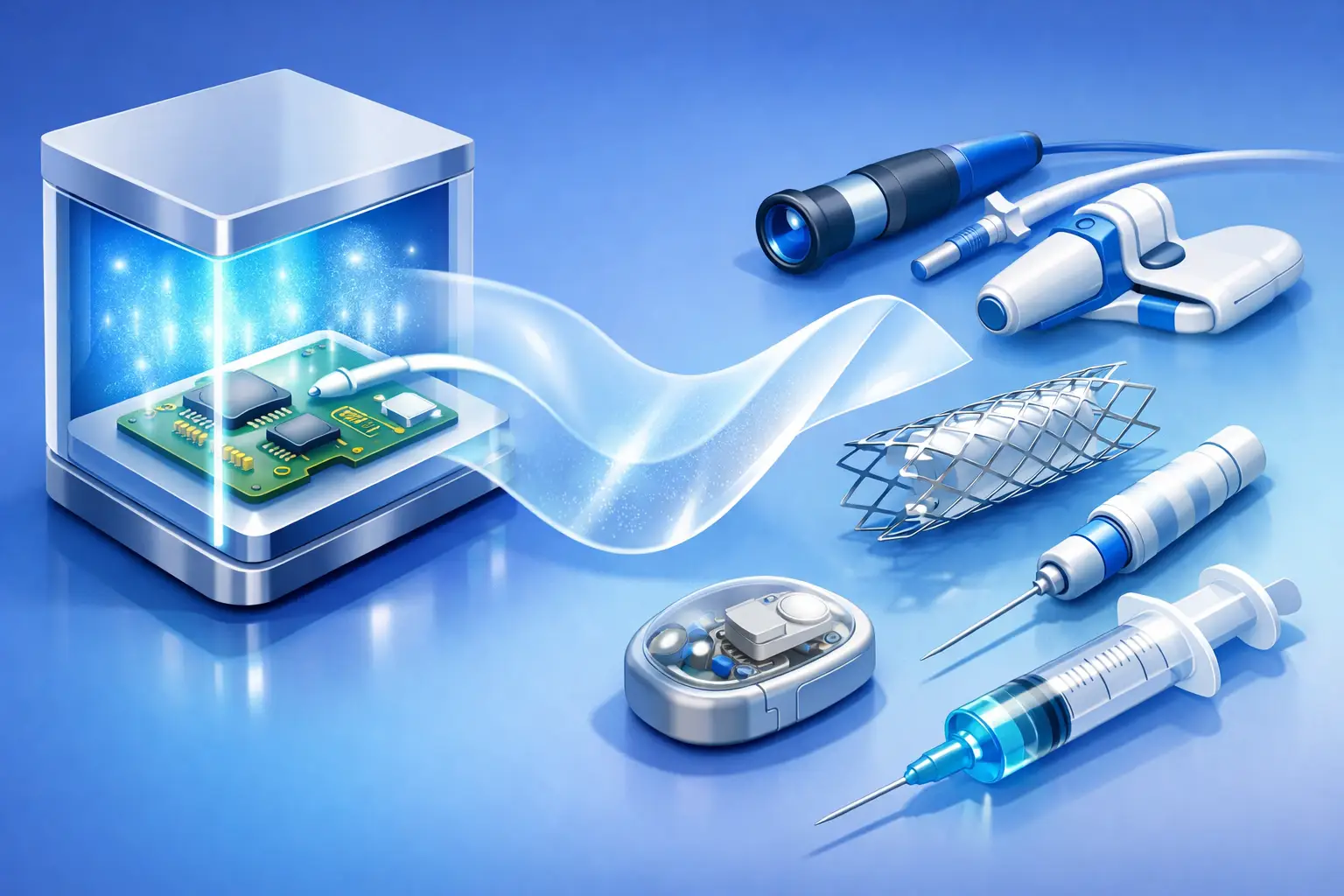
Parylene coating for medical devices is particularly relevant where miniaturisation, electrical function and difficult geometries meet. Typical examples include implantable electronics, electrodes, sensors, catheter components, stents, surgical tools, diagnostic assemblies and parts within drug delivery systems.
For implantable or patient-near electronics, parylene often serves as a protective dielectric barrier around conductors, solder joints and microsystems. Its conformal deposition helps coat intricate assemblies without the pooling and edge-thickening seen in some liquid coatings. That can be decisive when electrical reliability must be maintained in humid, saline or cyclic thermal environments.
Catheter-based systems and minimally invasive instruments present a different challenge. Here, flexibility, low added mass and geometrical precision matter as much as protection. A coating must not significantly alter the handling characteristics of the device. Parylene can support these requirements because it forms a uniform film at low thickness, although the exact tribological benefit depends on the selected parylene type and any additional surface modification.
Reusable instruments and diagnostic components can also benefit, especially where repeated sterilisation, cleaning chemistry and dimensional precision place competing demands on the material system. Yet this is precisely where a realistic qualification strategy is essential. Sterilisation resistance is not a box to tick once. It must be verified against the actual method, cycle count and substrate combination.
Process quality decides the result
The technical promise of parylene is only as good as the process control behind it. In regulated sectors such as medical technology, reproducibility matters more than nominal coating thickness alone. Surface preparation, masking, fixture design, chamber loading, deposition parameters and post-process inspection all influence the final functional outcome.
Adhesion is one of the most underestimated topics. Parylene bonds well to many substrates when the pre-treatment is right, but adhesion is not automatic. Metals, polymers, ceramics and mixed-material assemblies each behave differently. If the substrate has release agents, oxides, machining residues or unstable surface energy, the coating may perform well in initial tests and still fail later under sterilisation, bending or environmental ageing.
This is why development work should not stop at a laboratory coupon. Functional samples, realistic geometries and application-specific test methods are needed early. That includes electrical testing under humidity, corrosion exposure, friction assessment, sterilisation validation and, where relevant, accelerated ageing. For high-value programmes, process capability is not a side topic. It is part of the product design.
A technically strong coating partner brings value here by linking material science, process engineering and industrial implementation. That is where companies such as NTTF Coatings typically differentiate - not through standard catalogue coating, but through application-specific process development and scalable system design.
Common trade-offs engineers should address early
Parylene is often chosen because it solves several problems at once, but trade-offs remain. Thickness is a good example. A thicker layer may improve barrier performance and dielectric strength, yet it can also influence flexibility, mating tolerances or edge definition. The right target is therefore application-specific, not generic.
The same applies to masking. Medical devices frequently contain contact points, bonding zones, optical areas or moving interfaces that must remain uncoated. Precise masking is possible, but it adds complexity and must be designed into the manufacturing route. If this is treated as an afterthought, throughput, yield and inspection effort can suffer.
Material compatibility can also shape the project. Some polymers, elastomers or adhesive systems react differently under vacuum, plasma pre-treatment or sterilisation after coating. A device may pass coating deposition but later show changes in bonding strength, flexibility or outgassing behaviour. These are not reasons to avoid parylene. They are reasons to evaluate the full system rather than the coating in isolation.
Cost should be viewed in the same engineering context. Parylene is rarely the cheapest surface treatment per part if compared only on direct process price. It often becomes economical when it reduces failures, enables miniaturisation, replaces bulkier encapsulation approaches or improves device longevity. For technical decision-makers, the meaningful calculation is total product performance and manufacturing risk, not coating price alone.
Selecting the right route from prototype to series production
The transition from feasibility sample to serial manufacturing is where many coating projects become difficult. A device that performs well in pilot quantities may still face challenges in fixture design, masking repeatability, chamber utilisation or traceability when volumes rise. Medical products add another layer of complexity because process windows, inspection plans and documentation must support qualification and sustained compliance.
That makes early industrial thinking worthwhile. If a coating process is expected to become part of an in-house production environment, equipment architecture, automation level and validation strategy should be considered from the beginning. If the process remains outsourced, the supplier still needs to demonstrate stable transfer from development to routine production.
For manufacturers, the strongest position is to treat parylene not as a late-stage add-on, but as part of the design-for-manufacture discussion. When coating requirements, masking strategy, substrate preparation and verification methods are aligned early, the probability of a stable, certifiable process rises sharply.
The real value of parylene coating for medical devices lies in that combination of precision on atomar-level surfaces and practical reliability in production. When the coating is matched to the component, the application and the qualification pathway, it becomes more than a protective film. It becomes an engineering lever for safer performance, longer service life and more dependable product behaviour where failure is not an option.
