
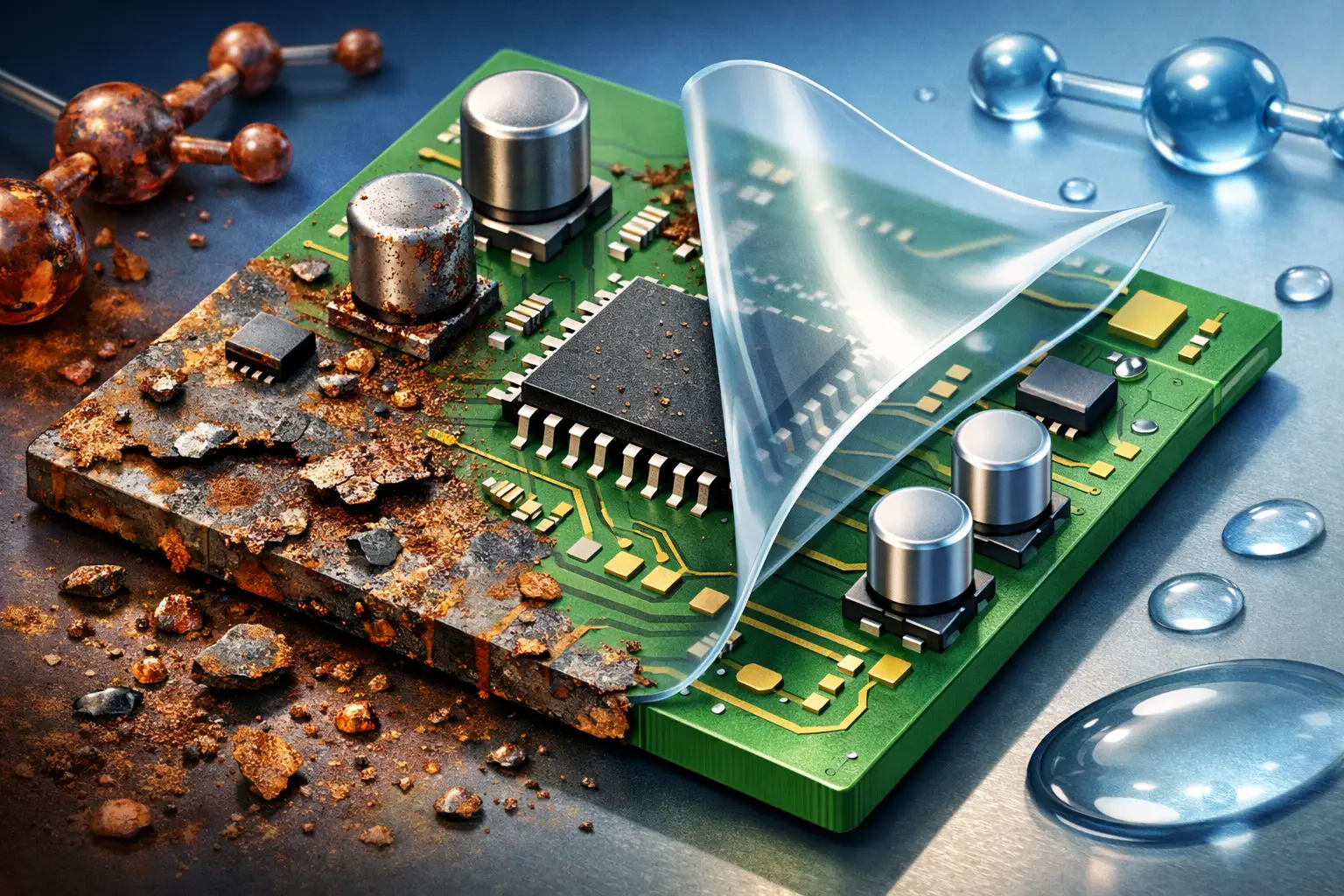
Coating corrosion protection
A component rarely fails because corrosion looked dramatic from the outset. More often, the problem starts invisibly – a little moisture ingress, ionic contamination, a weak point at an edge, a coating that is too thick in one area and too thin in another. For technical decision-makers, parylene coating corrosion protection matters precisely because these failure mechanisms begin where conventional surface systems often struggle: in fine geometries, cavities, sharp edges and electrically sensitive assemblies.
Parylene is not just another protective lacquer. It is a polymer coating applied by chemical vapour deposition under vacuum. That process difference is decisive. Instead of flowing onto a surface and then curing, parylene forms as a highly uniform, pinhole-minimised film directly on the component. For corrosion-critical applications in electronics, medical technology, automotive systems and precision mechanics, that opens up a level of coverage that many wet-chemical or spray-based coatings cannot reliably achieve.
Why parylene coating corrosion protection works differently
The corrosion protection effect of parylene starts with barrier performance. The coating creates a continuous, conformal layer that follows the substrate topography very closely, even on complex three-dimensional parts. This reduces local weak spots where water, salts, process media or aggressive atmospheres can attack the underlying material.
In practice, this is especially relevant for miniaturised assemblies. A conventional coating may bridge over fine structures, pull back from edges or leave shadowed zones insufficiently covered. Parylene deposition is fundamentally different because the gaseous precursor reaches exposed surfaces throughout the chamber and polymerises there as a thin film. The result is highly even thickness distribution across intricate geometries.
That does not mean parylene is automatically the right answer for every corrosion problem. The actual protection level depends on the parylene type, the substrate, the pre-treatment, the required layer thickness and the media involved. Corrosion caused by humidity and ionic residues calls for a different design approach from corrosion driven by fuels, solvents or repeated sterilisation cycles.
Where parylene has clear strengths
Parylene shows its value where a coating must protect without significantly changing component dimensions or function. This matters in connectors, sensor systems, electronic assemblies, implantable or patient-near devices, micro-mechanical components and precision parts with tight tolerances.
Because the coating can be applied in very low thicknesses while still forming a coherent barrier layer, it is particularly suitable when conventional corrosion protection systems would be too bulky. A metal housing may tolerate a thicker coating system. A fine-pitch PCB, MEMS component or moving micro-part often will not.
A further advantage is electrical behaviour. In many applications, corrosion protection cannot be separated from insulation requirements. Moisture ingress does not only attack metals. It also changes leakage currents, dielectric properties and long-term reliability. Parylene can therefore serve both as a corrosion barrier and as a functional dielectric layer, which is highly relevant in electronics and medical technology.
Parylene coating corrosion protection in real industrial environments
The performance of parylene under corrosive conditions is best understood in relation to actual operating scenarios. In electronics, the challenge is often a combination of humidity, condensation, salt exposure and bias voltage. Here, parylene helps by reducing penetration paths for moisture and contaminants while protecting sensitive conductive structures.
In medical technology, the demands can be more complex. Components may require corrosion resistance against bodily fluids, cleaning media or sterilisation-related stress, while at the same time needing biocompatibility and a very precise coating thickness. Parylene is well established in this field because it can protect intricate devices without masking functional detail under a thick layer.
In automotive, aeronautics and defence applications, exposure profiles tend to be harsher and more variable. Temperature cycling, vibration, salt spray, hydraulic media and long service life all influence coating design. Here, selecting parylene purely for its general reputation would be too simplistic. The key is whether the full system – substrate, adhesion promotion, layer design and downstream testing – has been developed for the application in question.
The role of adhesion and pre-treatment
One of the most common misconceptions is that corrosion protection depends mainly on the coating material itself. In reality, adhesion is just as important. Even an excellent barrier coating loses value if local delamination allows media to migrate at the interface.
This is why pre-treatment is not a side issue. Surface cleanliness, activation and substrate-specific adhesion promotion strongly influence long-term performance. Metals, polymers, ceramics and hybrid material systems each behave differently. Residual oils, oxides, release agents or process contamination can compromise coating quality before the deposition process even starts.
For demanding applications, plasma-based pre-treatment is often a critical part of the process chain. It can improve surface activation and support reproducible adhesion on difficult substrates. In industrial terms, that means parylene coating corrosion protection should be viewed as a complete engineered process, not as a stand-alone material layer.
Which parylene type is suitable
Not all parylene grades deliver the same corrosion protection profile. Parylene C is widely used because it combines good barrier properties with chemical resistance and broad industrial applicability. Parylene N offers advantages in some dielectric and penetration-related scenarios. Fluorinated variants such as parylene AF-4 can be relevant where higher thermal stability is required.
The right choice depends on the stress profile. If the key issue is moisture and salt ingress on electronics, one type may be ideal. If the application involves elevated process temperatures or chemically demanding media, another may be better suited. Material selection should therefore follow qualification data and application-specific testing, not generic preference.
Limits, trade-offs and design realities
A technically sound discussion of corrosion protection has to include limits. Parylene is highly effective as a thin, conformal barrier, but it is not a universal substitute for every anti-corrosion system. Where extreme mechanical abrasion dominates, a different coating technology may be required or parylene may need to be combined with another functional layer.
Geometry also matters. Parylene deposits on all exposed surfaces, which is a strength, but selective coating requirements must be solved through precise masking and process planning. In addition, the desired protection lifetime influences the economically sensible layer thickness. More thickness is not always better. It can affect flexibility, process time and cost without proportionally improving performance.
This is especially important for series production. A laboratory-proof concept is not enough if the process window is too narrow for repeatable industrial implementation. For manufacturers in regulated or high-reliability sectors, reproducibility is often just as critical as headline material performance.
Qualification matters more than marketing claims
For B2B buyers, the relevant question is not whether parylene can protect against corrosion in principle. It is whether the coating system has been validated against the actual load profile of the component. That means looking at test methods, acceptance criteria and process capability.
Depending on the sector, qualification may include salt spray testing, climate storage, electrochemical evaluation, insulation measurements, adhesion testing, thermal cycling or media resistance trials. The useful output is not a generic pass or fail statement, but a clear understanding of how the coated part behaves over time under defined stress.
This is where an engineering-led coating partner creates real value. NTTF Coatings, for example, operates at the point where process development, application-specific coating design and industrial implementation intersect. For customers, that is relevant because corrosion protection is rarely solved by selecting a material alone. It is solved by building a reproducible process around the component, the substrate and the operating environment.
When parylene is the right corrosion protection strategy
Parylene is particularly compelling when components are geometrically complex, dimensionally sensitive, electrically functional or exposed to moisture-driven corrosion mechanisms that conventional coatings do not handle well. It is also strong where a combination of corrosion resistance, dielectric insulation and chemical protection is required in a very thin layer.
It may be less suitable as a stand-alone answer where the dominant challenge is heavy wear, high-impact loading or a purely cost-driven application with generous tolerances and simple geometry. In those cases, another system may be more economical or more technically appropriate.
The real decision criterion is therefore not whether parylene is advanced. It is whether it aligns with the failure mode, the manufacturing concept and the qualification pathway. If it does, parylene coating corrosion protection can extend service life, reduce field failure risk and stabilise product performance with a precision that thicker conventional systems often cannot match.
For engineers and buyers working on sensitive assemblies, that precision is usually the point. The best corrosion protection is not the one with the biggest claim, but the one that stays reliable where the component is smallest, most complex and least tolerant of error.
