
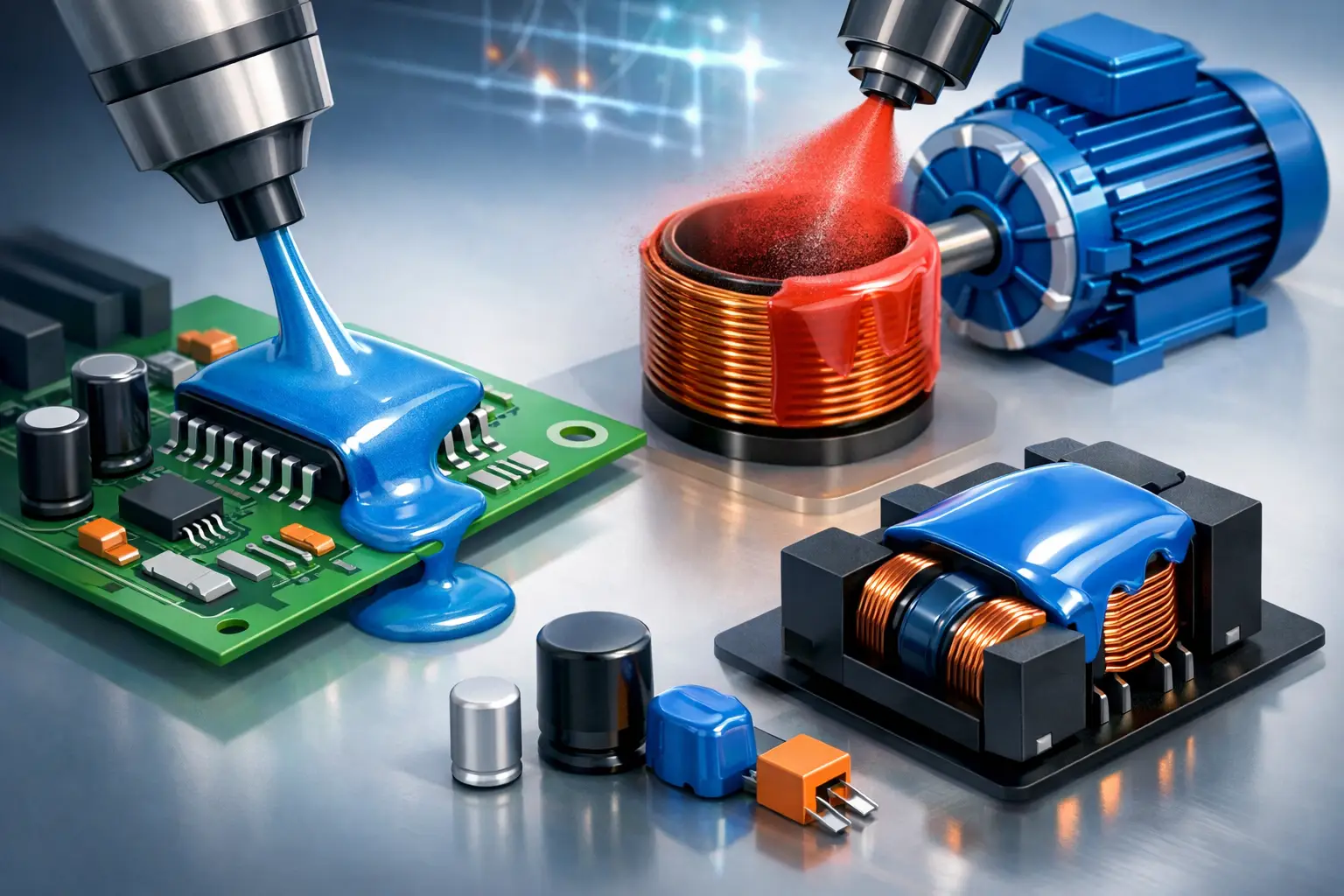
A failed insulation layer rarely announces itself early. In practice, it appears as leakage current, drift, partial discharge, corrosion under bias, or an unexpected field return from an assembly that passed initial test without issue. That is why electrical insulation coating for components is not a finishing detail. It is a functional design decision that directly affects reliability, safety, miniaturisation and process capability.
For technical decision-makers, the central question is usually not whether insulation is needed, but which coating technology can deliver it under real operating conditions. Electrical performance alone is not enough. The coating must also match component geometry, substrate chemistry, thermal load, media exposure, regulatory constraints and the economics of series production. In high-value sectors such as medical technology, electronics, automotive systems, aeronautics and defence applications, these factors cannot be separated.
What electrical insulation coating for components must achieve
At a basic level, an insulating coating creates a dielectric barrier between conductive structures and their environment. In demanding applications, however, that barrier has to do far more. It must remain stable across temperature changes, adhere reliably to metals, ceramics or polymers, resist moisture ingress, and cover edges, cavities and complex three-dimensional features without weak points.
This is where many conventional coating approaches reach their limits. A nominally insulating lacquer may perform adequately on open, simple surfaces, yet fail around sharp edges, under thermal cycling or in narrow gaps. Film thickness variation becomes critical when assemblies continue to shrink while voltage requirements remain unchanged. If the process also introduces particles, pinholes or stress into the layer, the dielectric result may look acceptable in the laboratory and still become unreliable in production.
The right solution therefore depends on the full requirement profile. For some components, high dielectric strength at moderate thickness is the priority. For others, the key criterion is conformality on intricate geometries. In regulated environments, reproducibility, traceability and validated process windows may be just as important as the coating material itself.
Why process selection matters more than material data sheets
Material data sheets provide useful baseline values, but they rarely describe the true behaviour of an insulating layer on a finished component. Surface preparation, deposition method, curing profile, film stress and substrate interaction all shape the final performance. Two coatings with similar dielectric figures on paper can behave very differently on an assembled part.
This is especially relevant when working with fine structures, mixed materials or sensitive electronics. Spray and dip processes can be economical, but coating distribution may vary on recessed areas or densely packed assemblies. Powder systems can deliver durable layers, yet they are not suitable for every geometry or temperature-sensitive substrate. Thin-film approaches such as Parylene, by contrast, offer highly uniform and conformal deposition, which is a major advantage when insulation is required deep inside complex component topographies.
The engineering task is therefore to align the coating process with the functional target. A thicker layer is not automatically better. Excess thickness can change tolerances, impair heat dissipation, or complicate downstream assembly. Equally, an ultra-thin film is only useful if it provides sufficient dielectric integrity and remains defect-free across the relevant service life.
Key technologies for insulating coated components
In industrial practice, several coating classes are used for electrically insulating coated components, each with clear strengths and limitations.
Liquid-applied polymer coatings are often selected when cost sensitivity is high and geometries are relatively accessible. They can offer useful insulation and environmental protection, but process control becomes more demanding as structures become smaller and more complex. Masking effort, solvent management and edge coverage all need close attention.
Epoxy-based systems provide mechanical stability and good dielectric behaviour in many applications. They are common where thicker protective layers are acceptable. The trade-off is that they may be less suitable for delicate structures, tight dimensional tolerances or applications requiring highly uniform thin films.
Parylene-based coatings occupy a different position. Because deposition takes place from the gas phase, the coating forms exceptionally conformal, pinhole-free films even on intricate geometries, internal surfaces and fine features. This makes the technology particularly relevant where miniaturised components, high aspect ratios or demanding dielectric requirements are involved. Parylene can also combine electrical insulation with chemical resistance, low friction and, depending on grade, favourable biocompatibility. For many advanced components, that multifunctionality is commercially significant.
Plasma-assisted and hybrid thin-film systems can further expand the design space, for example when specific interfacial properties, adhesion promotion or tailored surface functions are required. Here, the coating is no longer a generic protective shell but an engineered functional layer integrated into the product concept.
Design factors that influence coating performance
Electrical insulation cannot be assessed in isolation from geometry. Sharp edges intensify electric fields and can become local failure points. Blind holes, undercuts and capillary structures challenge coating penetration. Closely spaced conductors demand a stable layer without bridges, voids or weak spots.
Substrate condition is equally decisive. Surface energy, contamination, oxide state and roughness have a direct effect on adhesion and dielectric integrity. Even a high-performance coating chemistry cannot compensate for inadequate pre-treatment. In practice, many failures attributed to the coating actually originate at the interface.
Environmental exposure also changes the specification. Moisture, cleaning agents, sterilisation cycles, hydraulic media, vibration and temperature cycling can all degrade insulating performance over time. A coating that works well in dry indoor electronics may not be suitable for under-bonnet automotive assemblies or implant-adjacent medical components. The operating profile has to be translated into a realistic test regime early in development.
From prototype to series production
One of the most common mistakes in coating projects is to validate a technology at prototype level without considering scale-up. A process that performs well on a few manually handled samples may become unstable once batch sizes increase, takt times tighten and tolerance chains become more complex.
For that reason, industrialisation should begin early. Fixturing, masking concept, cleaning sequence, handling sensitivity, inspection method and batch documentation all influence whether a coating can be reproduced economically. This is particularly true for components with mixed-function surfaces where some areas require insulation and others must remain conductive, bondable or dimensionally untouched.
In this phase, partnership matters. A specialist coating provider should not merely process parts to print. The stronger model is collaborative development: defining critical properties, selecting the suitable deposition route, establishing test methods and building a stable process window around the real product. For customers who later want to integrate coating in-house, that expertise extends into customised equipment design and process transfer.
Where electrical insulation coating delivers measurable value
In medical devices, insulating coatings can protect miniaturised electronics, sensors and implant-related components against moisture and aggressive media while supporting dimensional precision and biocompatibility requirements. In automotive and e-mobility systems, they help improve reliability in compact electronics exposed to temperature fluctuation, vibration and chemically challenging environments.
In aeronautics and defence applications, weight, space and long-term reliability are often under simultaneous pressure. Here, a thin but highly effective dielectric layer can be preferable to bulkier insulation concepts. In industrial electronics and machinery, the benefit is often a combination of electrical protection, corrosion resistance and longer maintenance intervals.
The commercial effect is straightforward. Better insulation performance reduces failure risk, stabilises product quality and supports more compact designs. When the coating process is well engineered, it also lowers rework, scrap and qualification effort.
Selecting the right partner for electrical insulation coating for components
For complex projects, supplier selection should go beyond a coating portfolio. What matters is the ability to translate application requirements into a repeatable industrial process. That includes material and process knowledge, analytical capability, application-specific testing and, where needed, custom plant engineering.
A credible partner will discuss trade-offs openly. If a required dielectric value conflicts with thermal management, that needs to be addressed. If a component design creates avoidable field concentration, design feedback should be part of the conversation. If a chosen technology is not the best fit for the geometry or cost target, the recommendation should reflect that.
This engineering-driven approach is particularly valuable when no standard solution exists. Companies such as NTTF Coatings work precisely in this space: combining coating expertise, process development and customised equipment concepts for demanding industrial and regulated applications. For technical buyers and development teams, that reduces the gap between laboratory feasibility and dependable production.
The useful question is therefore not simply which coating insulates. It is which coating system will still insulate predictably after assembly, testing, transport, sterilisation, thermal cycling and years of service. That is where careful process engineering turns a coating from a specification line into a real performance advantage.
