
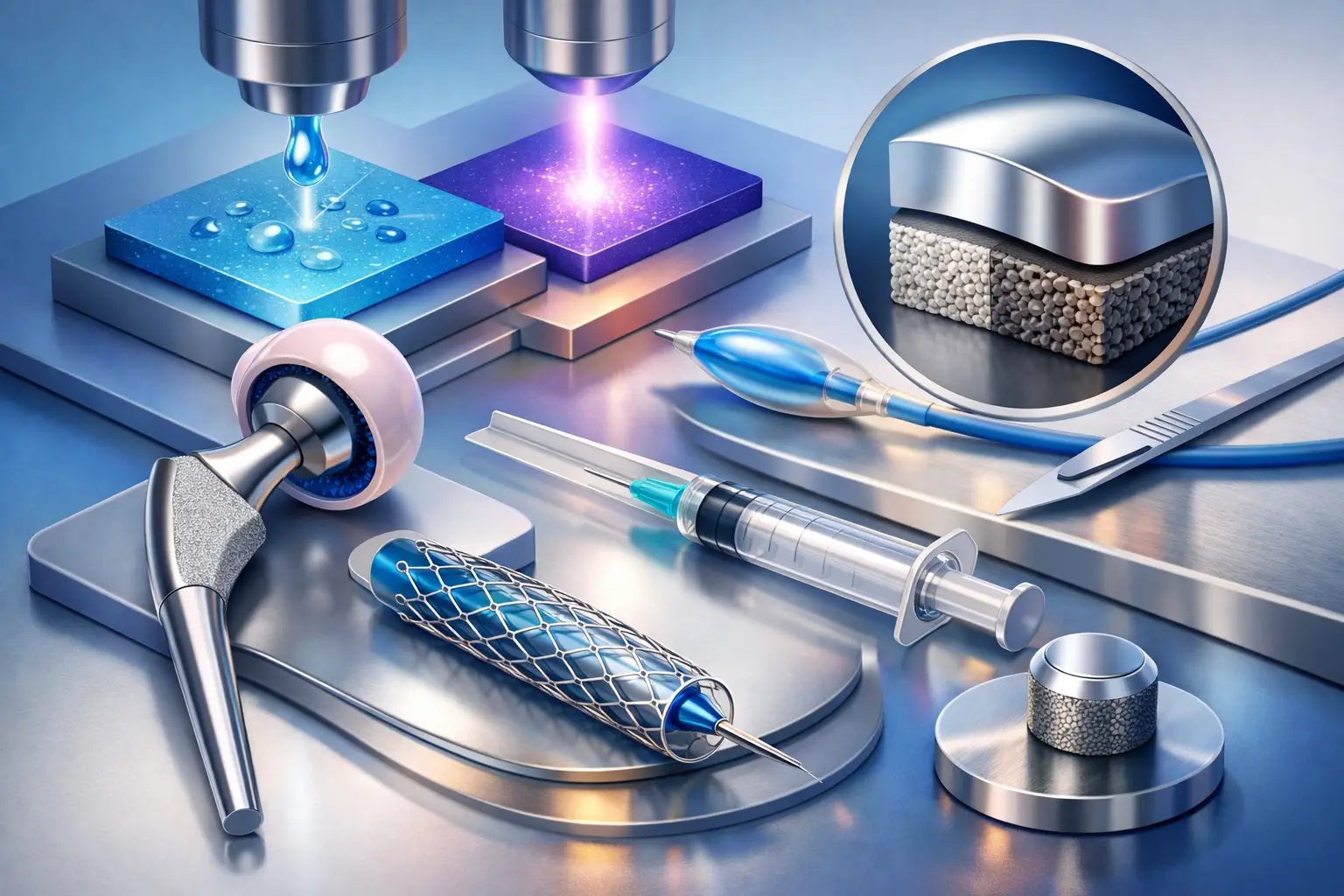
A catheter shaft that slides predictably, an implant that retains its function in physiological fluid, or a diagnostic sensor that remains electrically stable after sterilisation: these outcomes are often determined by only a few micrometres of material. Surface engineering for medical devices turns the component interface into a defined functional layer. It can protect, insulate, reduce friction, control interactions with tissue or fluid, and preserve performance throughout the intended service life.
For medical device manufacturers, the question is therefore not whether a coating can be applied. The relevant question is whether the complete surface system – substrate, pre-treatment, coating chemistry, layer thickness and validation method – can reliably meet functional and regulatory requirements in serial production.
Why surface engineering matters in medical devices
Medical products operate at demanding interfaces. They are exposed to saline solutions, body fluids, cleaning media, sterilisation cycles, mechanical contact and, in many cases, high electrical or dimensional requirements. A material that performs well in a dry laboratory environment may behave very differently once it is assembled, sterilised and used clinically.
The bulk material alone rarely provides every required property. Stainless steel may offer strength but require electrical insulation. Polymers may be lightweight and flexible but need a barrier against moisture or chemical attack. Electronic assemblies may be highly sensitive to ionic contamination, condensation and corrosion. Surface engineering makes it possible to assign the required function precisely where it is needed, without redesigning the entire component.
This is especially relevant where miniaturisation limits material choices. As wall thicknesses fall and geometries become more complex, conventional protective methods can add too much mass, alter tolerances or leave edges insufficiently covered. Conformal thin-film technologies can provide a controlled functional layer while preserving the geometry of the base component.
Functional requirements must drive coating selection
A suitable coating cannot be selected solely by material name or a generic data sheet. Medical devices differ substantially in intended use, contact duration, sterilisation route, substrate composition, assembly sequence and production volume. The engineering task begins with translating these conditions into measurable surface requirements.
Biocompatibility and chemical stability
For components with patient contact, the coating must be assessed in the context of the finished device and its intended contact category. Biocompatibility is not an inherent, universal property of a coating material. It depends on factors including formulation, process residues, layer integrity, extractables, sterilisation and the actual use environment.
The coating must also withstand the relevant media. This can include saline solutions, disinfectants, cleaning agents, lipids or pharmaceuticals. A barrier layer that is chemically stable under one condition may not be the right choice for repeated exposure to another. Application-specific testing is therefore more informative than relying on generic resistance claims.
Electrical insulation and moisture protection
Many medical devices combine electronics with compact, reusable or implantable designs. Here, dielectric strength, insulation resistance and low water vapour transmission can be decisive. High-quality conformal coatings protect conductors, solder joints, sensors and connectors without requiring bulky housings or extensive potting.
Parylene coatings are particularly relevant where uniform coverage over complex three-dimensional geometries is required. Deposited from the vapour phase, they can cover edges, cavities and fine structures with a high degree of conformity. Their performance, however, depends on correct substrate preparation, adhesion promotion, thickness specification and process control. A thin, continuous layer can be highly effective, but only if the full process chain is designed around the component.
Friction, wear and mechanical interaction
Guidewires, surgical instruments, pumps and moving diagnostic assemblies may require controlled friction or improved wear behaviour. The goal is not always the lowest possible coefficient of friction. In some applications, predictable movement, defined haptic feedback or resistance to particle generation matters more.
Plasma treatments, PVD coatings and hybrid thin-film systems can modify surface energy, hardness, adhesion or tribological behaviour. Their suitability depends strongly on geometry and loading. A hard layer may improve wear resistance on a metal component, yet be unsuitable for a flexible polymer part that undergoes repeated bending. Matching coating mechanics to substrate mechanics is essential.
Surface engineering for medical devices begins before deposition
The deposition technology receives much attention, but pre-treatment often determines whether the final system performs consistently. Oils, fingerprints, mould-release agents, oxide layers and particulates can impair adhesion or create local defects. For sensitive products, cleaning is not a peripheral production step. It is a controlled part of the coating process.
Plasma processes are valuable because they can clean, activate or selectively modify surfaces without wet-chemical residues. Depending on gas chemistry and process parameters, plasma treatment can increase surface energy, support adhesion or prepare challenging substrates for subsequent layers. It is particularly useful where component geometries are delicate, internal surfaces must be reached, or tight cleanliness requirements apply.
Material combinations require careful consideration. Medical assemblies increasingly combine metals, elastomers, technical plastics, adhesives, ceramics and electronic components. These materials react differently to temperature, vacuum, plasma exposure and coating stress. A process that is appropriate for a machined metal part may damage an adhesive bond or alter an optical polymer. Feasibility work should therefore use representative assemblies wherever possible, rather than idealised material coupons alone.
Comparing relevant coating technologies
No single process is universally superior. The appropriate technology follows the functional target, component design and scale of production.
Parylene is often selected for highly conformal barrier and dielectric layers. It is well suited to fine geometries, electronic assemblies and components that need thin, pinhole-minimised protection. Its deposition process supports uniform coating on complex shapes, but masking concepts, adhesion and deposition batch design require early engineering attention.
Plasma technology is commonly used for cleaning, activation and targeted surface functionalisation. It can form a highly effective bridge between substrate and coating, or serve as the functional treatment itself. Its advantage lies in precise process adjustment, though the treatment effect may depend on storage time and downstream handling.
PVD and CVD processes offer access to hard, wear-resistant and chemically stable thin films. They can be appropriate for instruments, mechanically loaded parts and specialised functional surfaces. The trade-off is that process temperature, line-of-sight effects, fixture design and substrate compatibility may place tighter limits on component selection than vapour-phase polymer coatings.
Hybrid approaches combine several mechanisms. A plasma pre-treatment followed by a conformal polymer layer, for example, may provide stronger adhesion and improved environmental protection. In demanding projects, this system-level approach is often more effective than attempting to solve every requirement with one coating material.
From laboratory result to qualified production process
A successful test coating is not yet a production solution. Medical device production requires reproducibility across batches, defined handling, traceable parameters and inspection methods that detect relevant variation. The coating process must fit the wider manufacturing route, including incoming-part cleanliness, masking, fixturing, curing or deposition, demasking, final assembly, packaging and sterilisation.
Layer thickness is a central example. More thickness does not automatically provide more protection. Excessive thickness can affect flexibility, dimensions, heat transfer or assembly fit. Insufficient thickness can compromise barrier performance or electrical insulation. The target range should be derived from functional testing and then maintained through validated process windows.
Fixture and masking design deserve the same engineering discipline. Devices may require coating-free electrical contact areas, bonding surfaces, optical windows or mechanically critical interfaces. Reusable masking can improve economy at volume, but it must not introduce particles, positional variation or handling damage. Automated or semi-automated concepts may be justified where repeatability and throughput are critical.
Qualification should reflect the actual risk profile of the product. Depending on application, relevant evaluations can include adhesion testing, thickness measurement, dielectric testing, corrosion exposure, chemical resistance, particulate assessment, thermal cycling and post-sterilisation inspection. The strongest evidence comes from tests that reproduce realistic use conditions and credible failure mechanisms.
When a custom coating system is the better decision
For early-stage or variable-volume programmes, external coating services can provide access to specialised technology without immediate capital investment. This is useful for feasibility studies, prototyping, validation batches and products with limited annual demand. It also gives development teams the opportunity to refine material, masking and process parameters before committing to a fixed production architecture.
For established products or high-volume programmes, an in-house coating system may offer advantages in lead time, process integration and capacity control. However, the machine should not be treated as a standalone purchase. It must be designed around the specific components, batch geometry, process gases, cleanliness concept, operator workflow and quality documentation required by the product.
NTTF Coatings develops both application-specific coating processes and customised plant systems for this reason. The objective is not simply to deposit a layer, but to create a reproducible manufacturing capability that supports the device throughout its lifecycle.
The most effective projects start with a precise description of the failure to be prevented or the function to be achieved. From there, surface engineering becomes a disciplined design decision: test representative parts early, define acceptance criteria before scale-up, and build the coating process around the realities of clinical use and production.
