
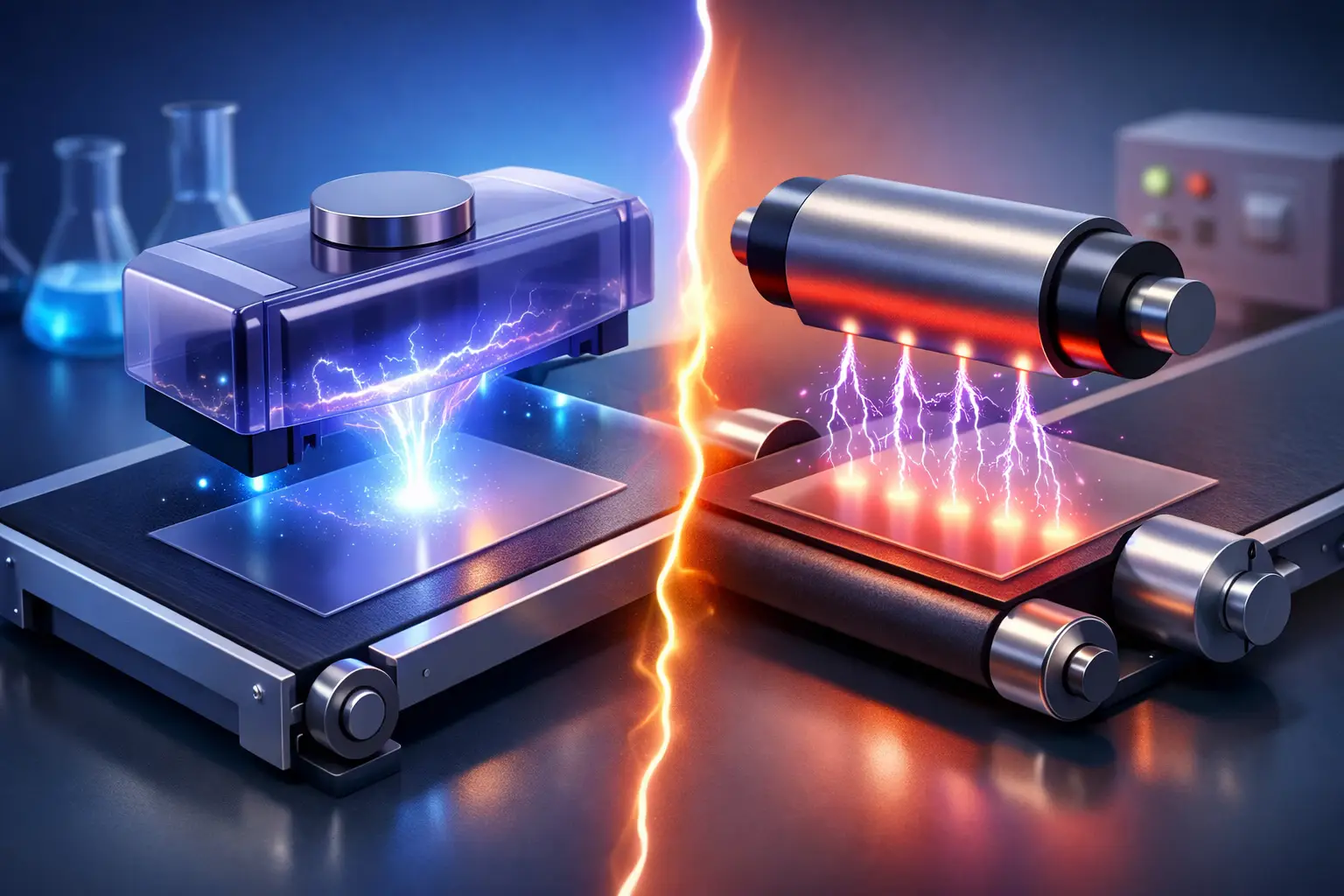
A bond failure at a coating interface rarely begins with the adhesive or coating itself. More often, it starts with a surface that appears clean but carries low surface energy, organic residues or a chemically inactive boundary layer. In the choice between plasma treatment vs corona treatment, the decisive question is not which technology is generally superior. It is which process creates a stable, reproducible surface condition for the component, material and production environment in question.
Both methods are established forms of surface activation. They improve wettability and adhesion without significantly changing the bulk properties of the substrate. Their practical capability, however, differs considerably when geometry, material sensitivity, cleanliness requirements and process validation become demanding.
What both processes achieve
Plastics, elastomers, metals and composite materials frequently have surfaces that resist bonding. Polyolefins such as polypropylene and polyethylene are typical examples, but the issue also arises with fluoropolymers, engineering plastics, coated metals and contaminated components. Liquids bead up, adhesives spread unevenly and coatings may detach under thermal, chemical or mechanical load.
Plasma and corona treatment address this by supplying energy to the outermost molecular layers. The treatment can remove weak boundary layers, break chemical bonds and introduce polar functional groups. As a result, surface energy rises and the substrate becomes more readily wettable by inks, adhesives, lacquers, potting compounds or functional coatings.
The effect is measured through methods such as contact-angle measurement, test inks, peel testing and application-specific adhesion tests. For industrial use, the relevant result is not simply a high initial surface energy. It is a surface state that remains suitable until the next production step and delivers reliable bond strength in service.
Corona treatment: efficient activation for continuous materials
Corona treatment is an atmospheric-pressure electrical discharge generated between an electrode and a counter-electrode. It is widely used on films, sheets, webs and other predominantly flat substrates. In roll-to-roll production, the process can be integrated directly before printing, laminating or coating.
Its principal advantage is productivity. Corona systems can operate at high web speeds, occupy relatively little space and are well suited to continuous manufacturing. For packaging films, labels, tapes and many converting applications, corona treatment is often an economical way to achieve the surface energy needed for downstream processing.
The discharge is concentrated near the treatment gap. This is effective where the material passes through the process with a consistent distance from the electrode. It becomes less predictable on strongly three-dimensional parts, deep recesses, sharp edges or complex internal features. In those cases, local under-treatment is a real risk.
Corona is also more exposed to the surrounding production environment. Airborne contaminants, changing humidity, surface migration of additives and variation in substrate composition can affect the result. These factors do not make corona unsuitable, but they require appropriate process monitoring when adhesion is safety-critical or subject to formal validation.
Plasma treatment: controlled activation for complex components
Plasma is an ionised gas containing energetic electrons, ions, radicals and excited species. Depending on the system design, plasma treatment can operate at atmospheric pressure or under vacuum. The gas composition, power, pressure, exposure time and component handling can be adapted to the material and required surface chemistry.
This flexibility is the central distinction in the comparison of plasma treatment vs corona treatment. Plasma processes can be configured for cleaning, activation, micro-etching or the deposition of extremely thin functional layers. They can treat intricate geometries more uniformly than a conventional corona gap, particularly where components must be rotated, moved or exposed within a controlled chamber.
Vacuum plasma is especially relevant for technically demanding components. The reduced-pressure environment supports controlled removal of organic contamination and can provide highly repeatable treatment conditions. It is well suited to medical technology, electronics, sensors, precision mechanics and aerospace components, where undefined residues or variable adhesion cannot be accepted.
Atmospheric plasma provides a different balance. It can be integrated into automated production cells without a vacuum chamber and can selectively treat local zones on moulded parts, profiles or assemblies. This can reduce cycle time and avoid treating surfaces that do not require modification. The achievable result depends on nozzle design, stand-off distance, gas selection, line speed and the stability of part positioning.
The technical differences that influence process selection
The most visible difference is geometry. Corona treatment is strongest on broad, accessible and largely planar surfaces. Plasma can be designed for parts with contours, cavities and functional areas that are difficult to reach consistently with a fixed electrode arrangement. Complex geometry alone does not automatically demand vacuum plasma, but it should trigger a detailed assessment of treatment coverage.
The second difference is process control. Corona treatment is typically adjusted through power, electrode configuration, web speed and treatment distance. Plasma adds further control parameters, including gas chemistry, chamber pressure, plasma mode and exposure profile. More parameters increase development effort, yet they also enable a process window tailored to a sensitive material or a demanding bonding system.
Cleanliness is equally significant. Corona can activate a surface effectively, but it is not primarily a precision cleaning process. Plasma treatment, particularly under vacuum, can remove traces of oils, release agents and organic residues before activation. Where contamination is a known cause of failure, combining cleaning and activation in one controlled step can materially improve reliability.
Material sensitivity must also be considered. Both technologies introduce energy to the surface. Excessive treatment may damage thin films, alter optical properties, embrittle sensitive polymers or create non-uniform results. The goal is therefore not maximum treatment intensity. It is the minimum controlled exposure that achieves the required functional result without adverse effects.
Surface ageing: the often underestimated constraint
Activation is not always permanent. Many polymers gradually lose part of the treatment effect through hydrophobic recovery, molecular reorientation or migration of low-molecular-weight additives to the surface. Storage conditions, handling and the time between treatment and bonding can therefore be as important as the treatment itself.
For a high-volume film process, corona treatment immediately before printing or laminating may be entirely sufficient. For a medical component that is treated, packaged, transported and bonded later, the treatment concept may require stricter control, defined storage conditions or a different plasma-based surface modification.
A reliable development programme should test not only freshly treated samples. It should include realistic ageing intervals, temperature and humidity exposure, sterilisation where applicable, and the mechanical or chemical loads expected in service. Initial contact-angle values are useful indicators, but they do not replace application-specific durability testing.
Choosing the right process for the application
Corona treatment is usually the pragmatic option when the substrate is a continuous web or a simple flat part, high throughput is the overriding objective and the downstream process follows immediately. It delivers a favourable cost-to-performance ratio in many packaging, printing and laminating applications.
Plasma treatment is generally the stronger candidate when parts are three-dimensional, cleanliness requirements are strict, bonding surfaces are localised or component value justifies a more controlled process. It is also appropriate when the process must be documented and reproduced across batches, production sites or regulated product lifecycles.
The correct decision should not be based on substrate material alone. A polypropylene film and a polypropylene medical housing may share the same polymer family, but their geometry, contamination risk, quality requirements and allowable failure rate are fundamentally different. The treatment method must be selected against the complete process chain: incoming condition, handling, treatment, delay time, bonding or coating, curing and final use.
From laboratory result to stable production process
A successful feasibility test is only the first step. Industrial implementation requires defined component fixtures, controlled treatment distances or chamber loading, parameter monitoring, maintenance concepts and quality criteria that correlate with product performance. For regulated applications, traceability and validated process windows are often integral requirements rather than optional additions.
NTTF Coatings develops surface processes and tailored equipment with this production reality in mind. The aim is not merely to demonstrate improved wettability in a laboratory sample, but to establish precision at the molecular level in a process that can be scaled, monitored and repeated.
The most useful next question is therefore practical: what must the treated surface withstand after it leaves the treatment station? Once that is defined in measurable terms, the choice between corona and plasma becomes an engineering decision rather than a technology preference.
