
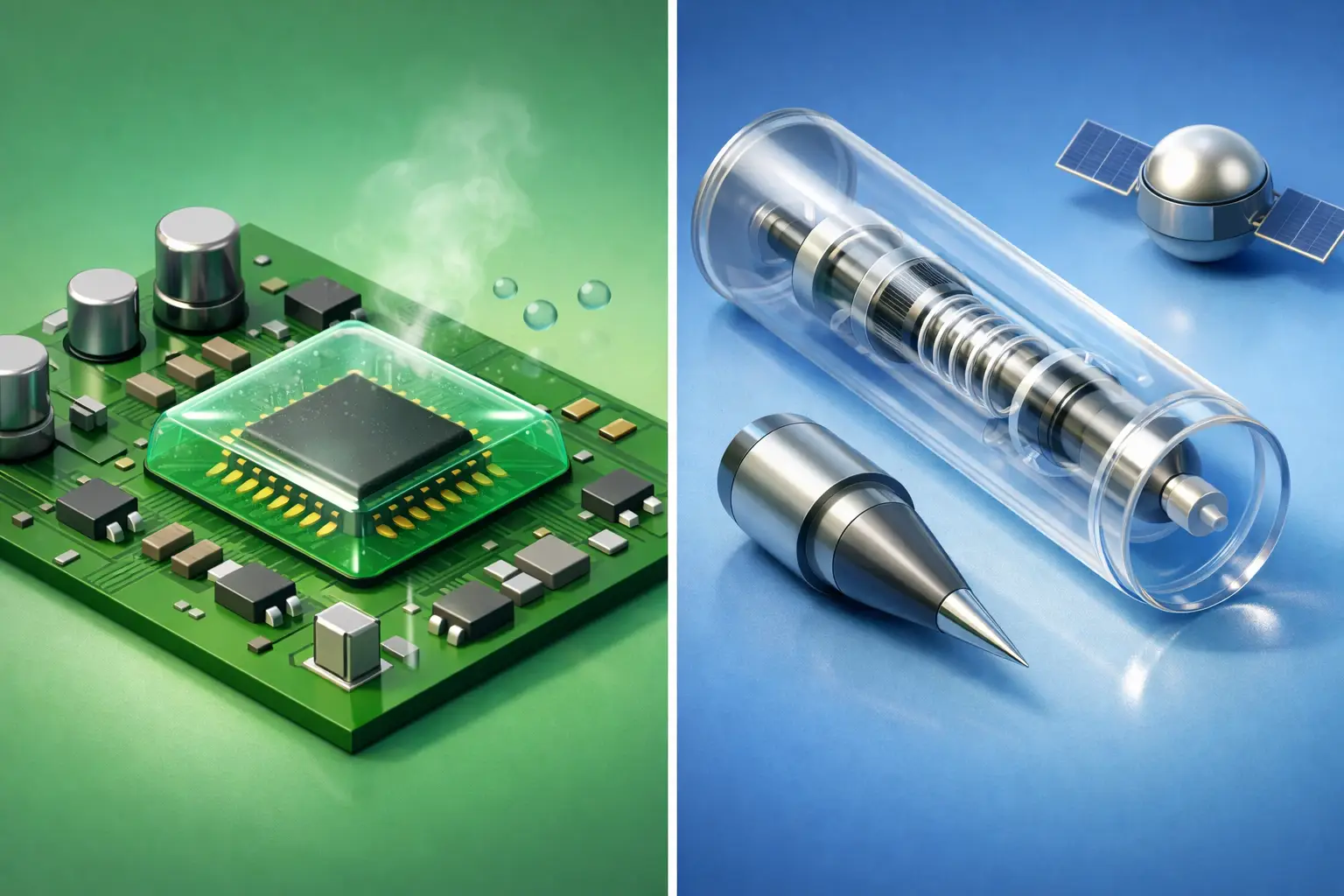
A coating choice can determine whether a miniaturised electronic assembly survives years of humidity exposure or fails at an interface that was never adequately protected. In the comparison of Parylene C vs Parylene N, both materials provide highly conformal, pinhole-free polymer films, yet their molecular structure leads to materially different performance in moisture protection, dielectric behaviour and thermal applications.
Neither variant is universally superior. The correct choice depends on the component geometry, the operating environment, required film thickness, electrical function, validation route and the production process into which coating must be integrated.
Parylene C vs Parylene N: the material difference
Parylene coatings are deposited through a vapour-phase polymerisation process. The precursor is converted into reactive monomer vapour, which enters the deposition chamber and polymerises directly on exposed surfaces. Unlike liquid coatings, Parylene does not rely on gravity, spray access or solvent evaporation. It can therefore cover sharp edges, internal geometries, fine-pitch electronics and complex three-dimensional components with exceptional uniformity.
Parylene N is the parent material, chemically known as poly-para-xylylene. Parylene C is a chlorinated derivative in which one hydrogen atom on the aromatic ring is replaced with chlorine. That apparently small modification changes the material’s polarity, crystallinity and barrier performance.
For many industrial projects, this creates a clear starting point: Parylene C is commonly selected where reliable moisture and chemical protection are decisive. Parylene N is often favoured where low dielectric constant, high dielectric strength and thermal behaviour carry greater weight. However, the final decision should never be made from a datasheet value alone. A film that performs well in a standard permeability test may still be unsuitable if adhesion, masking, curing compatibility or downstream assembly constraints are not resolved.
Where Parylene C has its strongest case
Parylene C is widely regarded as the more versatile protection film for demanding environments. Its chlorinated structure produces a lower permeability to moisture and many corrosive media than Parylene N. For electronics exposed to condensation, salt-containing atmospheres, cleaning agents or long-term storage conditions, this barrier performance can be central to product reliability.
The coating is also valued for its chemical resistance. It can protect sensitive conductors, sensor structures and electronic assemblies from many process fluids and environmental contaminants without adding significant thickness or mass. Typical coating thicknesses are measured in micrometres, making Parylene C particularly relevant where connector clearances, moving mechanisms or dimensional tolerances cannot accommodate conventional encapsulation.
In medical technology, Parylene C is frequently assessed for protective and electrically insulating functions on diagnostic, therapeutic and implantable components. Its established biocompatibility profile makes it relevant for carefully defined applications, although the actual suitability must be verified for the complete device, including substrate, pre-treatment, thickness, sterilisation method and intended duration of contact.
For automotive, aeronautical and defence-related electronics, the principal value is often not a single material property. It is the combination of conformality, low coating mass, insulating performance and resistance against environmental exposure. A properly engineered Parylene C process can protect areas that are difficult or impossible to reach with conventional lacquers.
Limits that must be engineered, not ignored
Parylene C is not an automatic solution for every moisture-sensitive component. Barrier performance depends heavily on film continuity and on the condition of the substrate. Contamination, machining residues, trapped moisture and unsuitable surface energy can undermine adhesion and create pathways for corrosion at interfaces.
Pre-treatment is therefore a functional part of the coating system. Plasma activation, cleaning sequences, adhesion promoters and controlled handling may be required to achieve reproducible results. The coating thickness must also be matched to the requirement. More thickness can improve barrier reserve, but it may affect tolerances, flexible structures, thermal paths or the time required for deposition.
When Parylene N is the better engineering choice
Parylene N has a lower dielectric constant than Parylene C and is often chosen for applications in which electrical insulation must be combined with reduced capacitive influence. This can be relevant for high-frequency electronics, precision sensors, microelectromechanical systems and components with sensitive signal paths.
Its dielectric strength is also highly attractive. In practical terms, Parylene N can provide effective electrical insulation in very thin, conformal layers, preserving compact component design. The absence of chlorine contributes to different electrical and thermal characteristics from those of Parylene C.
Parylene N is also associated with stronger thermal capability than Parylene C in certain operating scenarios. That does not mean it should be selected on a nominal temperature figure alone. Temperature cycling, exposure duration, substrate expansion, mechanical stress and adjacent materials all influence long-term behaviour. For example, a coating that remains chemically stable may still experience interfacial stress if its thermal expansion differs substantially from that of the underlying component.
Where the component operates in a dry or controlled environment and electrical performance takes priority over maximum moisture barrier properties, Parylene N can be the more technically appropriate choice. It is particularly worth considering where every additional dielectric contribution near a signal path must be understood and controlled.
The trade-off in environmental protection
The key compromise is moisture resistance. Parylene N generally does not provide the same water-vapour barrier performance as Parylene C. If a precision electronic device will encounter high humidity, condensation or corrosive atmospheres, the dielectric advantages of Parylene N may be outweighed by the need for a stronger environmental barrier.
This is why material selection should begin with failure mechanisms, not with a preference for a familiar coating grade. If the dominant risk is ionic corrosion, Parylene C is often the more logical candidate. If parasitic capacitance, dielectric loss or temperature-related electrical behaviour defines the risk, Parylene N may warrant detailed evaluation.
Compare the properties in the application context
A direct property comparison is useful, provided it is treated as a guide rather than a final specification. Parylene C normally offers stronger moisture and chemical barrier performance. Parylene N generally offers lower dielectric constant and may be advantageous in electrically sensitive or thermally demanding designs. Both materials can form extremely uniform films through controlled vapour deposition and both can be applied to complex geometries without the edge thinning associated with many liquid processes.
The practical differences become clearer when viewed through component requirements. A printed circuit assembly in an outdoor sensing unit may prioritise moisture protection, ionic contamination resistance and coverage beneath connectors. Parylene C will often be the initial material candidate. A high-frequency sensor element, by contrast, may require a low-k insulating film that has minimal effect on signal behaviour. Here, Parylene N can provide a more suitable starting point.
Medical devices require an additional level of scrutiny. The selected material must fulfil the function of the specific component while remaining compatible with cleaning, sterilisation, packaging and applicable biological evaluation. A coating cannot be considered biocompatible in isolation from the finished device and its intended use.
Process design determines whether the material delivers
The comparison between Parylene C and Parylene N can be misleading if deposition is treated as a simple finishing step. In high-reliability production, the coating process is an engineered system. It includes fixture design, masking strategy, substrate cleaning, pre-treatment, loading density, chamber parameters, thickness monitoring and inspection criteria.
Masking deserves particular attention. Parylene coats every exposed surface, including contact pads, connector interfaces, optical windows and tight mechanical fits. Critical areas must therefore be protected before deposition or opened afterwards using a validated method. On high-value parts, the cost of an unsuitable masking concept can exceed the cost of the coating itself.
Verification should be aligned with the actual failure risk. Depending on the application, this may include thickness measurement, visual inspection, adhesion testing, electrical testing, humidity exposure, thermal cycling, salt mist testing or chemical resistance evaluation. A qualified process defines not merely a target thickness but an evidence-based route to reproducible component performance.
For projects that move from prototypes to serial production, equipment design becomes equally important. Chamber capacity, vapour distribution, loading fixtures, process control and traceability must be configured around the part family and quality requirements. NTTF Coatings develops coating processes and systems with this production integration in mind, rather than treating material selection and industrial implementation as separate questions.
A practical route to the right selection
The most effective selection process starts by defining what the coating must prevent. Corrosion, electrical leakage, moisture ingress, unwanted capacitance, particle release and chemical attack demand different priorities. The next step is to examine the component itself: substrate materials, surface condition, gaps, moving interfaces, masked zones and permitted coating thickness.
Parylene C should usually be evaluated first when environmental protection is the dominant challenge. Parylene N should be brought forward where electrical and thermal requirements are more influential, especially when lower dielectric constant matters. In many cases, sample coating and application-specific testing will resolve uncertainties faster and more reliably than theoretical comparison.
The useful question is not which Parylene grade is better in general. It is which coating system will protect this component, under these loads, with this geometry and with the process control required for its full service life.
