
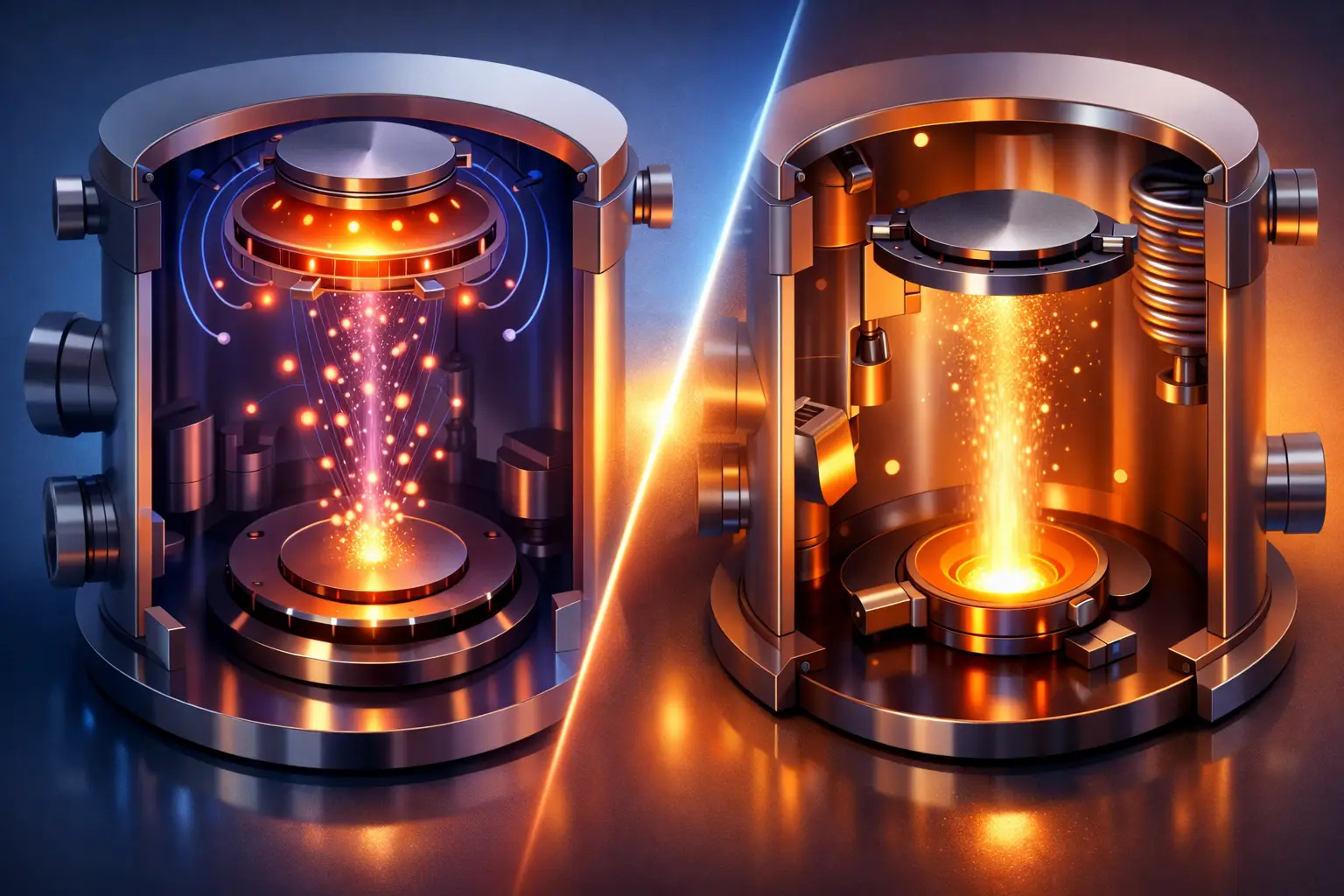
A coating can meet its nominal thickness specification and still fail its function. Pinholes in a barrier layer, insufficient adhesion on stainless steel, excessive stress in a conductive film or poor coverage around a component edge often originate in the deposition method itself. The decision between magnetron sputtering versus evaporation therefore affects far more than equipment selection: it determines coating performance, process capability and the route to reliable series production.
Both methods are established physical vapour deposition (PVD) technologies. Both create thin functional layers under vacuum, from a few nanometres to several micrometres depending on the material system and application. Their mechanisms, however, produce distinctly different film structures and impose different constraints on component geometry, material choice and process control.
Magnetron sputtering versus evaporation: the essential difference
In evaporation, a source material is heated in vacuum until atoms or molecules leave its surface as vapour. Thermal evaporation uses resistively heated boats, crucibles or filaments. Electron-beam evaporation directs a focused electron beam at the source and is particularly suitable for high-melting-point materials. The vapour then travels largely in straight paths to the substrate, where it condenses to form a coating.
Magnetron sputtering works differently. A plasma is generated in an inert process gas, usually argon. Positively charged ions from this plasma strike a solid target, ejecting target atoms into the gas phase. Magnets positioned behind the target confine electrons close to its surface, increasing ionisation efficiency and enabling stable deposition at practical pressures and power levels.
That difference matters because sputtered atoms experience more collisions on their way to the substrate than evaporated atoms in a high-vacuum system. Their energy and angular distribution can be controlled through pressure, power, substrate bias and target configuration. This creates valuable process latitude, but it also makes sputtering systems more complex to engineer and qualify.
Film density, adhesion and microstructure
For demanding functional surfaces, film density is frequently the decisive criterion. Magnetron sputtering generally produces denser layers with better adhesion than conventional evaporation. The arriving species have higher kinetic energy, and the process can be combined with plasma cleaning or ion etching before deposition. Native oxides, organic residues and weak boundary layers can be removed immediately before coating without breaking vacuum.
The result is often a compact microstructure with lower porosity. This is particularly relevant for diffusion barriers, corrosion protection, optical layers, electrically conductive films and wear-related applications. Dense coatings can improve resistance to moisture ingress, chemical attack and mechanical loading, provided the selected material and layer stack are appropriate for the service environment.
Evaporated films can also achieve very good functional properties, especially with disciplined substrate preparation, controlled deposition rates and suitable substrate heating. Electron-beam evaporation is widely used where high purity, high deposition rates or sensitive source materials are important. Yet conventional evaporated coatings tend to be more columnar and porous when deposited at low substrate temperatures. For a barrier coating on a component exposed to humidity or corrosive media, this structural difference may be critical.
Film stress requires equally careful attention. Sputtered coatings can develop significant intrinsic stress, particularly at high power or under energetic ion bombardment. This can lead to cracking, curling of thin substrates or reduced adhesion in multilayer systems. Evaporation may offer lower-stress deposition in some material combinations. The correct choice is therefore not simply the densest available film, but a process window that balances density, stress, adhesion and substrate sensitivity.
Coverage on complex component geometries
Evaporation is fundamentally a line-of-sight process. Surfaces directly facing the source receive the highest flux; recesses, undercuts, deep holes and shadowed features receive less material or none at all. Planetary rotation, fixturing and multiple sources can improve uniformity, but they cannot eliminate the underlying geometric limitation.
Magnetron sputtering also has a directional component, but gas-phase scattering broadens the transport of deposited atoms. At higher working pressures, this can improve coverage on moderately complex shapes. Rotating substrates, cathode positioning and tailored chamber geometry further extend the usable coating envelope.
Neither process should be assumed to provide conformal coverage in deep, high-aspect-ratio structures. If continuous protection inside fine channels, around sharp edges or across highly intricate assemblies is mandatory, the application may require a different technology or a hybrid coating concept. The right assessment begins with the actual component geometry, including areas that are difficult to inspect after coating.
Deposition rate and material efficiency
Evaporation can achieve high deposition rates, especially with electron-beam sources. This is a strong advantage for large-area metallisation, optically functional layers and applications where cycle time is a primary commercial driver. The evaporant source can also be used efficiently when the substrate layout is designed around its vapour distribution.
Sputtering rates depend on target material, power density, cathode design, reactive gas control and required film properties. Some metals deposit efficiently; ceramics and compound materials may require specialised power supplies or reactive sputtering. In reactive processes, such as forming oxides or nitrides from a metallic target, maintaining the correct chemical state of the target is central to stable throughput and repeatable film composition.
Material utilisation must be judged at system level rather than by deposition rate alone. In sputtering, part of the target remains unused because of the erosion profile, although rotating or advanced cathode designs can improve utilisation. In evaporation, material can deposit on chamber shields and fixtures as well as on the product. For high-value materials, tooling geometry, batch loading and reclaim strategy can influence the total cost as much as the source technology.
Process control and reproducibility
Industrial coating programmes are evaluated by their repeatability, not by a single successful sample. Magnetron sputtering offers extensive control over layer composition and properties. Power, pressure, gas flow, bias, substrate temperature and deposition time can be monitored and managed within a validated recipe. Co-sputtering and multilayer sequences also allow alloy formation, graded interfaces and tailored functional stacks.
This degree of control makes sputtering especially attractive where electrical resistivity, optical response, hardness, surface energy or barrier performance must remain within tightly defined limits. It is also well suited to processes requiring reproducible plasma activation and in-situ surface preparation.
Evaporation can be highly repeatable when source condition, vacuum quality, deposition geometry and rate control are properly managed. Quartz crystal monitoring provides valuable real-time feedback, while optical or mass-spectrometric methods may support more sophisticated processes. The challenge is that changes in source shape, charge condition and vapour distribution can affect thickness uniformity from batch to batch. For critical components, these effects must be addressed through equipment design, preventive maintenance and qualification data.
Selecting the process for the application
The appropriate choice follows the functional requirement, not a generic hierarchy between methods. Four questions usually establish the direction of travel:
- Does the layer need maximum density and strong adhesion for corrosion, wear or barrier performance?
- Is the component geometry simple and directly exposed, or does it include recesses, edges and partially shadowed surfaces?
- Are high throughput and low thermal load more important than fine control of film structure?
- Must the process support complex multilayers, reactive compounds or tightly controlled electrical and optical properties?
Magnetron sputtering is often the stronger option for dense metallic, ceramic, nitride and oxide coatings; multilayer architectures; reactive processes; and components where adhesion and reproducibility carry high technical or regulatory weight. It is common in electronics, medical technology, aerospace and precision engineering because it supports precise adjustment of the deposited layer.
Evaporation can be the more economical and technically appropriate option for high-rate metallisation, simple geometries, temperature-sensitive substrates and applications that benefit from very high vacuum and minimal gas-phase interaction. It may also be preferred where the source material is difficult to sputter efficiently or where a particular evaporated microstructure is advantageous.
Equipment design determines the practical result
The method alone does not guarantee coating performance. Cathode arrangement, pumping capacity, chamber materials, substrate handling, plasma cleaning, temperature management, sensor selection and automation architecture all influence the usable process window. A poorly matched sputtering system will not compensate for unsuitable fixture design; equally, an evaporation system with well-engineered source geometry can outperform expectations on the right component family.
For production integration, qualification should include more than thickness mapping. Adhesion testing, surface analysis, corrosion or environmental exposure, electrical measurement and inspection of representative critical features provide a more meaningful basis for release. The same applies when transferring a process from development to series manufacture: loading configuration, maintenance intervals and operator interaction must be designed into the validated process.
NTTF Coatings approaches this decision as an application-engineering task. The relevant starting point is the component’s failure mode and functional target, followed by process development and, where required, a coating system configured for the required material, geometry and quality controls.
The most useful next step is to coat representative parts with defined acceptance criteria rather than compare deposition methods in isolation. That turns magnetron sputtering versus evaporation from an abstract technology choice into evidence for a dependable production decision.
