
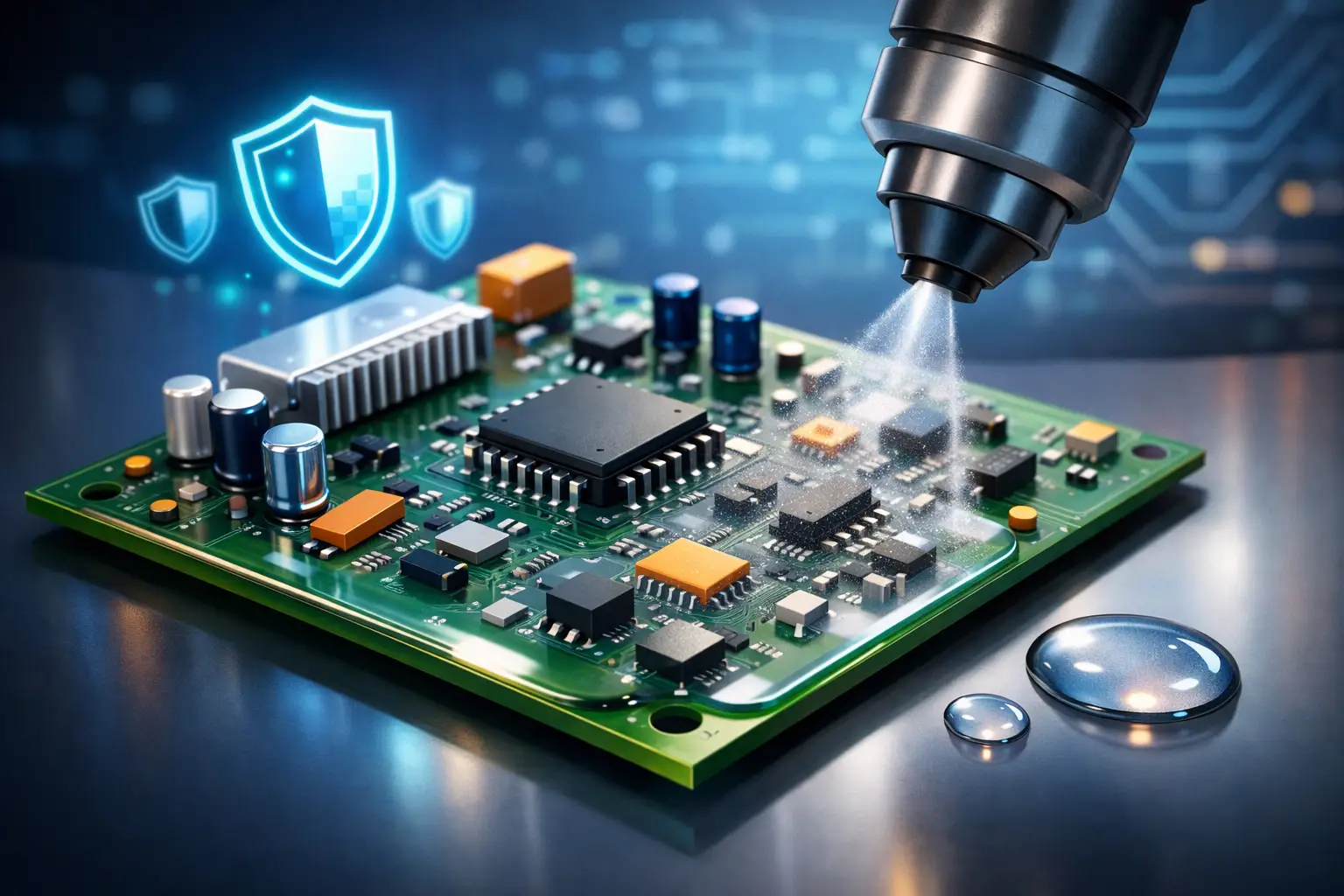
A control board that performs flawlessly in validation can still fail within months once it faces condensation, salt mist, cleaning chemistry or fine particulate contamination. In high-value electronics, the weak point is often not the circuit design itself but the exposed surface of the assembled board. That is where conformal coating for electronics protection becomes a decisive engineering measure rather than a finishing step.
For technical decision-makers, the question is rarely whether added protection is beneficial. The real question is which coating system, process window and inspection concept will protect the assembly without creating new risks in production, rework or long-term field performance. The answer depends on the environment, the geometry, the electrical demands and the level of reproducibility required.
What conformal coating for electronics protection actually does
A conformal coating forms a thin, continuous polymeric barrier over populated electronic assemblies. Its purpose is to shield sensitive surfaces against moisture, ionic contamination, corrosive atmospheres, dust and, in many cases, electrical stress. The coating follows the contours of components, solder joints and conductors, which is why thickness control and coverage consistency matter so much.
In practice, the protective effect is never just one-dimensional. A well-selected coating can reduce corrosion risk, stabilise insulation performance, lower the probability of leakage currents and improve resistance to climatic cycling. In some applications, it also supports mechanical durability by reducing the effect of vibration on delicate soldered structures. However, no coating solves every problem equally well. Material chemistry and deposition method determine where the real strengths lie.
Why standard coating choices often fall short
Many coating projects begin with a familiar assumption: apply acrylic, silicone or urethane by spraying or dipping, then the board is protected. That can be sufficient for moderate environments and cost-sensitive products. Yet assemblies used in medical technology, automotive electronics, aerospace systems or defence equipment usually demand more than basic surface coverage.
The difficulty is that electronic assemblies are rarely simple two-dimensional surfaces. They contain tight gaps under components, sharp edges, mixed material interfaces and zones that must remain free for connectors, test points or thermal contact. Conventional liquid-applied coatings can struggle with shadowed areas, local thickness build-up and edge retreat. If process control is weak, exactly those areas that need protection most may receive the least reliable coverage.
This is why coating selection should be treated as an engineering decision with defined performance criteria, not as a generic consumable purchase. Environmental load cases, cleanliness before coating, cure conditions, masking strategy and inspection capability all influence the final result.
Material systems and where trade-offs matter
Acrylic coatings are widely used because they are economical, relatively easy to process and often straightforward to rework. For many industrial electronics applications, they provide a reasonable balance of moisture protection and manufacturability. Their limitation is that chemical resistance and long-term barrier performance may not be sufficient for more aggressive conditions.
Silicone coatings perform well where assemblies see broad temperature ranges and require flexibility. They can handle thermal cycling better than more rigid systems, which makes them relevant for power electronics and outdoor exposure. The trade-off is that rework, adhesion behaviour and contamination control can become more demanding depending on the formulation.
Urethane systems offer good chemical resistance and solid environmental protection, but they are often less forgiving in processing and repair. Epoxy coatings can provide high hardness and chemical stability, yet their rigidity may be a disadvantage where thermal stress is significant.
Parylene occupies a different category because it is deposited from the vapour phase rather than applied as a liquid. That process characteristic changes what is achievable on complex geometries.
Parylene as a high-performance option
For demanding electronics, Parylene is often selected where pinhole-free, highly uniform and extremely conformal coverage is required. Because the coating is formed in a vacuum deposition process, it can reach intricate geometries, edges and narrow gaps more consistently than many wet-chemical methods. The result is a thin functional layer with very good dielectric properties and strong barrier performance.
This matters especially where miniaturisation, high packing density or sensitive signal integrity leave little tolerance for coating inconsistency. Medical electronics, sensor systems, aerospace assemblies and specialised control electronics are typical examples. The trade-off is that the process infrastructure, masking concept and specification work are more exacting. Parylene is not the lowest-cost route, but it can be the most economical choice when failure costs, compliance requirements and product lifetime are considered properly.
Process selection is as important as material selection
A coating material can only deliver its intended performance if the deposition process is suited to the product. Spraying offers flexibility and can be automated effectively for many board designs, but atomisation, overspray and shadowing need close control. Dipping can be efficient for higher volumes, though it may create issues in trapped volumes and with variable drainage. Selective coating improves precision in defined areas, yet programming and fixture design become critical.
Vapour-deposited systems such as Parylene demand a different process philosophy. Surface preparation, masking fidelity, chamber loading and deposition parameters all affect the outcome. The advantage lies in exceptional uniformity and coverage even on complex topographies. For high-reliability sectors, that reproducibility is often more valuable than simple throughput comparisons.
Design and manufacturing factors that decide success
Failures attributed to the coating itself often originate earlier in the chain. Residual flux, outgassing materials, poor component spacing or unsuitable keep-out design can undermine even a technically strong coating system. For this reason, conformal coating for electronics protection should be considered during design for manufacture, not after the PCB layout is frozen.
Component stand-off heights influence whether the coating reaches under critical areas. Sharp edges can produce locally thinner films. Connectors, switches and grounding points require precise masking. If heat-generating components are present, thermal management must be evaluated carefully because a coating may alter surface heat transfer or constrain subsequent interface materials.
Inspection also needs attention. Visual checks under UV light may be enough for simple assemblies, but highly critical products often require stricter verification of coating presence, thickness and defect profile. In regulated industries, process validation, traceability and repeatability can be just as important as the chemistry itself.
Where conformal coating delivers the highest value
The strongest business case appears where electronics face a combination of environmental stress, high replacement cost and limited tolerance for field failure. In medical technology, reliable insulation and corrosion protection can support device safety and service life. In automotive and aeronautical systems, thermal cycling, humidity and vibration create a demanding mix that exposes weaknesses quickly. In industrial control electronics, fine dust, aggressive atmospheres and intermittent condensation remain common causes of premature degradation.
There is also a growing case in sensor technology and miniaturised assemblies. As geometries become smaller, conductor spacing tighter and packaging more complex, uncontrolled moisture paths and contamination effects become more serious. Thin, highly conformal coatings are increasingly a functional requirement rather than an optional safeguard.
How to specify the right solution
A useful specification starts with the real operating environment, not with a preferred coating family. Temperature range, humidity profile, chemical exposure, electrical stress, mechanical load and expected service life should be defined first. From there, the coating chemistry, target thickness, masking zones, adhesion requirements and inspection method can be derived.
For many organisations, the most effective route is collaborative process development with a specialist partner that can assess both coating performance and industrial implementation. That becomes especially relevant when the project may later move from contract coating into an in-house production concept with custom equipment and validated process control. Companies such as NTTF Coatings work in exactly this intersection of material science, application engineering and scalable coating system design.
The key is to treat coating not as an isolated layer, but as part of the product architecture and production strategy. That mindset reduces qualification loops, avoids costly redesigns and improves the probability that the protection concept will still be fit for purpose years into the product lifecycle.
A well-engineered coating system does not draw attention to itself. It simply keeps sensitive electronics stable, insulated and field-ready under conditions that would otherwise expose every weak interface on the assembly.
