
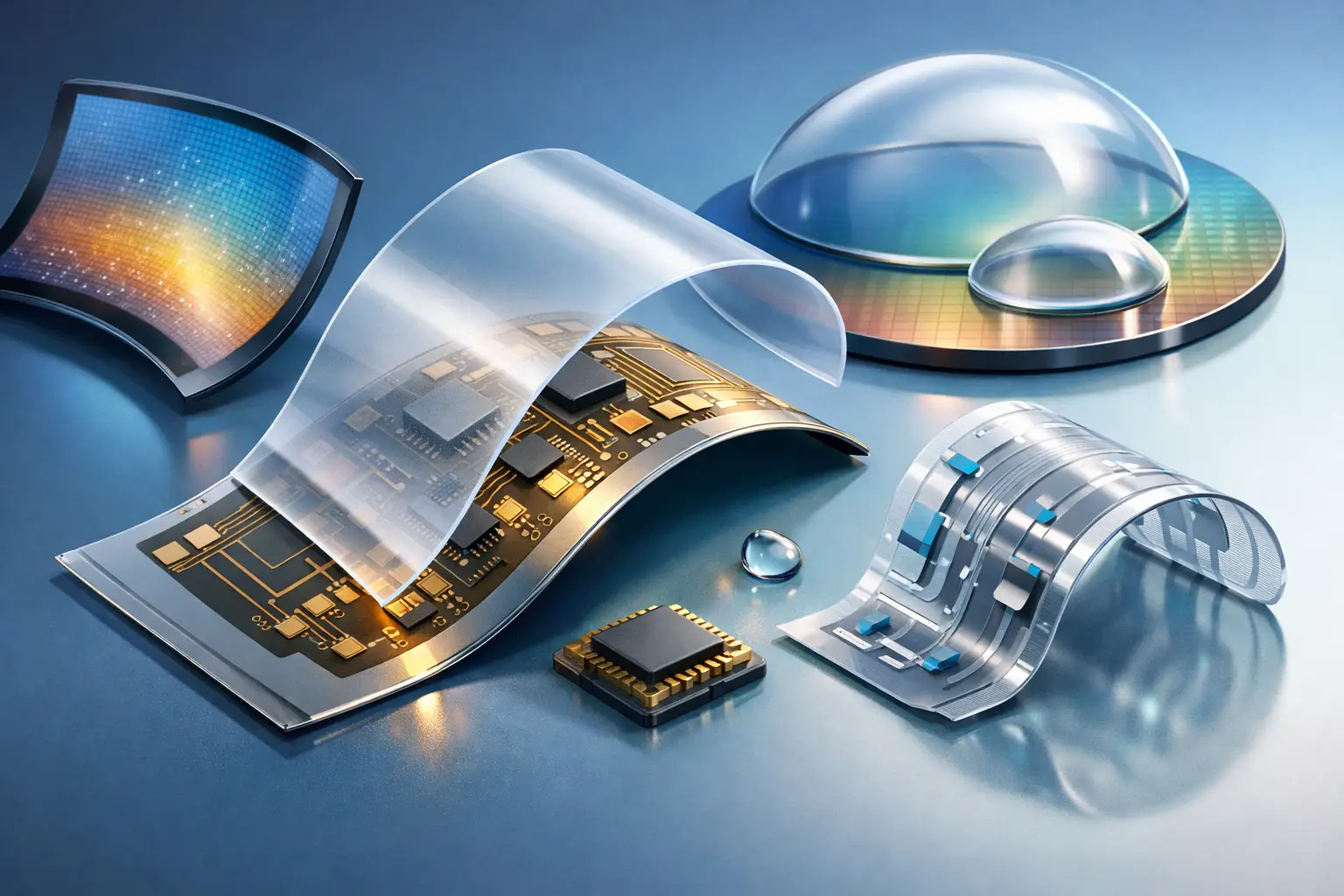
When a flexible circuit fails, the root cause is rarely dramatic. More often, it is slow moisture ingress, a pinhole at an edge, micro-cracking under repeated bending or a coating that looked acceptable in the lab but could not tolerate production reality. That is where parylene for flexible electronics becomes technically interesting – not as a generic protective layer, but as a process-defined functional coating that has to preserve electrical performance while following the mechanics of the substrate.
For development teams working with wearable sensors, flexible printed circuits, thin-film electrodes or miniaturised assemblies, the question is not simply whether parylene can be applied. The relevant question is whether the coating system, deposition parameters and part design together produce a stable result over the intended service life. In flexible electronics, that distinction matters.
Why parylene for flexible electronics is different
Parylene is well established as a thin, pinhole-minimised, conformal coating deposited from the gas phase. For flexible electronics, those properties are valuable because conventional liquid coatings often struggle with fine structures, sharp topographies and sensitive components. A vapour-deposited polymer layer can cover traces, solder joints, vias and component edges with far greater uniformity, even on geometries that are difficult to wet consistently.
But flexibility changes the boundary conditions. A coating that performs well on a rigid PCB is not automatically suitable for a stretchable sensor patch or a repeatedly flexed interconnect. The coating has to remain adherent under dynamic strain, avoid embrittling the substrate and preserve the function of contact areas, sensing zones or bonding interfaces. In other words, parylene for flexible electronics is not a single material decision. It is a system decision involving substrate, geometry, thickness, masking concept and expected mechanical load.
What parylene contributes at component level
The first advantage is barrier performance. Flexible electronics are often exposed to humidity, sweat, cleaning agents, process media or aggressive ambient conditions. Thin conductive structures and sensitive interfaces can degrade quickly when unprotected. A well-controlled parylene layer acts as an effective barrier against moisture and many chemicals while adding very little thickness and mass.
The second advantage is dielectric behaviour. In compact flexible assemblies, electrical insulation is often needed without sacrificing profile height or bendability. Parylene provides high-quality dielectric isolation with very uniform coverage, which is especially relevant where conductor spacing is tight and failure by leakage current or parasitic effects has to be avoided.
Third, the coating supports miniaturisation. Flexible electronic systems are typically designed under severe space constraints. Bulky encapsulation is often not an option. Parylene can provide protection in the micrometre range, allowing the underlying design to remain compact and mechanically compliant.
This does not mean parylene solves every packaging problem. If a component experiences substantial abrasion, repeated high-strain deformation or aggressive sterilisation cycles, the coating specification has to be matched carefully to the use case. Thinness is an advantage, but it also means the coating should not be asked to compensate for poor mechanical design.
Material and process choices matter
In industrial practice, the phrase parylene is often used too broadly. Different parylene types offer different balances of barrier effect, dielectric properties, thermal behaviour and mechanical response. For flexible electronics, this becomes relevant very quickly.
Parylene C is often selected when reliable moisture barrier performance and broad chemical resistance are central requirements. It is a proven option for many electronic assemblies and can work well on flexible substrates, provided the bend radius and coating thickness are aligned with the application. Parylene N may be preferred where dielectric performance and penetration into fine geometries are particularly important. In other cases, additional process steps such as plasma pre-treatment are essential to improve adhesion on low-energy polymer films or demanding surface chemistries.
Thickness is another key variable. More coating is not automatically better. A thicker layer may improve barrier performance, but it can also reduce flexibility, increase stress at edges or influence sensor response. Very thin layers preserve compliance, yet may provide less margin against defects or demanding media exposure. The correct value depends on the substrate stack, the mechanical duty cycle and the electrical function of the assembly.
Design limitations that should be addressed early
Bending, torsion and local strain
Flexible electronics are rarely loaded uniformly. The highest strain often occurs at transition zones, connector regions, stiffener edges or component islands on otherwise compliant substrates. A parylene coating may perform very well across large smooth areas and still become critical at these local stress points. Early design reviews should therefore focus on real deformation paths rather than nominal flexibility claims.
Adhesion on polymer substrates
Polyimide, TPU, silicone-based systems and other flexible substrate materials each behave differently during coating. Surface energy, additives, release residues and prior process steps can strongly influence adhesion. Plasma activation or other pre-treatment steps are often decisive if reproducible bonding is required. Without that process discipline, even a high-quality coating material can underperform.
Selective functionality
Many flexible electronic devices include zones that must not be coated – for example contact pads, optical windows, sensing surfaces or bonding areas. Selective masking on delicate flexible parts is feasible, but it has to be engineered carefully. The challenge is not only to keep defined regions free, but also to control transition edges without introducing damage or contamination.
Where parylene is especially relevant
Wearables and skin-near electronics
Wearable systems combine several difficult requirements at once: low profile, mechanical compliance, exposure to sweat and cleaning, and high expectations regarding reliability. Parylene can provide a thin protective envelope without turning a flexible assembly into a rigid package. If biocompatibility or skin-near use is relevant, the coating concept must still be validated at application level, but the technology is well suited to this class of device.
Medical sensor systems and implant-adjacent components
In medical technology, flexible electronics are increasingly used in sensors, leads and compact diagnostic assemblies. Here, barrier performance, electrical insulation and reproducibility are all critical. Process stability matters as much as material choice, especially where traceability and qualification are mandatory.
Automotive and aerospace electronics
Flexible assemblies in vehicles and aircraft are exposed to vibration, temperature variation and chemically challenging environments. In such cases, parylene can support long-term protection of lightweight electronic structures, provided the coating is specified against realistic loading rather than idealised laboratory conditions.
Process control decides whether the concept scales
For technical decision-makers, the interesting part is not the textbook description of chemical vapour deposition. It is the question of reproducibility. Can the same coating quality be achieved across varying part geometries, production batches and qualification demands?
That depends on fixture design, masking strategy, chamber loading, pre-treatment, cleaning discipline and verification methods. In flexible electronics, handling itself can become a source of variation because thin substrates are more sensitive to particle contamination, deformation and inconsistent positioning. The deposition process may be highly precise, but upstream and downstream process control still determines whether that precision reaches the component.
This is also where a standard catalogue approach often reaches its limit. Flexible electronic assemblies differ widely in substrate type, conductor architecture, component density and end-use environment. A coating solution that is technically convincing on one design can be suboptimal on another. NTTF Coatings addresses that reality with application-specific process development and, where required, custom plant engineering for integrated production environments.
Qualification should reflect real use, not only specification sheets
A common mistake is to validate parylene only by nominal thickness and a small number of static tests. For flexible electronics, meaningful qualification should include cyclic bending, environmental ageing, adhesion testing on the actual substrate system and electrical verification after loading. If the device will encounter sweat, disinfectants, saline media or thermal cycling, those influences should be tested in combination rather than isolation.
It also helps to define the real failure criterion early. Is the decisive endpoint visible cracking, loss of insulation resistance, drift in a sensor signal or delamination at a functional edge? Different applications require different acceptance windows, and the coating process should be tuned accordingly.
The real value lies in matching coating to application
Parylene for flexible electronics is attractive because it combines conformal coverage, low added mass, strong dielectric properties and effective environmental protection. Yet those strengths only translate into reliable products when the coating is treated as part of the design and manufacturing strategy, not as a late-stage add-on.
For technically demanding projects, the best results usually come from early coordination between product design, materials selection, coating development and qualification planning. That is particularly true where flexible electronics have to meet strict service-life targets or operate in regulated environments. A thin coating can do a great deal – but only when the process around it is just as carefully engineered as the device itself.
The useful question, then, is not whether parylene is suitable in general. It is where the coating creates measurable functional reserve in your specific design, and where a tailored process can turn that reserve into reproducible performance.
